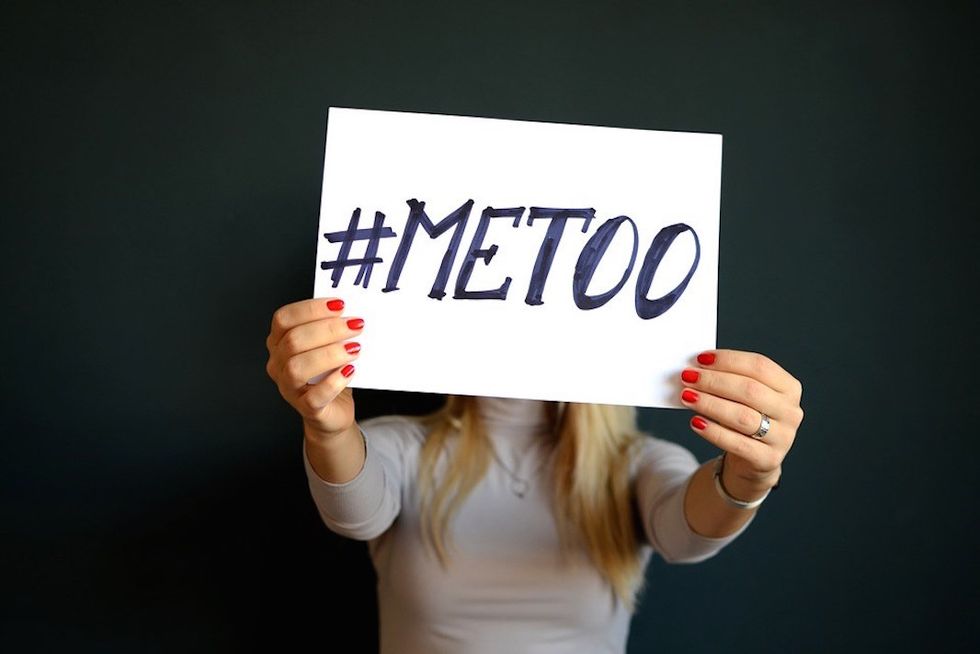
Within the past week, if you've been on Facebook or Twitter, chances are you've seen the hashtag "#MeToo." If you happen to click on that hashtag, it will bring up thousands upon thousands of people speaking about their own experiences with sexual assault, sexual harassment, any type of sexual violence or people supporting them.
The movement started after allegations surfaced against Harvey Weinstein, a Hollywood Producer and co-founder of Miramax Films and also The Weinstein Company. While the hashtag didn't go globally viral until actress Alyssa Milano tweeted about it, it was started ten years ago, by a woman named Tarana Burke. She is the program director for Girls for Gender Equality, an organization out of Brooklyn, New York, working towards empowering young women of color.
While it started its life among mainly a community of young women of color, help from Milano's tweet quickly spread it to men and women, of any age, of any race, ethnicity, and creed. The hashtag has become a way of showing solidarity among people who have gone through similar traumatic experiences, and to show how common sexual assault, abuse, and harassment really are. The numbers are staggering, and quite terrifying. According to an article published by CNN, that by Tuesday on Twitter, the hashtag had been used "more than 825,000 times," since noon on Sunday (article was published on Thursday October, 19). They continue in saying that on Facebook in 24 hours, 4.7 million people worldwide took part in the "#metoo" movement and that there were over "12 million posts, comments and reactions."
Before continuing, it's important to define a couple of terms.
-Rape culture is defined by Oxford Dictionary as "A society or environment whose prevailing social attitudes have the effect of normalizing or trivializing sexual assault and abuse."
-Sexual harassment as defined by Oxford Dictionary as, "Harassment (typically of a woman) in a workplace, or other professional or social situation, involving the making of unwanted sexual advances or obscene remarks." (*The important word to note in this definition is the word "unwanted")
-Street harassment is "Gender-based street harassment is unwanted comments, gestures, and actions forced on a stranger in a public place without their consent and is directed at them because of their actual or perceived sex, gender, gender expression, or sexual orientation." This source also continues on to give examples of street harassment such as, "unwanted whistling, leering, sexist, homophobic or transphobic slurs, persistent requests for someone’s name, number or destination after they’ve said no, sexual names, comments and demands, following, flashing, public masturbation, groping, sexual assault, and rape."
As a young woman, I've had my fair share of cat-calls and lewd comments made towards me. I've been followed down the street by a car full of twenty-something year old guys. They shouted at me, whistled and asked if I needed a ride. When I said no, they continued to ask, and began making jokes about who's lap I would have to sit on and who would become aroused the fastest. I was completely alone and defenseless. In the mall, on the streets, and in the hallways of school even, I've been whistled at or had comments made towards me, and It honestly makes me uneasy to go places alone. I try to go places with a group, or with a male, because I know it will be less likely for someone to try anything if I'm not alone. It's unsettling, scary, and something that I definitely did not welcome. Luckily for me, that's the extent of my experiences. For so many others however, the harassment goes beyond what I can imagine, crossing lines into abuse and assault.
One thing that I find incredibly heartbreaking, but also empowering, is the sheer amount of people that can relate to the same situation and set of circumstances. This hashtag is bringing an entirely new awareness to the problem of sexual harassment, assault, abuse, and to rape culture in general. Both men and women experience these situations, but only about 50% of rapes and or sexual assault were reported, according to Rape Response Services. They also found that "One in five women has been the victim of attempted or completed rape in their lifetime. Nearly 1 in 2 women have experienced sexual violence other than rape in their lifetime." They also report that, "1 in 5 men have experienced a form of sexual violence other than rape in their lifetime." These statistics are staggering, terrifying, and eye-opening. Many victims are too afraid to speak up about what happened to them, but this hashtag allows them to see the community rallying around them, even if they choose to not share their story.
This movement goes beyond any other movement that I can remember. The sheer outpouring of solidarity, love and support is truly awe-inspiring. It brings to light a critical issue in our society, one that men and women alike face on a daily basis in this country and around the world. Chances are, you know someone that has been the victim of some type of sexual assault, harassment, or abuse. Facebook statistics show that "more than 45% of people in the United States are friends with someone who's posted a message with the words 'Me too.'" This movement is another cry for help to push for an end to this kind of behavior. It is bringing light once again to the incredibly dark topics of sexual violence, sexual assault and sexual harassment. Times have changed, as have viewpoints and attitudes. The culture surrounding rape, sexual violence, and harassment have not. It's up to us to make the difference.
#MeToo