

What do we perceive as a “beautiful day”? Is it the clear, blue sky accompanied by a radiant sun? Probably so.
However, most of us are clueless about the real reason the sky is actually blue. Why blue as opposed to any other color? You might be thinking of the simple answer that most people commonly and erroneously spread: the sky is blue because it reflects light from the oceans, thus giving it a similar color to that of the ocean. Negative. As a matter of fact, the real reason the sky is blue has to do with our atmosphere, light, and human sense perception; so brace yourself for a scientific journey!
1. The Particles in Our Atmosphere:
This is probably the largest contributor to the color of our sky, as the majority of the molecules that create our atmosphere—primarily Oxygen and Nitrogen—are microscopic particles. The size of the particles is extremely important in creating the sky’s blue appearance, as small particles tend to have more contact with types of light that typically have short wavelengths.
2. Properties of Visible Light:
Visible light, or more simply known as the different colors we see such as red, blue, yellow, etc., is divided into a spectrum that is organized based on wavelength (distance between wave peaks that determines how close waves are together) and frequency (number of times a wave travels up and down in a second). Because light is a wave, it will exhibit these properties which consequently help us to distinguish the visible light. Nevertheless, in explaining the color of the sky, the wavelength is the important aspect, so the frequency of the light is not really taken into account. According to the spectrum, red light has the largest wavelength whereas blue light has the shortest wavelength after violet light. Therefore, as stated previously, the molecules in our atmosphere will mainly collide with the types of visible light that have the shortest wavelengths, namely blue and violet, and subsequently scatter blue and violet light into the atmosphere, formally known as Rayleigh scattering. So that explains why the sky is not green, yellow, orange or red, but why is it not violet then? Blame yourselves for not seeing a purple sky.
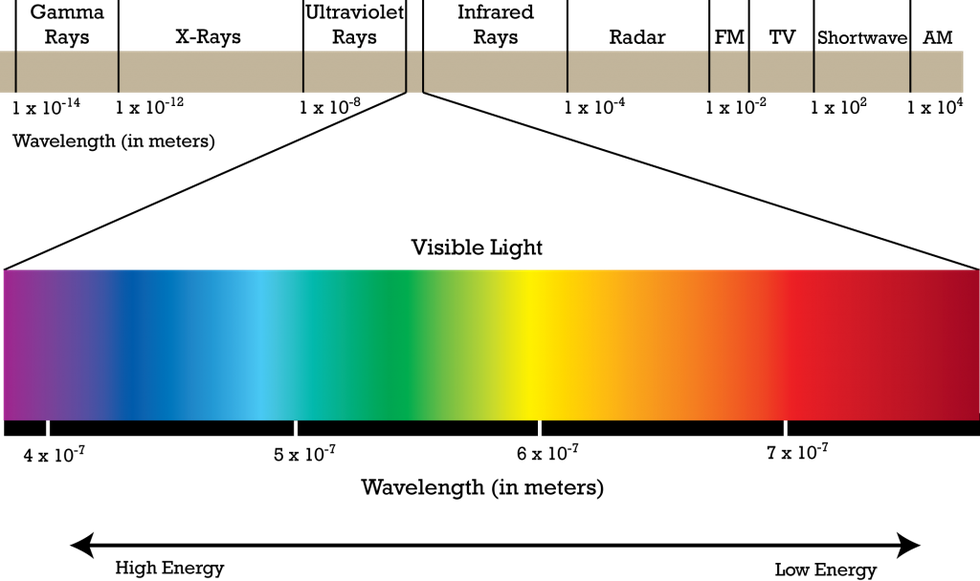
Image Credit: blog.luxexcel.com/printed-optics/light-spectrum/
3. Human Limits:
The final key to unlocking the secret of the sky’s color lies within our own bodies—particularly our eyes. Without a doubt, our eyes serve as our windows to the outside world, allowing us to view both unsightly and beautiful things, but they are not perfect. Although other animals may have the ability to do so, we cannot see everything that the world offers us with ease, and we may even lack the ability to see a particular phenomenon at all. Indeed, violet light falls under the category of difficult sightings, and it is for this reason that we see the sky as blue instead of purple, since blue light is more easy to detect than violet light. Therefore, although violet is being scattered more than blue light due to its extremely short wavelength, our eyes are less sensitive to violet light than blue light and thus display the next type of visible light that is most dispersed in our atmosphere: blue light.
The true reason as to why the sky is blue might be a lot to absorb, but it is better to make the painstaking effort of understanding it than sharing false knowledge with other people. So next time a child—or a person of any age—asks you “why is the sky blue,” do not hit them with the “short and sweet” (not to mention incorrect) explanation. Instead, be prepared to enlighten them with a load of exciting physics and human physiology.