
Ethics: the discipline dealing with what is good and bad and with moral duty and obligation, as stated by the Merriam-Webster online diction. That seems like a good thing, a thing that someone should strive to have a good set of, right? Various jobs, from Psychologists to Auditors have a board and code of ethics that they must follow and answer to, making sure they act in just a right ways. Everyone has some sort of code that they live by, right? So it only makes sense that our government does the same. In fact, it has two such: the House Committee on ethics, which was known as the Committee on Standards of Official Conduct before the 112th session of Congress, and the Office of Congressional Ethics, which was formed in March of 2008.
It might seem redundant to have two different offices deal with the same thing, but in reality, they do slightly different things. The committee is a board, made up of five democrats and five republicans, and does the following, amongst other things, according to the committee's website
"A) Recommend administrative actions to establish or enforce standards of official conduct.
B) Investigate alleged violations of the Code of Official Conduct or of any applicable rules, laws, or regulations governing the performance of official duties or the discharge of official responsibilities. Such investigations must be made in accordance with Committee rules.
C) Report to appropriate federal or state authorities substantial evidence of a violation of any law applicable to the performance of official duties that may have been disclosed in a Committee investigation. Such reports must be approved by the House or by an affirmative vote of two-thirds of the Committee.
D) Render advisory opinions regarding the propriety of any current or proposed conduct of a Member, officer, or employee, and issue general guidance on such matters as necessary.
E) Consider requests for written waivers of the gift rule (clause 5 of House Rule XXV)"
Seems like all good things, right? Well, in an effort to clean up and make this process more transparent, the Democrat-controlled congress formed the independent board, which consists of eight people who do not work for the government, as the Wall Street Journal describes. Now, this office does not replace the committee, in fact, they are supposed to work together. All this does is allows the public to be informed of investigations on their representatives, run independent investigations, and then transfer their findings to the house committee. In case you got lost, here's a nifty little diagram, found on the office's website:
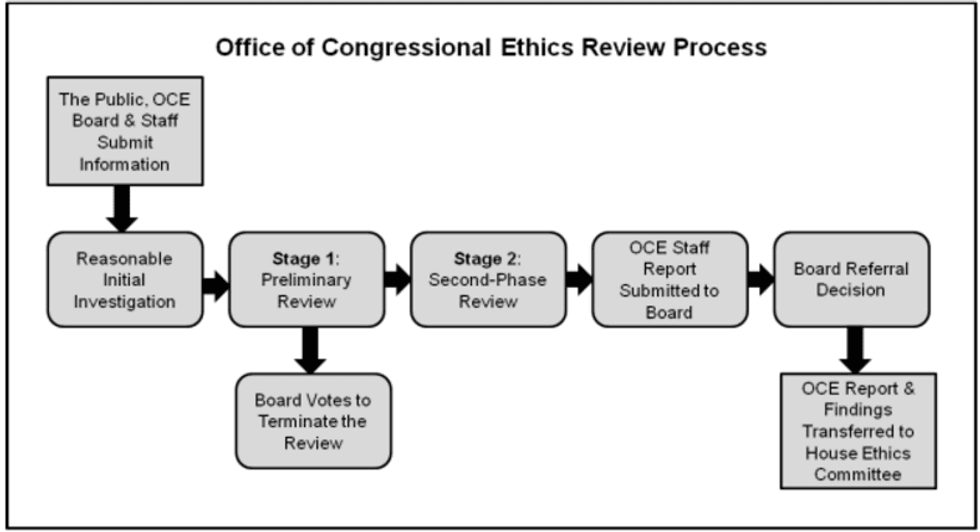
There's a few other neat diagrams that I suggest you take a look at. Now, you may be asking yourself at this point: "What's the point?" Well, lawmakers have often claimed that the process is "too aggressive," according to the Wall Street Journal. So, in an effort to take control before Trump becomes president, House members voted to put this office under the control of the Ethics committee. With this, the ethics committee could stop any investigation by the office, limit the amount of information released, and would no longer take anonymous tips to investigate.
The mastermind behind this, House Judiciary Committee Chairman Bob Goodlatte (R., Va.), stated that it would not diminish any of its effectiveness, and would help in its work. However, it seems a little odd to me that putting the independent reviewer under house control, the very people it may be investigating, will not hamper any of its effectiveness. Having to answer to the people you are investigating makes no sense to me. I guess you can add this to the things the government does that are backwards, like redistricting (an article for another time).