
It still shocks me when I talk to people who live in Michigan but have never been to the city of Detroit. There is this strange phobia of the city that is incredibly difficult for me to comprehend. Yet, when I put myself in the shoes of the average person, it is easy to see what drives the fear of the city I love.
Although media reports of Detroit have recently improved, many still view Detroit as a wasteland, polluted by violence and drugs. They still see it as the city abandoned by current suburbanites, a city full of racial tension and corrupt leadership. This is what years and years of negative reporting and admittedly bad authority does to a city.
I am not writing to confirm the negative stereotypes of Detroit, nor deny that there are still problems. Detroit has a long way to go, but it will also never be the same city that was driven by and partially ruined by the success of the auto industry. Detroit is reinventing itself for the better by becoming much more diverse in its opportunities.
Detroit has too many success stories for me to address all of them, but I will address a few. First, there is Midtown. Detroit is an extremely vast city. To prove this, Manhattan, San Francisco, and Boston ALL fit within the expanse that is Detroit. Midtown is just one of the distinct neighborhoods that occupies all of that space. It is home to Wayne State University, the Detroit Institute of Arts, the Charles H. Wright Museum of African American History, the Motown Museum, and many other entertainment and educational hubs. It is also home to bustling array of hot restaurants. A recent Washington Post article by Mark Guarino is entitled, "One of the country’s poorest cities is suddenly becoming a food mecca." Soon, the Midtown district will be connected to Detroit's Downtown district by the M1 Rail, which is a streetcar that will operate on a 3.3-mile loop.
Detroit's Downtown district is undoubtedly the area in which business, pleasure, and innovation have flourished most observably. A big contributor to such success in business mogul, Dan Gilbert. According to Forbes, Gilbert has spent "$1.8 billion to buy and renovate more than 75 downtown buildings, as he works to create a tech and entertainment hub in the Motor City." His company, Bedrock Real Estate, is plastered over a substantial number of buildings within the city's core, and his generosity to the city has been well received. A landmark within the Downtown area is Campus Martius Park. During the winter, it is the home of a beautiful skating rink that is lit up by an elaborately-adorned Christmas tree during the holiday season. In the summer, it is transformed into a lunchtime oasis. Every day, a new band comes to entertain those trying to soak up some midday sun. There is also a tiki bar surrounded by sand to help people escape the workday blues. Feeling more active? Join a sand volleyball or basketball league at the courts located within the park. I've heard many say that they cannot believe they are within the city of Detroit that they hear about on the news. I wish sensationalism captured the beauty of the city instead of trying to tear it down.
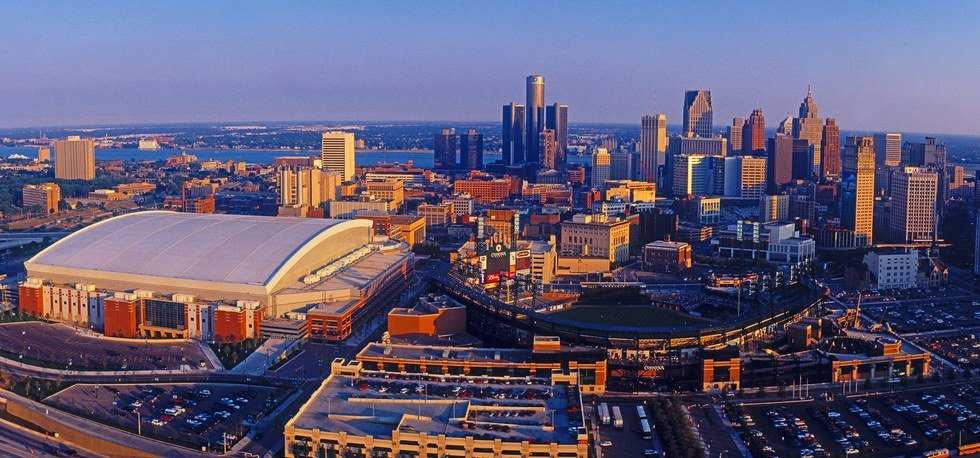
There will soon be another district that Detroiters can call their own. Detroit is affectionately known as Hockeytown U.S.A., and the passion for the sport runs thick in Detroiters' blood. Joe Louis Arena is the current home of the Detroit Red Wings, the city's NHL franchise, but it is getting increasingly weathered at 37 years old. Instead of renovating Joe Louis Arena, longtime Detroit franchise owner Mike Illitch proposed the new District Detroit that would further rejuvenate the city. According to the project's website, "The District Detroit will be 50 blocks of thriving businesses, parks, restaurants, bars and event destinations. It will be home to the young and the young at heart, families, new residents and long-time residents who want to be where the action is." The best part of the endeavor is its efforts to give back to the residents of Detroit. For the building of the arena, Illitch vowed that at least 51 percent of the jobs would be filled by Detroiters, and he aims to hire a majority of Detroiters when the new entertainment district is up and running. It is only fitting that Detroiters are rewarded for their resiliency and pride in their city.
The future is so bright for the city of Detroit. As someone who grew up only 20 minutes outside of the city limits, I have been able to witness the slow but exceedingly noticeable transformation. The influx of bright, young entrepreneurs is exactly what Detroit needed to kickstart its economy, and passion is what is needed to make significant and longstanding change. Change is not always easy and not always immediately gratifying, but it makes me believe that Detroit can be great again.