

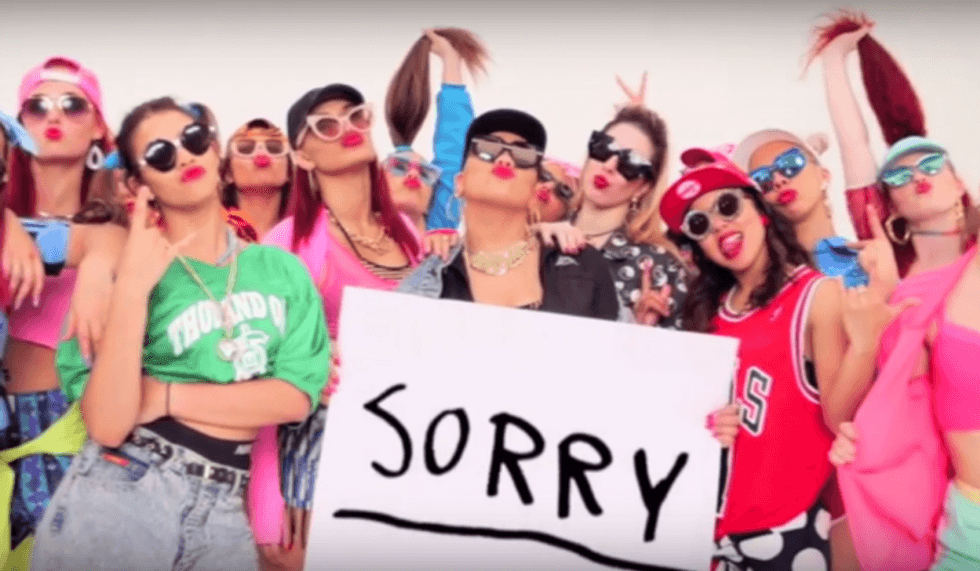
In 2014, Pantene launched a video depicting the tendency of women to over apologize, especially in situations where apologies are not even warranted. How many times has this happened to you: someone bumps into you on the sidewalk, and suddenly the word “sorry,” is flying out of your mouth before you can even reclaim it? I distinctly remember backing out of my driveway this summer, checking my rearview mirror, and seeing that the coast was clear. Out of nowhere, the renter across the street decided to go full throttle out of his driveway, almost taking out the back of my beloved CRV. As I awkwardly let him go, he paused on the side of the street to let his son, probably a permit driver, get behind the wheel. I waved, muttered a “Sorry,” and proceeded to drive down the road. Why was it that I was so compelled to apologize for something that wasn’t even my fault? To be honest, part of me hoped that he would acknowledge my apology and respond with one of his own. I was sadly mistaken.
As I continued to drive to work on that hot summer day, I got angry, but even more so, I was confused. Why had I apologized? His self-assured nod of dismissal to me replayed on a loop in my brain. By saying sorry, I was affirming the universal tendency for women to continuously apologize. I can’t tell you the amount of times I’ve stated, “Sorry, I have a question,” when I walk into a professor’s office hours, or “Sorry, I don’t mean to be annoying, but do you mind if you push in your seat? I can’t get by,” in the dining hall. Sorry, sorry, sorry.
“The thing with sorry is,” my roommate Jane always tells me, “Is that when overused, it begins to lose its authenticity. The more you say it, the less you mean it.” The more you say it, the less you mean it…what a concept. You see, when sorry becomes a filler word, the genuine apologies we give or receive run the risk of being disingenuous. Sorry becomes something we say in passing, something to mask our insecurities, and often times, we stick this word in front of a sentence solely to avoid being seen as a bitch. Is that our greatest fear then? Fear of how we are perceived? Let it be known that there are many who do not fall into this category, and can move about life without uttering the filler-word “sorry.”
However, for the rest of us, maybe if we didn’t care as much, we wouldn’t find ourselves apologizing nearly as much as we do. But telling girls not to apologize is like trying to reverse a universal stereotype: it is ideal, but it is not always plausible. We all want to change the world in a certain way, as cheesy, cliché, or redundant as that sounds. So maybe, the next time someone cuts you off in the supermarket, or bumps into you on the crowded subway, contain your squelch to apologize, and see what happens. Because apologizing just to avoid confrontation, or to maintain a kind image will ultimately make you a pushover, and I speak from experience. I’m usually not one for New Years Resolutions, but I am one for improving myself. Therefore, this year’s project will be to cut down on the apologies, that way, when I mean it, I mean it.