64 teams. 63 games. Cinderellas, All-Americans, buzzer-beaters and upsets. March Madness is great. But when billion dollar challenges, office pools, and small campfires of broken brackets get involved, March Madness becomes a monthlong Super Bowl. Every year millions of brackets are submitted, from casual fans to college basketball fanatics, and all seem to be the perfect bracket. Then the first game is played and half of the brackets become three point shots crumpled up in the trash. Although there has never been a perfect bracket submitted, America is still fascinated with the idea of filling out NCAA tournament brackets. But what is the key to crafting the perfect bracket?
Expert Opinions
Many sports analysts dedicate their careers to studying college basketball. Bracketology is a science and ESPN’s Joe Lunardi is its Einstein. He watches the games all year to help determine who gets in the tournament and what seed they will be and once it is announced, determines the best possible bracket based on analytics, the eye-test, past tournaments, RPI which no one really understands, and anything else imaginable. In the three days between bracket release and the beginning of the tournament, all the so-called experts will be somewhere explaining why their bracket makes sense. You could go with trusting one of these or combining some aspects from many different “experts,” but keep in mind March Madness is just that, mad, meaning what usually happens in unexpected and unthinkable if the possibilities are mapped out rationally.
Best Offense/Defense
One solid way to decide close matchups is looking at the stats, particularly points per game. You could decide to always pick the highest scoring offense or the stingiest defense or a combination of both. Take a look at these, use them to estimate the margin of victory and go with the largest value. These statistics are usually available when filling out your bracket.
Recent History
Scared to trust Villanova or Kansas who have been upset-prone in recent years? Still haunted by the two 13 seeds who made it to the first weekend last year? Those who ignore history are doomed to repeat it, so looking at past tournaments is not a bad idea. Certain statistical facts are usually provided by ESPN when filling out a bracket such as the fact that a number one seed has never lost in the round of 64.
Coin Flip
The greatest decision-making tool of all time, the Coin Flip. Heads for the higher seed, tails for the lower seed or however you decide. Flipping a coin provides a non-biased way to decide any matchup with 50-50 odds.
Most Storied Program
Choosing Duke, UNC, Kentucky or Kansas is a good bet since these are renowned programs across the nation. Choosing teams with a history of winning is never a bad idea. Schools that have proven themselves repeatedly to be the best have a better chance of winning than a team that has never made it before, BUT… there is always a first time.
Tough Mascots
Another option for deciding those tough games could be to choose which mascot would win in battle, because otherwise what is the point of having a mascot but to intimidate the other team? This is proven to be fairly successful. Just think, the best SEC basketball teams? Wildcats and Gators. Spartans in the Big Ten, Blue Devils in the ACC; the idea is perfect. It nearly worked for my bracket two years ago as the Cyclones from Iowa State lost to UCONN which went on to win the title. I mean what could fight a Cyclone?
Tallest
Height is valued more in basketball than any other facet of life, unless you are a giraffe and your diet depends on it. It seems obvious that the tallest guys should win, just like in fifth grade. When you’re the tallest you can just stand at the basket and block every shot, hold the ball over everyone’s head, and dunk anytime you want. So when you fill out your bracket and can’t decide who to choose, see which team has the tallest average height.
Chalk
Just picking the best overall team every time isn’t a bad strategy, they’re supposed to win. I mean no one is picking Valparaiso to win it all, so why should you? And hey, if you pick the team that is supposed to win every time, when your bracket fails, you can blame it on the team for underperforming rather than your lack of creativity.
Upsets
Just picking the underdog every time isn’t a bad strategy either, there are huge upsets every year. I mean no one is picking Valparaiso to win it all, so why shouldn’t you? Imagine if they did, you would be the talk of the town, “hey there’s the guy who picked Florida Gulf Coast, he’s a basketball genius.” You might not win the bracket challenge, but when the big upset happens, you can say you saw it coming. And hey, if you pick the underdog every time, you can blame it on the lack of excitement in the tournament rather than your lack of basketball knowledge.
Best Individual Player
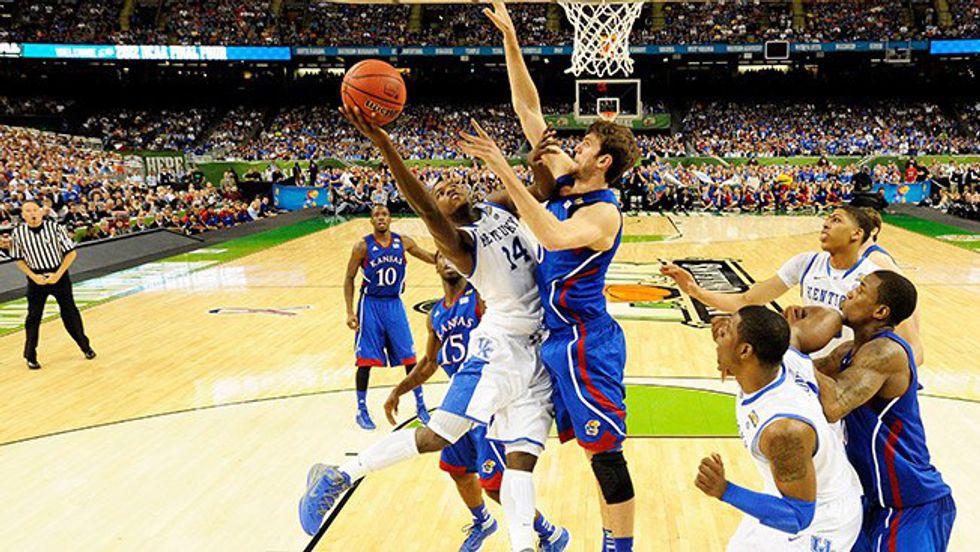
Jahill Okafor, Frank Kaminsky, Jimmer Freddette, Anthony Davis. With only five guys playing at a time and around 14 people on a team, basketball is the sport with which one player can take over a game or even an entire season. And in college basketball, where the talent range is so vast, it becomes even easier for one player to win a game for his team. Chances are in basketball, if you have the best player available, you are one of the better teams regardless of the other players, unless it’s LSU and Ben Simmons.
Best Coach
You can have the best players around, but without a coach, the team has no direction, unless you are Kentucky and your coach gets ejected three minutes after the tipoff, in which case you win by 20 anyway. A good coach puts his players in a good position to win and thus the better of the coaches betters his team’s ability to win.
Closest to Home Court
Teams ranked No. 1 this season are 7-7 on the road. With no home games for any team during the tournament, some fans travel across the country to support their team. But many fans make their decision based on the distance. Having the majority of the crowd on your side certainly helps. It could pay off to do the research and see who is closer to the neutral site, because nothing is perfectly neutral.
Pick Cinderella
Every year there is a story, a team that shouldn’t be in the tournament that ruins someone’s championship hopes. But unlike your every day upset, the team keeps winning. Next thing you know it’s a movement. Any fan at the game not committed to a team hops on the bandwagon. Florida Gulf Coast, Butler, Davidson, Wichita State, they become the story of the tournament and everyone’s favorite. The problem is finding the Cinderella before they get to the dance.
You have now been armed with all the information and ideas for how to fill out your bracket. These ideas are much more than enough to be considered. One should not base their bracket decisions based solely on one of these strategies, but a combination of all of them, or maybe just some of them, or even none of them. There are even more ideas that can be used that I don’t recommend. I have even watched a bracket be picked solely on the attractiveness of the players, although the results were not so attractive. That’s what is so great about March Madness, why we are so fascinated with watching the games and filling out brackets. If anyone could predict the perfect bracket, it would no longer be fun to try. The fact is that none of these ideas work, that’s the beauty of it. People now are afraid of failing so much that they would rather not try than fail, the bracket challenge is part of a dying art in society and needs to be appreciated.
But what strategy should be used to craft the perfect bracket?
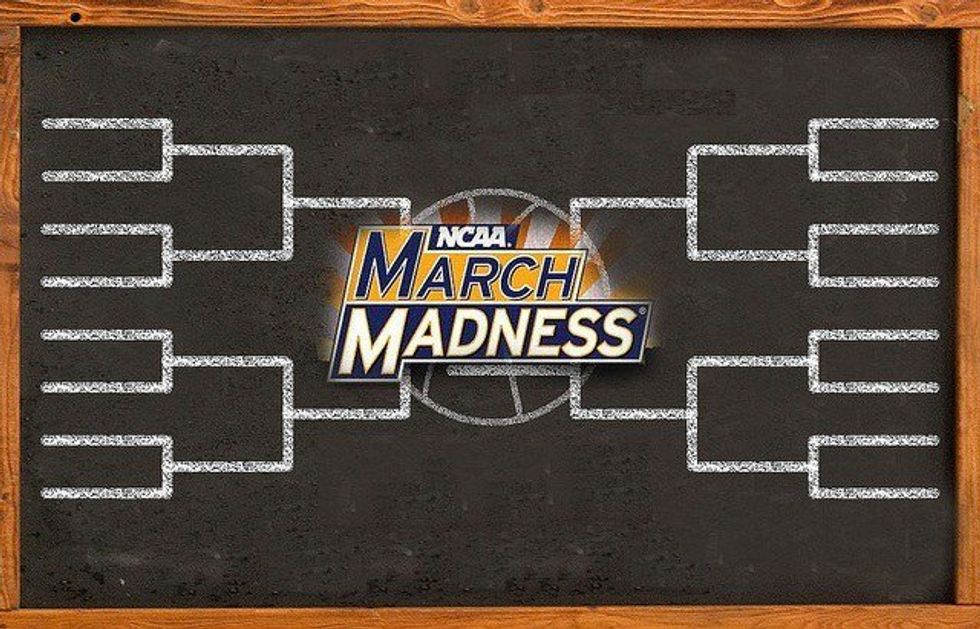
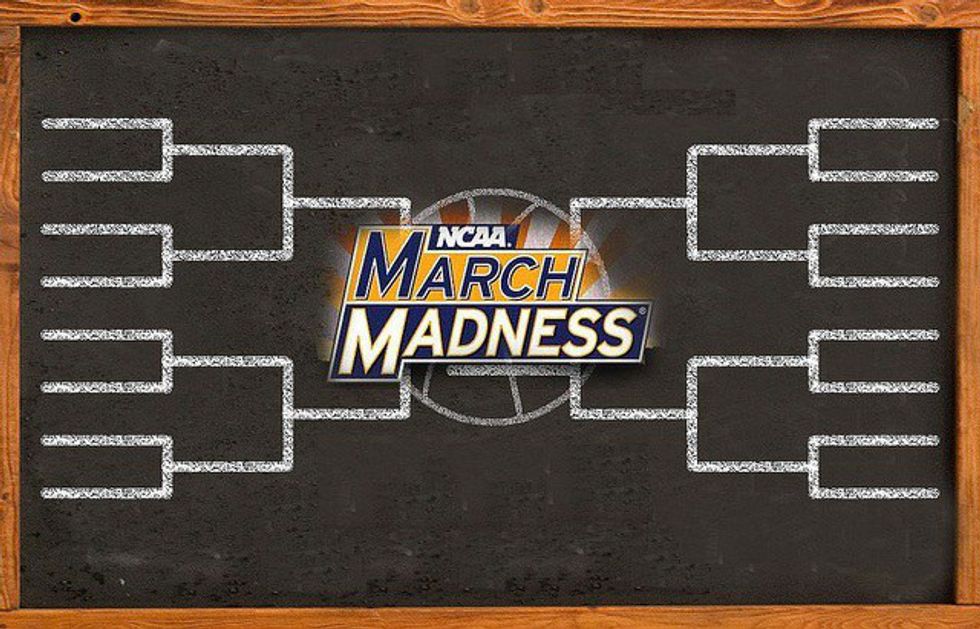
Still unsure which strategy to use. What better way to decide than, well… a bracket?
The Bracket
No. 1 Heads-Tails vs No. 16 Coolest Uniforms
No. 2 Chalk vs No. 15 Upsets
No. 3 Best Mascot vs No. 14 Tallest team
No. 4 Expert’s Advice vs No. 13 Pick Cinderella
No. 5 Highest Scoring Offense vs No. 12 Homecourt Advantage
No. 6 Famous Alumnus vs No. 11 Simulate using Fifa
No. 7 Best Scoring Defense vs No. 10 Let the Pet Decide
No. 8 Best Individual Player vs No. 9 Most Attractive