

I recently wrote a controversial article that slightly delved into the stigmas against mental illnesses, specifically eating disorders. I wrote about some "jokes" that Meghan Trainor made about anorexia nervosa, the mental illness with the highest mortality rate. Meghan Trainor aside, I realized in the comments of my article how many people actually support the stigmatization of eating disorders. It's disturbing how many people think that it is OK to mock or joke about mental illnesses.
It doesn't matter what the mental illness is, anxiety, OCD, anorexia, bulimia, depression, etc., it is simply not right to joke about it. Perhaps this stigma against mental illness is why four students committed suicide at my high school this year. People tell clinically depressed people to "cheer up," but let me clue you in -- they can't cheer up any more than an anorexic can "just eat."
Jokes about eating disorders hit far too close to home for me. I'm sure they also hit too close to home for the 13.5 percent of athletes who have subclinical or clinical eating disorders, or the 43 percent of female athletes in aesthetically demanding sports who have eating disorder tendencies or 25 percent of college-aged women who use a binge-purge method to control their weight. Is anyone laughing at those numbers? I'm not. How about the fact that only one-third of people suffering from anorexia actually obtain treatment in the United States, yet anorexia kills 4 percent of it's victims? The stigmas surrounding eating disorders probably prevent many from ever getting the help they need.
Somehow, despite all these awful statistics, people commented on my article telling me that "it's no big deal," and that I need to take a "chill pill" and "learn to take a joke." I don't think anyone should ever learn to take a joke about eating disorders -- or any mental illness, for that matter. They aren't funny in the slightest way.
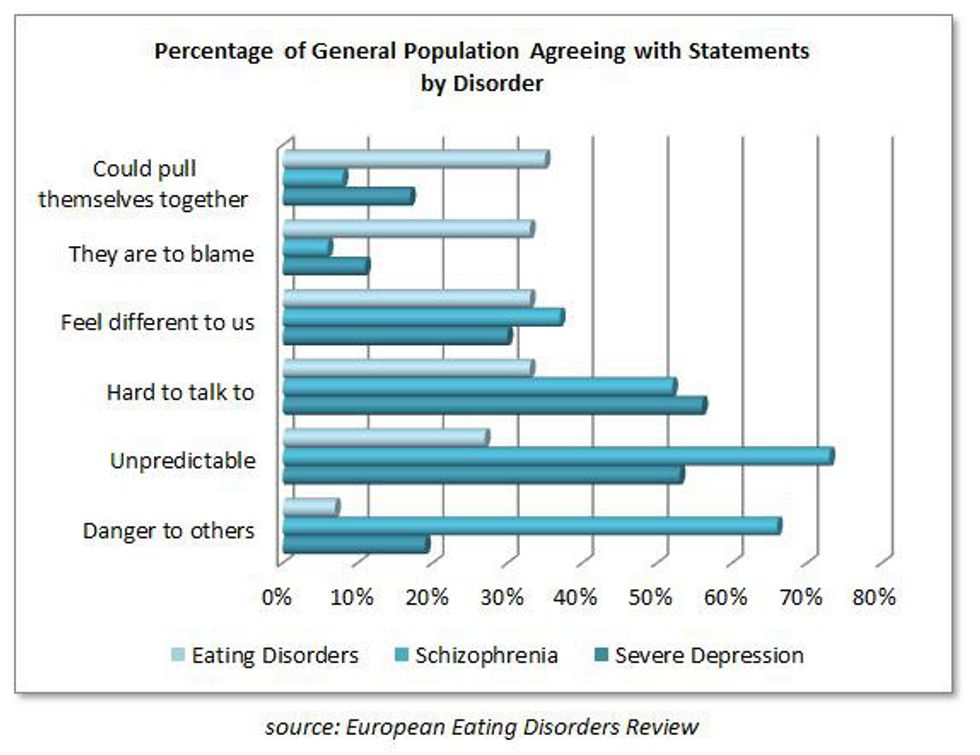
People told me that I was only upset by these "jokes" because I needed therapy for my issues with my low self-esteem and body confidence because I cannot expect other people to avoid my "triggers" because it wouldn't solve my "struggle." Joking about eating disorders doesn't trigger me to restrict my caloric intake to 200 calories, again, or run 10 miles before my classes, but it does trigger me to tell others that joking about any mental illness is just not OK. For instance, 44 percent of college students are depressed, yet the stigmatization of mental illness prevents 75 percent of them from ever getting help. People don't understand that there are certain biological factors in someone's brain that cause depression. Instead of trying to understand depression, people just tell the sufferers to "cheer up." That might be the reason that that there are more than 1,000 suicides on college campuses, alone, every single year. The chart below shows frightening statistics about how the general population's perception of mental illnesses.
I know that I have my own problems that I definitely do need to work on. I've battled many demons in my head, but I know that I am not the only one who has because so of my many bright, beautiful, and talented peers have struggled with mental illnesses. Anorexia isn't a choice. Anxiety isn't overreacting. OCD isn't the same as being a neat freak. Having depression doesn't mean you are weak. These are all difficult battles to fight and it would be nice if society would stop making jokes about them and offer those suffering a helping hand.
When society treats the person suffering from a mental illness as the problem, the victim begins to believe that they are the problem, too. I know this because I've been there. I wanted everyone to think that I was perfect and I believed that if people knew that I wasn't really happy, it would make me imperfect. As a result, I kept my feelings to myself while my mind tried to kill me from the inside out. A depressed, anxious, or anorexic person is not the problem, the chemical imbalances in their brains are the problem. No one is perfect and I just hope there will be a day when our society shows more empathy. It absolutely must be OK to ask for help.
I've been an Odyssey content creator for almost a year, and I think this might be the most important article that I have ever written. I will not "take a chill pill" because I am going to defend what I believe in. Mental illnesses are not a laughing matter.