
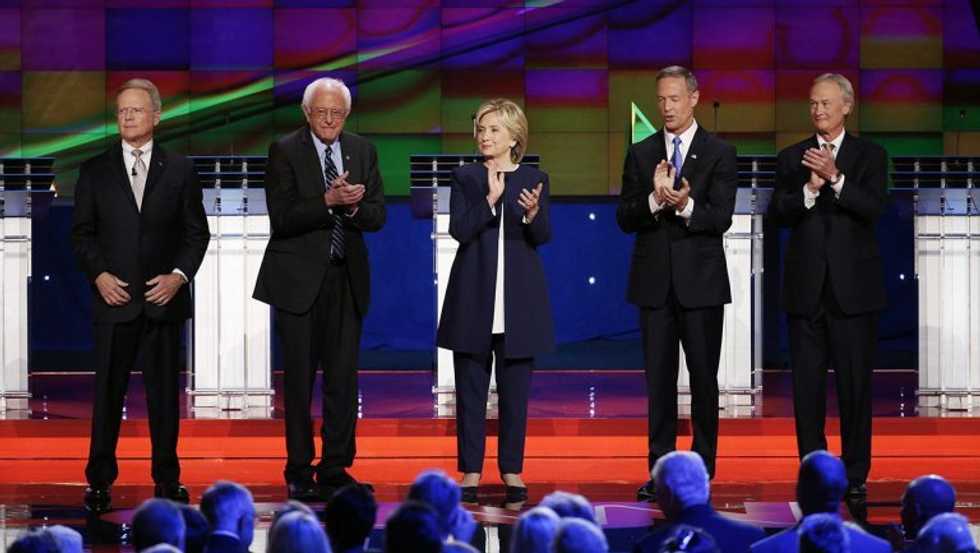
On Oct. 13, the world got to see the first debate of the Democratic candidates for President of the United States. For those who have been following this presidential race as closely as I have, this debate came as a welcome change of pace from the previous Republican debates, with upwards of 10 loud candidates all vying for their turn in the spotlight, with a generous helping of Trump sprinkled in. This debate showed us instead the only five Democratic candidates hashing out the real issues currently facing our nation.
At its beginning, we as an audience were introduced to the candidates; former Rhode Island Governor Lincoln Chafee, former U.S. Senator from Virginia Jim Webb, former Maryland Governor Martin O'Malley, U.S. Senator from Vermont Bernie Sanders, and former Secretary of State Hillary Clinton. Each candidate began with the usual pitch of what exactly set them apart and made them the best choice for president.
Chafee, Webb, and O'Malley spent a great deal of time explaining who they were and why they were such great choices despite that all of them are currently polling far behind the other two candidates and even Vice President Joe Biden, who isn't even in the race. Sen. Sanders spent a large portion of his introduction discussing his core stances on race relations, education, and wealth distribution in our country, and once again proved he was unafraid to show his socialist side to the masses. Clinton used her time to explain how she would maximize our nation's wealth inequality, and bring about a time of higher wages and more grand opportunities for the youth of our country, while managing to skillfully maneuver around the fact that she's married to a former president.
All in all I found all the candidates' introductions to be very strong, genuine, and clear showings of who exactly each of them were and what set them apart from the others. With how much content was covered in the debate, I would be remiss to try and discuss every topic and how each candidate reacted to them, so I'll try to give a basic overview of how the candidates performed overall.
Clinton had a fairly strong showing throughout the debate despite almost constantly facing the criticism of both moderator Anderson Cooper, and her fellow nominees; she was put on the defensive time and time again, and almost always managed to finish her statement on the offensive. Clinton was always confident in her answers and never faltered when it came to discussing her views, never compromising her position to appeal to more supporters as she had been criticized for doing before. Something she said that really stuck with me was that she was "not campaigning because her last name was Clinton," but because she has what it takes to beat the Republicans.
Sen. Sanders showed once again his resolve and conviction in his cause, never pandering to his supporters or giving in to attacking his fellow candidates. At one point in the debate, Sanders interjected during a discussion regarding Clinton's email scandal saying, "the American people are sick and tired of hearing about your damn emails," going on to say that we as a nation have far too many greater problems to be constantly worrying about how Clinton managed her emails. He played his usual hand of criticizing the current state of wealth distribution and racial integration in our nation, suggesting that we instead set ourselves up to be more like the progressive European nations of Sweden or Denmark in terms of our domestic policies. In addition, Sanders drew a major positive response when a question was posed as to whether black lives matter or all lives matter, Sanders replied very simply and confidently, "Black lives matter."
O'Malley was perhaps the most well-spoken candidate on the stage. O'Malley always spoke on his topics very eloquently and had perhaps the most genuine responses of all of the candidates on that stage. He proudly highlighted the importance of the fact that the Democrats were finally debating and discussing the issues that really mattered to the American people, regardless of who was leading the polls at the time. What really wowed me about O'Malley was how he closed the debate by discussing how it was different from previous Republican debates; he said, "On this stage you didn't hear anyone denigrate women...make racist comments about new American immigrants...speak ill of another American because of their religious beliefs," and highlighted how the candidates instead focused on, "...an honest search for the answers that will move our country forward." He may not draw high numbers in the polls, but O'Malley gained a great deal of my respect with that closing remark.
Jim Webb was interesting. Despite getting very little time to discuss his candidacy, a disadvantage which he was sure to point out on many occasions, Webb did not waste the time he had. He focused on putting the spotlight on his accomplishments both in and outside of politics,
and seemed to always be trying to set himself apart and highlight his time in the armed forces as well as his time working as an author and journalist. Webb further focused on his political resolve and his ability to follow through on the goals he sets, where other candidates would draw in support with rhetoric and false promises. Oh, and he even spoke lightheartedly about how he killed someone, that was pretty neat.
Chafee was the black sheep of the group. Polling at less than 1 percent support, Chafee was almost always on the defensive, much like Clinton. The only difference was that he rarely ended up on offense. Time and time again Chafee was slammed with criticisms, and very rarely did he manage to properly refute them, mostly skirting around the issue, or offering very convoluted answers as a rebuttal. At one point Chafee had the gall to try and take the fight the Clinton, criticizing her ability to lead, and stating how the American people needed a different kind of politician to be president; when asked by Cooper if she wished to respond, Clinton simply smiled and replied, "No."
So that was this humble college student's attempt at summarizing the first Democratic debate. There were strong showings from most of the candidates, and a lot of responses that just left me shaking my head, (I'm looking at you Chafee). But overall, I feel that as before, Clinton and Sanders are clearly the two frontrunners for the Democrats, and that one of them will be facing off against the Republicans next fall. Still, the question is who exactly it will be, and only time will tell.

















