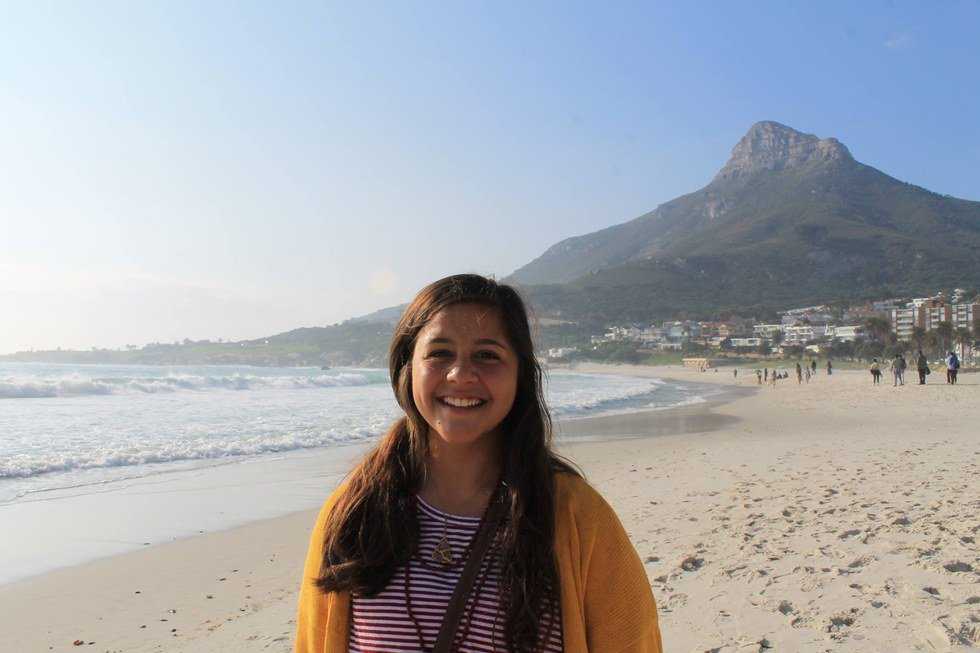
On one of the last days of our trip in Capetown, I found myself sitting on a couch, reading and journaling. After a few moments, I forgot where I was, while at the same time saying out loud, “I could live here.” When I signed up for the class in the spring, I had no idea that I would end up becoming so attached to not just the place but the people of South Africa. I was also very surprised to find how much the class impacted my entire experience while in Capetown.
The best way I can describe it, is the idea of the fourth wall. Being in Capetown, living, and seeing, and breathing in the city and what we saw of the country broke down the fourth wall that had been up during the school year. We read and watched and talked all semester about what South Africa has gone through in the last century and discussed what that means for us, or our values. I loved the discussions in the classroom, but have been completely awe struck by the conversations we had as a group while in South Africa, and the conversations that still happen while we are back home. Several things caught my attention while we were there, and caused me to question myself and my beliefs, the concept of “voluntourism,” the extreme poverty and the attitude of the people.
During our last weeks in the classroom, we had a bit of discussion over the concept of voluntourism or the “white savior” perpetuation that we see happening through social media and other accounts of mission trips and trips abroad. While in the classroom, it was so easy to condemn those “white savior” types with cliché captions on their instagrams about how much their lives had been changed by the nameless black children in their photos. It was easy to scoff at the ignorance and assume that we would be better. Through out the trip though, questions of how we were perpetuating this particular image infiltrated our trips to townships, the District 6 museum, and our day to day interactions with each other and the town. While in the townships, we were given tours by people who lived in a hostel in Langa, we were shown their room where they slept with six others. We were welcomed with open arms, and huge smiles by residents and children. We were the fascinating Americans and children gravitated toward us, asking for “selfies,” and holding on to our hands like they were never going to let go. It is a particular brand of community and kindness that none of us deserve. We were being loved on and held on to for simply being somewhere, a kindness that we would rarely grant others back in the States, or that would be granted to us. Our first instinct is to take pictures. I wanted to take pictures of the children whose love I didn't deserve but was given with no conditions. I wanted to take a picture of the townships to show my mom and dad, not how little they have, but how much they make of it. The townships value community, and do not have the space to waste on meaningless items. They use very intentional minimalism.
Voluntourism is yet another Western concept. I had an interesting conversation with Lilli because she wrote an article for the Odyssey on the subject. We worked at the Amy Biehl foundation for three days, which is enough to impact us, but not to necessarily change the lives of those around us. I think the perception of volunteerism is just as misguided as mission trips that go in with the idea that everyone needs saving. Thinking that our three day trip could seriously have a negative effect on the kids at Amy Biehl is just as silly as believing that we could change their lives in three days. We are not that special. We were constantly checking out privilege at the door, but its hard to check our perceptions as well. I am still not where I stand on the voluntourism aspect, because its not like there aren't millions of white people going into places and building wells where they are needed, Doctors Without Borders, and people going in to seriously learn and/or do service projects. I think everyone means well, and people aren't that bad. However, I do think there is a danger in voluntourism, not to necessarily to the people in the photos, but to the people posting photos.
It is us who perpetuate the stigma of starving children (not to say they don't exist, but they exist along with kids who are well fed, given opportunities and way cooler and smarter than us). It is us who perpetuate the idea that every non democratic, or newly democratic country needs our saving help, because obviously America must have it figured out...?! It is us who mean well, but do a disservice to the hosting community when we overestimate our impact. Lilli asked if I thought South Africans looked at us with cynicism and only saw white saviors, or if they hated Americans. But how can I answer this question? Of course there are people who are going to hate Americans, just as there are those who are going to love them. I mean, if everyone judged America based on Donald Trump, that would be pretty horrific. Americans are some of the most hateful people I know, hating for good and bad reasons, without reason, and sometimes just for fun. When we create static images of an entire nation of people, especially one as multifaceted and diverse as South Africa (TWELVE OFFICIAL LANGUAGES NEED I REMIND YOU), we do not move forward or to a place of better understanding. People in Africa have TV and radio and iPhones and know how to Whip and Nae Nae, and as our tour guide at Parliement exemplified, they probably know way more about how the American government and country works than people who live here.
There is not a surefire way to stop the voluntourism pandemic, because its been going on for ages, for various people, and is not a solely American creation. However, I think that the way we talk about and learn about other countries and people when we get back home is a way to increase our understanding and perpetuation of what a country is really like.
As we walked through Langa, I heard one of the people in our group say, “I could never live here,” or “I wouldn't be able to give people a tour of my neighborhood if it looked like this.” These observations struck me. I find that whenever I am in a foreign place, I usually end up asking the question, “Why don't we do that?” or “Why do they do that?” These questions feed my global understanding, and make me search for answers. In America, poverty is something shameful, we do not show off our food stamps and brag about fee waivers, because we believe very much in fierce independence, and see community as weakness. They have a saying in the townships that has cropped up in recent years, it is “vukuzenzele” which is Xhosa, for “get up and do it for yourself.” It is a burst of entrepreneurialism that has come into the townships and people. There are house shops and small groceries and salons where there used to be nothing. Many people have chosen to stay in their townships, even after apartheid because they see a need and they see an opportunity for them to vukuzenzele. They do not treat poverty as a source of shame, of something not to be talked about, because they see the ownership of their heritage and neighborhood as a way to make it better. Poverty is very prevalent in South Africa, with ever expanding township populations and a 25% unemployment rate, and poverty is still stigmatized. However, it is interesting to me to see how the townships have framed their poverty. I wonder what would happen if we stopped stigmatizing poverty in America?
In addition to the townships, the sheer population of homeless and beggars in Capetown made me very uncomfortable. It is when I am uncomfortable that I realize I am on the right track to something good. There were signs I saw in restaurants that said, “It is okay to say no to beggars.” Huh? Homelessness is such a huge problem, and hearing that people are encouraged to say no is confusing and morally tough. In Capetown, although it is huge, we saw several beggars over and over again, because they cover a lot of ground and begging is their job. Its weird. I don't even know if I learned something concrete about it. All I know is that homelessness isn't treated the same every where, and not knowing how to solve it makes me curious and a little frustrated.
The people we met in Capetown were incredible. They were kind, too kind to us ignorant Americans, and so ready to make us a part of their communities. For Amy Biehl I helped out with a “traditional” dance class, where I basically made a fool of myself in front of nine to eleven year olds for three days. I was nervous to go into a classroom where I was singled out by being American and then also knowing I would not be as great at dancing as them. However, I was welcomed by the dance teacher Simo, immediately who exemplified a hunger to always be learning. He taught dance classes for Amy Biehl part time and on his free time was a performer. The passion he attacked the class with was contagious, and if asked who was the best dancer in the class, he would answer that it was all of them.
The dances we did were dependent on a group dynamic, of everyone doing their best. All the movements had to be done together, and all that we had to do was show up. That was crazy to me because in America I grew up in a studio (which I love and value very much) which was very technical, and made a point to single out the best dancers or hardest workers, because that's the culture, its individually based. In this class though, it wasn't about the individual, it was about the group as a whole, which included me. In the last days, they performed a drama, which was mostly improv with a simple outline from which they would work. It was so incredible for two reasons, the kids switched in and out of roles, and adjusted the scenes for each person, and that it was mostly improv, and yet I could understand what was going on. They spoke passionately, loudly and proudly in Xhosa, telling the story of rich versus poor, and the coming together of two families to make a better Africa. Simo provided them with the outline, and let the kids work what truly became magic. It made me realize how much effort we put into being perfect and the same at home, but how much work could really be done when their isn't always a rigid structure to everything. With every new actor and every new scene or interpretation, the play became more concrete, more vivid and more powerful. I may or may not have cried a little. The kids did the play in their school uniforms, their only props being two chairs. A five scene play taking place in two homes, a school, and church, all done inside a tiny classroom by twenty kids.
At the end of the week, the boys in the class were calling me “tchomi” which means “friend” in Xhosa, while poking fun at my dancing and the way I pronounced words. The girls gave me hugs and kisses and a new name, Namhla (which is pronounced with a small click) a Xhosa word meaning “today”. I have never really loved nicknames, or variations of my name, but for some reason, being called Namhla struck me in my heart and soul, and I felt like kids who had known me for three days called me by my real name.
As we left South Africa, I couldn't promise an exact date of when I would be back, but I secretly whispered to myself that I would be back soon. The task at hand is tough, how do I bring back what I learned? One of my fears is that by losing proximity, I will lose my attachment. By losing sight of Table Mountain I will forget the lessons I learned. The task of taking a piece of Capetown back is a highly individual practice. I don't know what it looks like long term, but this is what I do know. I want to love the people in my life as recklessly and unconditionally as the kids in the townships. I want to check my privilege, not be ashamed of it, but to ask “what can I do with it?” I want to search for the answers to questions that make me uncomfortable. I want to be so present in each moment, that after three days I can know who I am. I want to seek a better understanding of the world around me through discussions like those I had, and compassion and humility.