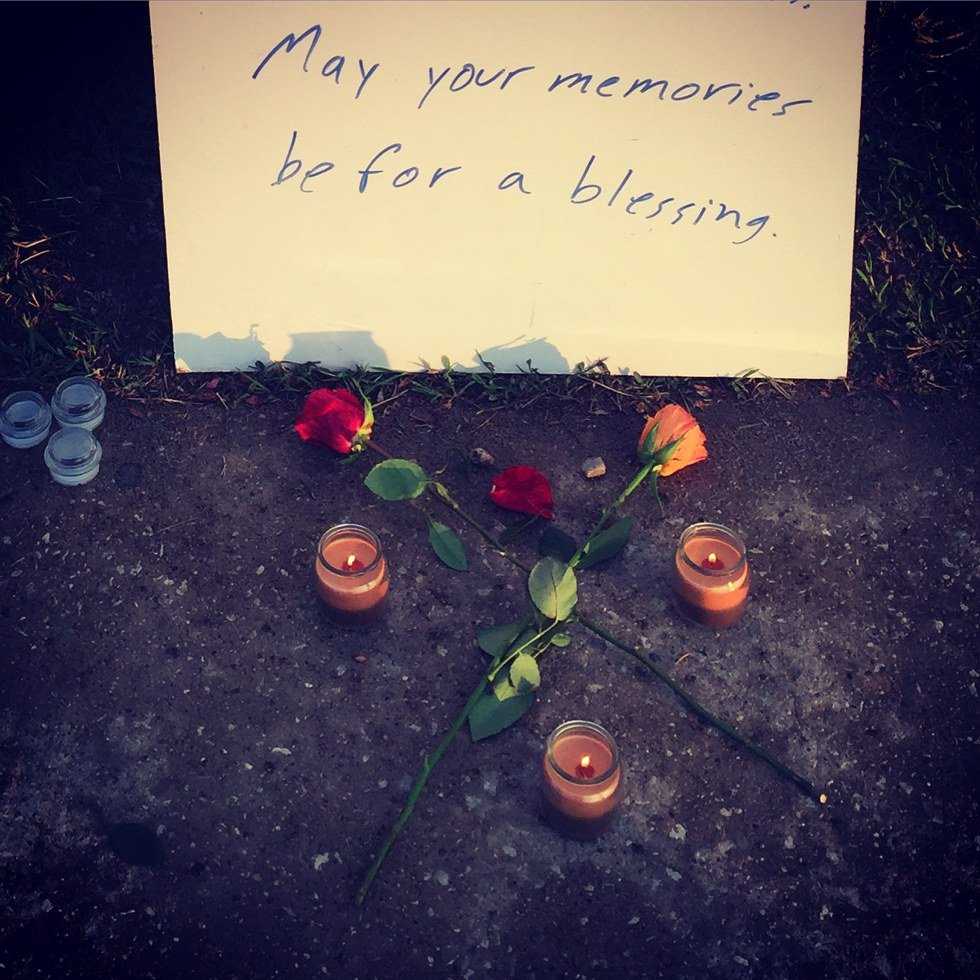
I suddenly found myself in the middle of the street alone, bearing a sign demanding justice for Alton and Philando. A crowd that was once big enough to divert the bus routes had diminished to a circle of angry faces bickering about saying the same thing in slightly different ways, a few reporters looking to cash in on their disagreement, and some white guy with a Jewish cap holding a yellow sign.
Earlier in the day, I was finishing up at the laundromat when the kid’s show they had been playing switched to the local news. Another black man, Philando Castile, was killed by a police officer, this one while his girlfriend video-taped the entire thing. Shortly thereafter, another report revealed that Alton Sterling was another victim killed by a police officer, this time while pinned down.
I came home in anguish, not knowing what exactly I could do. I started to read up on their stories. I knew that in a few hours, their names would be forgotten, and they would simply be death count 122 and 123 of black deaths at the hands of a police officer. I had to do something, but felt utterly helpless. I found a vigil being held in their honor of the south side of Chicago, so I grabbed a few supplies and headed out the door.
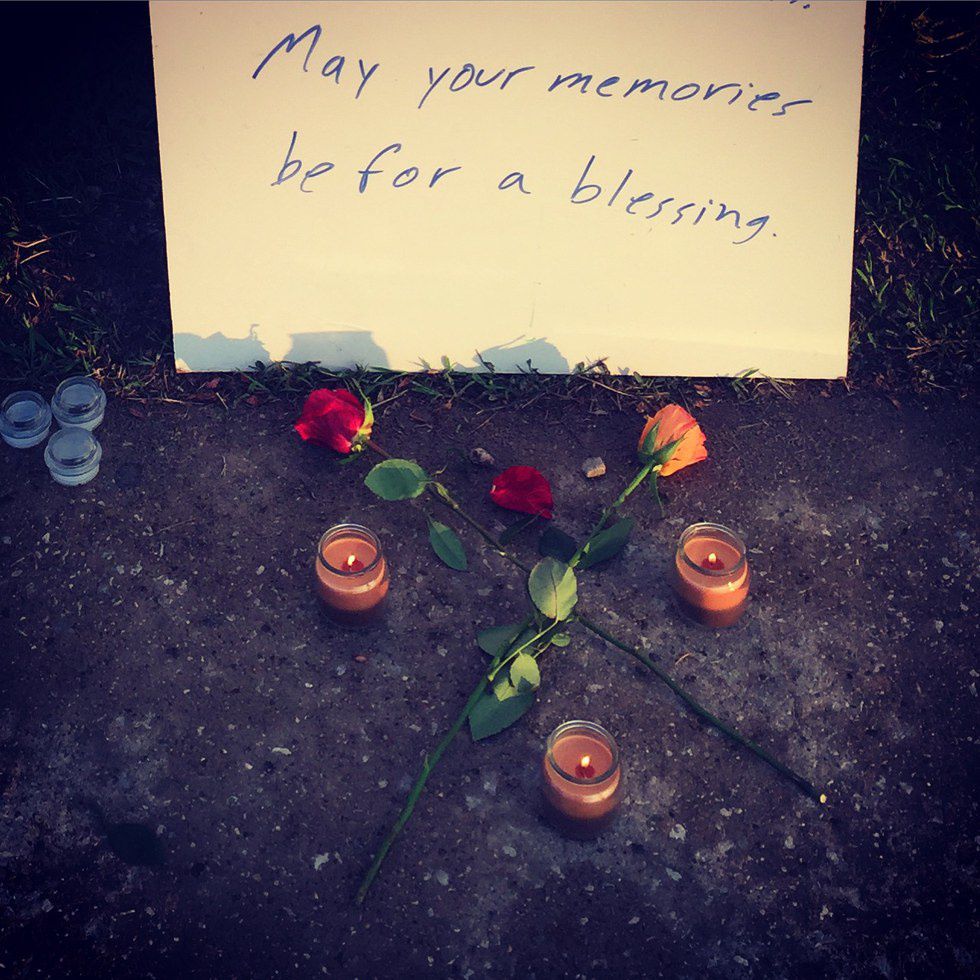
On my way, I found myself wondering what in the world I could do. I bought two roses, a few candles, and some stones. It is a Jewish custom to leave a stone on gravesites, to signify the lasting memory of their lives in our own. The great beauty of the stones, though, is that they are entirely innocuous. When the police eventually take down my small memorial, they will not think to throw away these stones. In that way, I hope, the memories of Philando and Alton remain with us, even if we may not notice them very often. Even still, this protest did not seem like I was doing very much.
I suppose that in going, I thought that I might be joining something that could ease my conscience. I could justify my privilege if I showed up to support those who suffer for it. Look at me. A good liberal. A good Christian. A good Jew.
Providence seems to have conspired against that position. I walked a little ways in the rain, and then caught a bus to about a quarter of a mile away. The bus normally stopped right where the protesters were standing, but there were so many of them that the bus had to be rerouted. I walked down the street, a ridiculously large marker board in my arms, a ukulele on my back, and a guilty conscience weighing heavily on my mind. At least this was something, much more than I have been doing, if I am entirely honest. As I approached, at least a dozen people were walking away. When I got there, a dozen more were leaving. By the time I finished setting up my small vigil, many more had gone. I had missed the even larger exodus, when the vast majority of people were ‘rained out.’
Soon thereafter, I made my way over to the remaining protesters. I wasn’t quite sure of what I was supposed to do, so I waited to be talked to and sat there silently for awhile, hoping some leader would give me instructions. Another white guy, equally confused, addressed me as if I would know what was going on, rather than have a conversation with one of the many black people around us.
I ended up talking to a man by the name of Mike. The center area of the road was abandoned, so we took up signs and headed there. We discussed for a little while why the protest was waning down, and watched as a discussion on the sidelines became more and more heated. He explained a little bit of the group dynamics, and I noticed there were at least four identifiable camps arguing with one another. Mike and I discussed how these different camps disagreed, and often had conflicting interests. Our conversation turned to the great need in our generation to move from taking action on social media to taking action in real life, and how one prophetic voice might be able to tie together these disparate factions within the Black Lives Matters movement.
From what I have seen on twitter, the earlier protest gave reason to be more optimistic. But what I saw was like a real-life version of a facebook comments debate. People were not listening to one another. Names were called. After Mike left, I walked over just to try and listen to their debates, to hear their concerns. But a feisty lady in a floral dress came over to me and asked me to leave, because they were busy discussing “family business.”
I began to walk home, hoping to catch the bus. I live in Hyde Park for the summer, which is considered a nicer neighborhood by most standards. Where I was then, however, was not. I stood by the bus stop waiting, but the bus never slowed down. I tried waving my arms, and I ran after it, but my cause was lost. It was way beyond me. I checked the time on the next bus, and it was not due for another 45 minutes.
So, I could either stand here on the corner of the bad neighborhood, or walk until I caught the bus later on down the road. When I first began my little quest, I was frightened. Every week at my synagogue, the rabbi reads off a list of those who have died in Chicago during the week due to violence. The list always seems to go on and on, and I find myself praying that the list will quickly end. This neighborhood, according to the rumors, was one that contributed to those numbers quite a bit.
I walked down the road, and as I did, I quickly became aware that mine was the only white face on the street. At this thought, my anxiety heightened. Maybe I will do something to offend someone, I wondered, and that will be the end of me. But rather than being greeted by the end of a gun, most people smiled at me as I walked along. Perhaps they were amused to see a white boy out that late. Maybe they were laughing at the giant marker board in my arms. Maybe they were just genuinely being friendly.
The dozens of independent businesses were practically perfectly matching the stereotypes; chicken restaurants, barber shops, African novelty stores. Almost as prevalent were the churches, oftentimes in buildings clearly intended for some other use. If this were another country, adventurous Americans would walk through this part of town to avoid the tourist traps. Children were walking back from the bus, some older ladies were pushing along little carts full of groceries, and a few men were standing together, smoking and laughing into the night sky.
This experience didn’t really make sense to me until just a few hours before this writing, when I sat in a shabbat service. The rabbi spoke about the nature of justice, and how the ancient Jewish scholars had struggled with the question, “Who is my neighbor?” With neighborly relationships come a series of expectations about the individual. The rabbi pointed out that in America, the police consider themselves neighbors with the white community, upholding their laws and protecting their properties. But the police often do not consider the black community their neighbors; often, they are the potentially dangerous criminals that need to be dealt with quickly.
It isn’t that the police are actively racist, or seek to hurt black people. The rabbi’s words say it best: “When the police encounter a white person, they see that person as potentially good. When they encounter a black person, they see that person as potentially bad.” The difference in that perspective leads to very different treatment, and that difference is the basic injustice underlying our modern problems.
So, as I wandered through that neighborhood, I was letting that bias go on in my own mind. This neighborhood is potentially bad, so I need to be careful. But, in walking along and actually seeing the community there, I began to feel at peace. This neighborhood instead is potentially good. That little shift made all the difference.
This story is one that I hope will cause you to pause and reflect on how you interact with people of different races, religions, genders, political parties, or any of the other boundaries we erect between one another. Ask yourself, “Am I treating this person as someone who is potentially good, or as someone who is potentially bad?” Odds are, the way that you treat them due to your paradigm is how you will gauge the experience, and it will shape your reaction in such a way that might cause them to live up to your expectation, good or bad.
But changing your own paradigm is not enough. If you want to take real steps for reform, please follow these simple instructions:
Call your legislator and demand reform.
Don't know what to say?
http://www.dailydot.com/via/ferguson-michael-brown...
Don't know your representatives?
http://whoismyrepresentative.com/
Don't know your House representative's number?
http://www.house.gov/representatives/
Don't know your Senator's number?
http://www.senate.gov/senators/contact/
They didn't answer?
Leave a message and set an alarm on your phone to call again in an hour.
Is one time enough?
Nope. Call as often as you can. Put it on your calendar. Set alarms. just keep doing it.
How do I spread the news?
One pretty good option is to share this article. Just make sure to not let social media be your only form of action.