
It’s hard to realize how rich a culture is until you see them burying their dead.
I went on a family pilgrimage with my grandpa (Laoye) in China this summer. We traveled by train from Beijing to the southern province of Guangdong; the trip down took 11 hours. The last time I had visited my Laoye’s homeland--the village of the Zhangs--was ten years ago, when I was a mere five years and ten months old. I distinctly remember parts of that decade-old trip: the neighbor’s daughter that accompanied me on a wagon to buy flowery headbands in a market, the Ramen noodles I shared with the friend I made on the train in exchange for him sharing the words to a nursery rhyme with me, the now-passed-away great uncle that brought home a pet toad for me.
I wasn’t planning to embark on this family pilgrimage the summer of 2016. In fact, my grandpa wasn’t either; we didn’t know about it until the night before. My other great uncle (Shugong) phoned in and told Laoye that they had to take care of “family business,” and that he’d have to come down the next day. Luckily, buying a train ticket in China is pretty simple, and we were able to secure seats for a train that left less than 12 hours from our purchase. And off we went.
I was filled to the brink with questions for my grandpa. What’s this family business? Did something bad happen? Laoye, why are you packing so much cash? It’s money for red packets to give to your cousins as a greeting present. No, nothing bad happened. We’re going down there to bury someone. Bury someone? Yes, it’s a family tradition. We’re moving my mother’s bones to be in the same mound as my dad’s. His first wife will also be buried there as well. What does that even mean? You’ll just have to find out when we get there.
So I waited. I patiently waited--well, not really. I paced back and forth on the train because I couldn’t sit still for 11 hours, I moved to the cafeteria cart and admired China’s ever changing landscape, I tried to fathom what these family traditions could possibly mean. I was pretty oblivious to the culture of my family’s roots; I had no idea what these customs--that we learn about in history books--actually meant to a group of people with that ethnicity.
Laoye is a Kejia person, which means he’s from the Nanfang Village, from the city of Huacheng, from the province of Guangdong. Nanfang Village is home to the entire Zhang family--those that are related to me, at least. When we arrived at Nanfang, we sat down to have tea with Laoye’s nephew. Shugong came with us, and he was pretty much our guide; I would almost call him a tour guide, except the only tourist would be me. I was the foreigner, not by the fact that I came from America, but by my lack of knowledge for my own family’s traditions. Shugong helped me out here: he introduced every plant and crop I saw, every dish I ate, every street I passed.
It turns out, our “family business” was to put Shugong and Laoye’s parents at rest--for good. In Kejia culture, when someone dies, they are buried in a grave until their body decomposes. Left as bones, they are dug back up. If he is a male, he gets relocated to a grand burial mound: a marble contraption cradled in the mountainside with blessings and prayers engraved. If she is a female, she will wait for her husband to get relocated before she can join him. Thus was the case for my great-grandpa’s first wife. She had died young, so he remarried; with this new wife, he had my grandpa, Shugong, and the rest of their siblings. He had been dug up and reburied years ago, and now the time was ripe for his wives to meet him again.
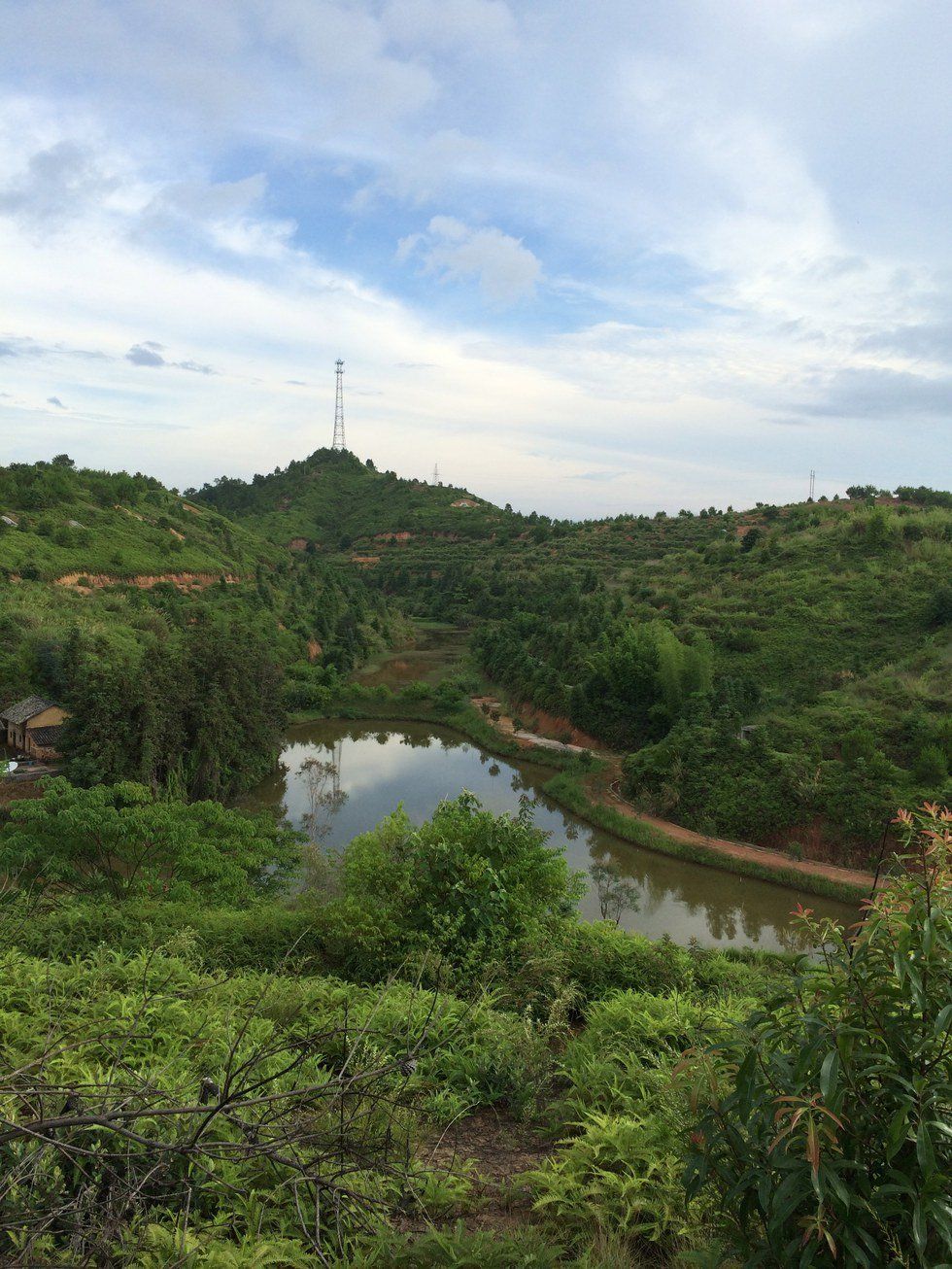
It was 3 AM on our second day when we started walking up the mountain where Laoye’s dad’s burial was located. The sun was still asleep--or shining on the other side of the globe--and I could hear a herd of insects’ wings fluttering. It had rained the day prior, so the hike upwards was a slippery, steep slope of sliding sand. When we got to the top, I finally realized why this spot was chosen for my great grandpa: it had the best view of the entire Nanfang Village, as you could see every barn, every rice paddy, every plantain tree.
The burial ritual itself was mesmerizing. I don’t think I’ve ever seen anything quite like it. It had a peaceful but mysterious aura, though it might’ve just felt mysterious to me because I didn’t have a clue about what was going on. We had carried up tree branches from the “Hundred Year Tree,” as well as bags of offerings. There were two professional buriers that came with us, complete with their superglue-mortar-gun. As the sun came up at 4:48 AM, the professionals took out two large jars that resembled vases. Shugong, what are those? Those are the bones. In one jar, my mother’s bones. The other one is for my dad’s first wife; we never found her bones, though, so there’s a piece of wood with her name engraved in it. Where are they putting the jars? They will open my dad’s mound, which has another one of these jars already in it--those are his bones. These two jars will go on either side of him, and then they will permanently seal the mound closed with their glue gun. Here they are now, opening the wives’ jars to burn incense in it as a blessing. You can go take a look at their bones.
And take a look I did. I had never seen a dead person’s bones, never raw, never up close. They looked morbid and restful at the same time. It was the crust of dirt around the edges, the slight decay, the fragility--but yet it was so peacefully cradled in the jar, cushioned by incense ashes. I watched the buriers move like clockwork, like they had rehearsed these burial rituals in their sleep. Together, they hoisted the two jars above the opening in the mound and carefully, gently, lightly brought them down. The final seal of mortar felt like a stamp of completion: the family business had been taken care of.
Except we weren’t finished yet. We had to set out the offerings, which included a variety of foods and luxuries. Raw meat consisted of chicken, pork, beef, and lamb; apples, oranges, and bananas made up the fruit section; candies and crackers composed the treats. In addition, there were three cups to be filled with white wine, three cigarettes to be lit, three incense sticks to be burned. Flowers and the “Hundred Year Tree” branch were laid out. Finally, we burned bundles of fake currency, so that our ancestors would have this money in the afterlife.
The whole process seemed to go by in a flash, but by the time we finished, the sun was already directly above us. These kinds of experiences don’t last long, but the memories will forever be engrained into my mind and soul.