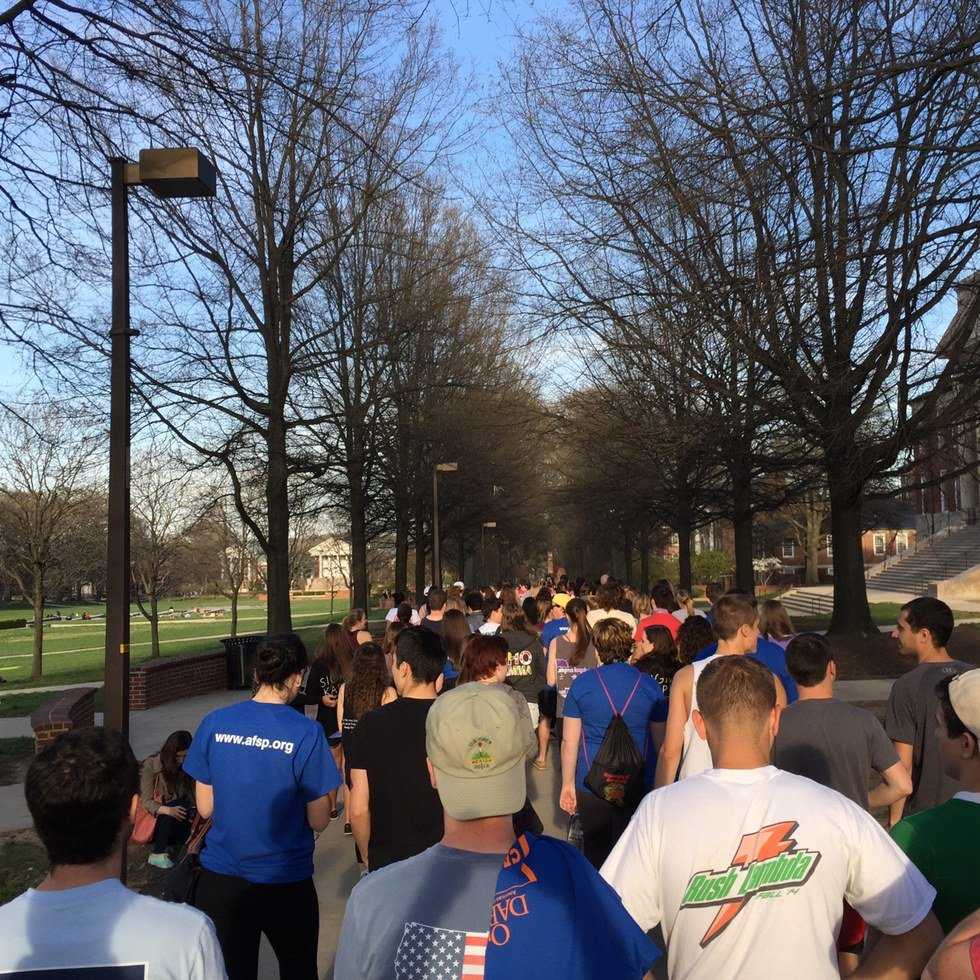
On the McKeldin Mall Sunday afternoon, Lambda Chi Alpha and Alpha Chi Omega sponsored the year's largest and most profitable
Out of the Darkness Suicide Prevention Walk in the country, thanks in part to an enormous response from campus Greek life.For Lambda Chi sophomore CJ Pendleton, this was personal. The uncertainty and stress surrounding high school can drown out the positives in life and prompt questions regarding self-worth and decency. The road can be dark and lonely, and suicidal thoughts exist only within the realm of one's own mind, drastically altering perception of the outside world. There is no recovery time; no cast to put on to help heal. The necessary rehabilitation is a loving support group and the proper resources. Experiencing these difficult thoughts in high school, Pendleton kept them to himself, not seeking counseling or sharing with his parents.
As a sophomore now settling into Greek life, he finally saw his opportunity. “I didn't want anyone else to go through what I did," said Pendleton. He approached fellow brother Jacob Katinsky, and they contacted the AFSP to bring a suicide prevention walk to the University of Maryland. “It was a personal issue for CJ and a few other brothers, and at that point, it becomes a personal issue to the whole chapter," said Katinsky, the walk's lead organizer.
The AFSP holds three types of walks: community walks in more than 350 communities across the country, overnight 16- to 18-mile walks in rotating cities annually, and three- to five-mile walks at colleges and high schools across the country. On Saturday and Sunday across the country, 15 colleges held Out of the Darkness walks, all contributing to the AFSP goal to cut suicide by 20 percent in 2025.
High school stressors increase enormously in college. Worries about what school to attend shift to what jobs to apply for. Social life is bigger, freedom is greater and your responsibilities multiply tenfold. The transition can be tough for students, as a standardized, personal high school environment vanishes, and you become one of nearly 40,000 students. Pendleton believes a sense of individuality can easily be lost.
Claiming over 40,000 lives a year, suicide is the second leading cause of death for college students, and third for those aged 15 to 24. The number one cause of death in both groups is diagnosed or undiagnosed adolescent depression.
The key lies in bringing the issue into the light and out from under the shadow of its stigma. It is not easy for someone to bring up such personal issues, and for many it is as tough to try and help out.
An accepting environment is key, but it is not always a reality. “My goal from this is for people to be more understanding," he said, “This isn't something to be scared of, or something to shake your head at. We want to change the mentality regarding suicidal tendencies and better limit the communication bridge and lessen the stigma."
To truly bring the issue out of the darkness, Pendleton knows those who have suffered from depression and suicidal tendencies must come forward and share their experiences. These people, like Pendleton, are the survivors. They are the only ones able to share the experience and wisdom of someone who has questioned taking their own life, and raised themselves above it. Their voices are more important than ever. “We're trying to be open about it," he said, “And be willing to talk and come out and be the face of what suicidal tendencies can be."
Suicidal tendencies are severely stigmatized and unfairly broadcast onto social outcasts or those who seem different. There is no mold, no outfit and no checklist determining who does and does not suffer from these thoughts. For most, like Pendleton, the suffering was internal. The more welcoming an environment, the more likely someone is to open up about similar circumstances. Pendleton has received an overwhelming number of messages from strangers thanking him for bringing suicide prevention to the light, while sharing their own personal stories.
“Me being so open about it gave people a connection to relate to, it wasn't something invisible," he said, “it's flesh and blood... and it can be anyone and everyone in your everyday life."
While raising awareness for the walk, Pendleton received an outpouring of support and personal stories from those thankful for his efforts. The walk, 500 participants strong, served as a personal measuring stick for Pendleton and his efforts to raise awareness.
"It was a big driving force behind why I wanted to come out in the open with it," he said. “Not only for myself to recognize where I've been and where I'm going, but to give someone that connection that can seem missing when you're going through something as serious as suicidal tendencies."