
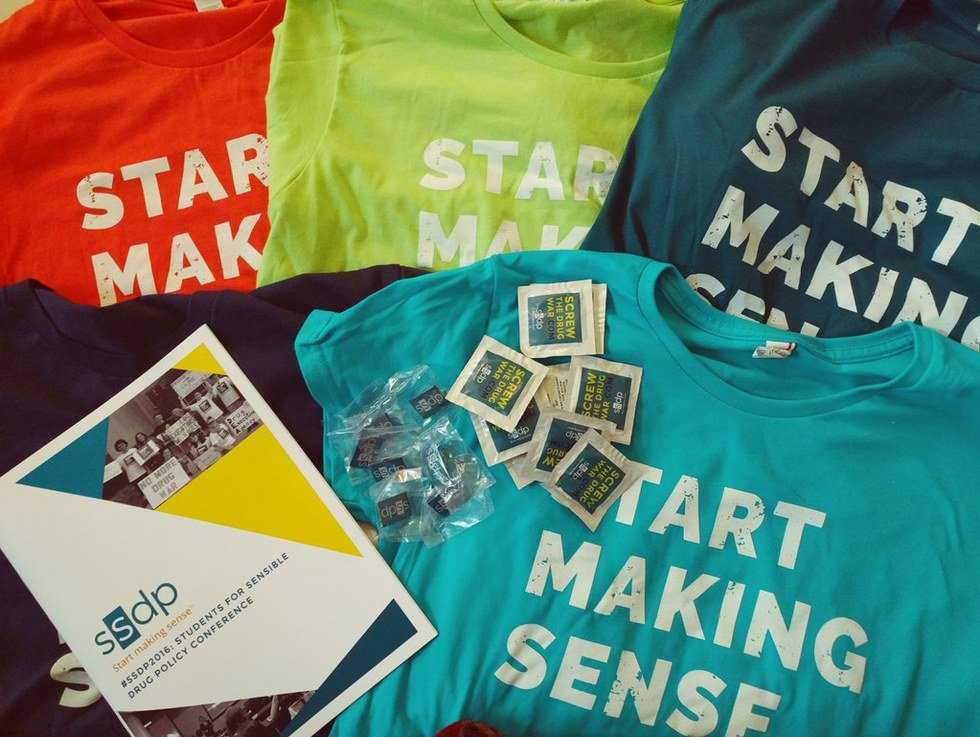
Last weekend, I had the opportunity to travel to Washington, D.C. for the 2016 Students for Sensible Drug Policy Conference. It's the one weekend every year where members, leaders, and alumni from SSDP chapters from across the country, and across the globe, gather to share ideas, meet with and learn from leaders in the drug policy reform movement, network, and party. Over my stay, I saw some amazing speakers, more than I could possibly write about today. Alas, I hope to share with you what I learned from some of my favorite speakers over the weekend.
1. Eric Sterling - Finding the Party in Your Heart
Saturday morning started with a breakfast hosted by legendary drug policy reform activist Eric Sterling, who kicked off the conference with his experience, humor, and kindness. Sterling spoke about what motivated him to get involved in activism when he was in college and his disgust towards injustice, a sentiment that all of us in the room could relate to. He spoke about the profound impact drugs have had on his life, saying, "I was raised an atheist. Psychedelics helped me see God." He spoke about all the amazing opportunities his work in policy reform had given him, which include being an adviser to the U.S. Congressional Committee on Crime, and, shortened for simplicity's sake, being deeply involved in nearly every major organization working to end the Drug War. At lunch later that day, Sterling ended up eating next to me, where we had the opportunity to further talk about the amazing things he's accomplished, my ambitions, and what I can do to achieve what he has. Bluntly, it was awesome to meet such a prominent figure in the movement I've committed myself to.
2. Lyn Ulbricht - The War on Drugs in the Digital Age
Perhaps my favorite speaker of the weekend was Lyn Ulbricht. Lyn, unlike many of the speakers I saw at the conference, does not have an extensive background in drug policy reform, yet, has suddenly become one of the most important figures, not just in the drug policy reform movement, but also in advocating for digital privacy rights and protecting our rights to private and encrypted communications.
Lyn found herself involved in the movement following the arrest of her son, Ross Ulbricht. Ulbricht, who also goes by the pseudonym 'Dead Pirate Roberts', is currently serving three life sentences, without parole, for starting and operating the Silk Road Marketplace, a service similar to eBay, where users could buy and sell goods, including illicit drugs, anonymously, using Bitcoin as their form of payment, and receiving them in the mail.
From an outsiders perspective, especially for those who don't yet support an end to drug prohibition, it's easy to see why Ulbricht received the sentence he did. In the years the Silk Road Marketplace was in operation, by many definitions could be considered a kingpin, even though it was users distributing illegal goods, not Ulbricht himself.
Details of the investigation and trial are proof that the FBI, DEA, and other law enforcement agencies do not respect civil liberties when they do their jobs. During the investigation, millions of dollars were stolen from Ulbright, resulting in the imprisonment of two DEA officers, and during the trial, substantial evidence in Ulbright's defense was withheld. His trial also only lasted four hours, including two breaks, which makes little sense considering the complexity of the case.
This case sets a dangerous prescient for future cases regarding online markets, digital currency, and encrypted communications. Questions like: "Should the government force individuals to hand over decryption keys?", "Are online services responsible for the actions of their users, and should they be required to monitor everything that happens on their websites?", and questions related to the future of online anonymity and crypto-currency are extremely important, and deserve far more debate and discussion than that which is allowed in a short, one sided trial.
Lyn is leading the #FreeRoss campaign, which is hoping to appeal the original case in the following weeks. The campaign needs all the support it can get, whether it be public awareness or financial contributions. If you're interested in learning more about this case, I'd strongly encourage you to look at the #FreeRoss website: at http://freeross.org/
3. Dr. Mikhail Kogan - Cannabis and Cancer Care
Dr. Kogan is a leading researcher in using medical cannabis in cancer treatment. Public discourse, and the discourse that shaped the medical marijuana laws in Minnesota, is that cannabis can be used to treat the pain, anorexia, and lessened quality of life that is associated with cancer treatment, but Dr. Kogan has found that cannabis use, especially in oil form, attacks and kills cancer cells. He called the evidence he's found "indisputable", and is hoping that the evidence he presented to us and SSDP leaders, could be used to to expand medical marijuana laws, and to fight for the rescheduling of cannabis on the federal level, in an effort to make his and others research easier and to make this effective cancer treatment accessible to as many people as possible.
4. Brett Phelps - Learning Not to Hate the Police
Brett was my favorite presenter of the weekend who was a student, rather than an expert in the industry. He started off his speech with, "Imagine if you were smoking marijuana for the second time ever, and a police officer pulled up next to your car and arrested you..." then proceeded to list off seven more situations of a person getting arrested for marijuana possession. He continued, saying, "All of these things happened to me between ages 17 and 23."
In a situation like his, he said, it is very easy to have animosity towards law enforcement officers, to always see them as "the bad guy". He felt that way for much of his life as a young adult, and I can say with honesty that I and many of my peers have shared similar sentiments. In a prohibition world, its easy for this hate to build and propagate, and, as improving police-community relations is a common goal across the nation.
He closed his speech by asking us to call our local police station and ask to go on a ride-along. He encouraged us to have open conversations with them about what they think about drug prohibition, cannabis, and this idea that prohibition fuels hate against the police. Later that night, while in the city for dinner, I met a police officer getting chicken wings at the same shop I was, and I decided to ask him these questions. I recommend everyone who has felt this hatred to have this conversation, I definitely don't regret it.
5. Kenneth Tupper - Psychedelics as Tools for Learning and Healing
The final speaker I saw before catching my flight back to Minnesota was Kenneth Tupper. He is a researcher at the University of British Columbia, who primarily focuses his research around psychedelic drugs and the brain. He belongs to a growing sect of researchers that believe psychedelics, such as LSD, "Magic" Psilocybin mushrooms, and MDMA can be used to aid in treatment, and in some cases cure mental illnesses like anxiety, depression, and PTSD.
In an age where mental health is an ever increasing issue, with suicide, especially among teenagers and veterans being at an all time high, all potential solutions should be explored. In Canada, they are, and the results are astounding. In clinical trials, MDMA has been shown to reduce PTSD symptoms in veterans at a rate 80 percent effectiveness, and LSD and Psilocybin have been shown to have similar rates of effectiveness for treating depression and anxiety.
He also suggested that the use of these drugs may be effective in aiding with learning, and even suggested that psychedelic use be a coming-of-age ritual, a serious paradigm shift in the discussion about youth drug use.
I am so honored I got to witness and hear from all of these great people during the 2016 Students for Sensible Drug Policy Conference. I strongly recommend that you look into SSDP and what we are all about.