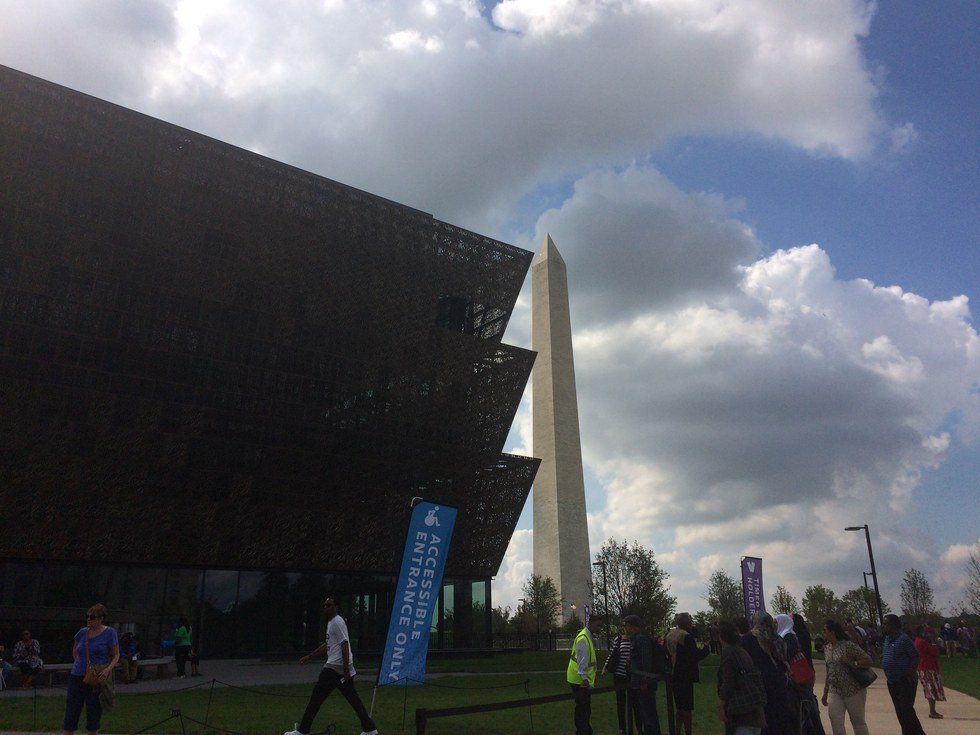
Before going to the newly opened National African American History Museum, I had no clue what to expect. I avoided reading articles, or getting others’ opinions so that I could form my own after my visit. The museum had opened only about two weeks prior to my visit, so the turnout that day was huge, despite it being 12 PM on a Monday. The people were energetic, starting conversations with strangers about how excited they were as we all waited to board the elevator to the first exhibit. Old ladies dressed in their Sunday best to go see this beautiful tribute to their heritage. For many of the visitors of the museum, a portion of the exhibits in the museum aren’t history, but are reminders of the early years of their lives. It was only 1954, only 62 years ago, that segregation was deemed unconstitutional, after all.
The way the museum is set up, you are taken chronologically chronologically through the history of black people in America, from the time slaves were first brought over in the 1500’s to the current day Black Lives Matter Movement. There are exhibits dedicated to the well-known figures in the black community, such as Harriet Tubman and Malcolm X, and the lesser known, like Margaret Garner, who took her daughter’s life to prevent her from living a life of captivity.
There is an exhibit dedicated to Emmitt Till, a 14 year old boy who was kidnapped from his uncle's home while visiting his family in Mississippi in 1955. After flirting with a white woman at a store, the woman's husband and brother committed the heinous act against Till. This case brought nationwide attention to racism that was still very existence in the South As tragic as Till's death was, his story acted as a catalyst for the civil rights movement, and inspired well known figures, such as Rosa Parks, to take action.Till’s casket, along with statements from his mother, are on display, but per his family’s request, no pictures of the exhibit were allowed.
People of all different ages and races attend the museum each day, but I must say, that as a black female, it is a more personal experience to visit the museum. Many African Americans are unable to trace their lineage, since slave records are not always accurate or obtainable, or their ancestors were unable to keep written records about their experiences, as it was outlawed for black people to read and write until the 1800's. This makes it more difficult for some to celebrate their heritage, as they don’t know where they are from, or know much about their ancestors. But to be able to visit the museum and read about the experiences of a black person 400 years ago, and being able to say "That would have been me if I was alive during that time," not only creates a deeper connection to our heritage, it also creates a sense of pride. The NAAHM is a way for black Americans to celebrate our history through not only the experiences that our people have overcome, but our vibrant culture that has shaped many aspects of American society as we know it.
In a time where black is being taught inaccurately in schools, or is not being taught well at all, a museum celebrating black history and black culture is now more crucial than ever. It is especially important that people know the truth of black history.
Of course, it is important to be up to date on the current civil rights movements, but it is equally important to know the full history of the first civil rights movement, and how our ancestors, dating back to the 1400's, paved the way for us today to fight for justice. I recommend that, if given the chance, everybody visit the National African American History Museum. The museum itself is huge, with more than 37,000 items on display, so it is nearly impossible to get through the entire museum in one visit. It is definitely well worth the multiple trips, though. A visit to the National African American History Museum is a very emotional experience, and one that I know I will never forget.