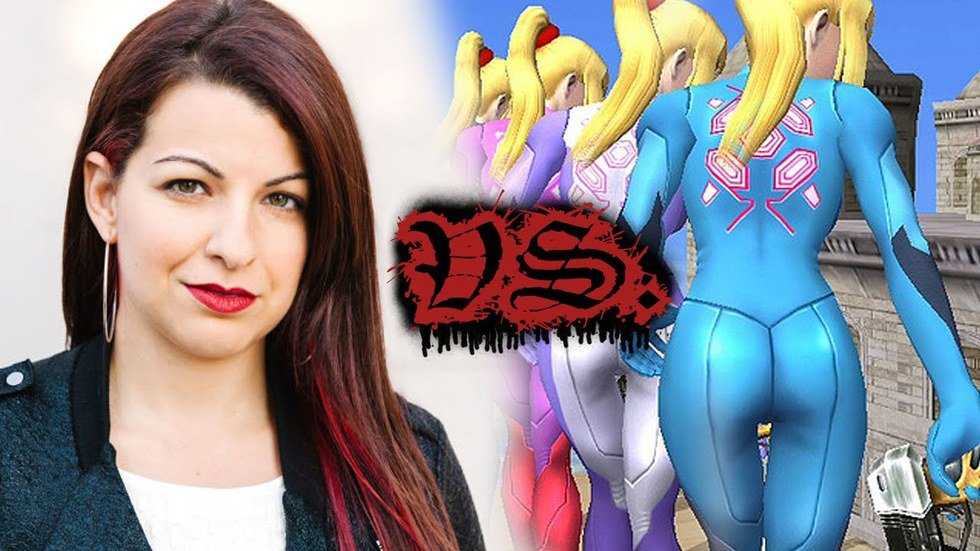
On March 10th, controversial feminist media critic Anita Sarkeesian was invited to Scripps College for a conversation with students. I desperately tried to acquire a ticket and was unfortunately not able to do so. I wanted to ask her some questions about her views of tropes of women in video games as well as her opinions on feminism and women's rights as a whole.
Sarkeesian has famously been the target of malicious backlash from various groups of people, notably Men's Rights Activists. Most egregiously, an anonymous male student at University of Utah threatened to bomb the school when Sarkeesian was invited to speak unless Sarkeesian's presentation was cancelled. The violent and sexist response to her critiques of video games is uncalled for and emphasizes the ongoing oppression that female activists suffer.

However, Sarkeesian has also received valid criticism due to the somewhat shady way in which she runs her blog, "FeministFrequency." Many, many people have proven that she does not play the games she reviews and instead takes footage from various Let's Plays without proper accreditation. She also stated in a video that she knows very little about video games, yet later expresses her lifelong love for them once she started asking viewers for donations. As this already has been addressed time and time again, I won't go into detail: a YouTube video by NateTalksToYou, despite the somewhat immature title, carefully and logically summarizes the discrepancies in the modus operandi of "FeministFrequency."
This is not my issue with Sarkeesian. Even though I personally love video games, I am not offended when people decry them and point out their contribution to the systematic oppression of women (which, on some level, they certainly do). I disagree with many of the claims she makes about video games; but, again, she is allowed to form her own opinion about them.
In my humble opinion, however, Sarkeesian's mode of thought is not representative of what feminism should look like and instead insidiously lends itself to systematic violence against women.
I take issue with what she chooses to focus on in her critiques; mainly that when a woman is scantily clad in a game she is no longer a character with substance and instead a sex object for male gamers. I am offended by the notion that these sexy characters have no depth or real purpose. "If you want to get to know a character," Sarkeesian says in her video "Strategic Butt Coverings," "[and] learn about their interests, goals, and desires, their butt is probably not going to give you that information". Of course not: a butt gives very little information about a character. What Sarkeesian fails to address is that, although a female character's butt may be emphasized, very rarely is that the only aspect of said character that is presented by the game.
Sarkeesian uses the example of Lara Croft from "Tomb Raider" in "Strategic Butt Coverings," showing how in some camera angles Lara's butt is needlessly front and center. However, Lara's body and sexual characteristics are by far not the only thing "Tomb Raider" presents about her. She is the titular character in the franchise and is a respected, smart-as-a-whip archaeologist who doesn't mess around.

Her somewhat impractical clothing and sexualized body are very small aspects of her character compared to what is emphasized about her in the game.
This is why Sarkeesian's argument rubs me the wrong way. Again, this is not because I adore video games and video game characters: it is because I am staunchly in support of a branch of feminism that asserts women can be both sexual and capable.
The Queen Bey herself highlighted this in her song "Partition." Beyonce is a headstrong, smart, "woke" Black woman who also likes partaking in sex with her husband in the back of a limousine. This is important because men in popular culture are encouraged and lauded for having sex while women are slut-shamed. Beyonce addresses this double standard by presenting herself as a very accomplished sexy woman.
Sarkeesian identifying as a feminist while expressing that sexualized women in games have no substance is harmful to young women exploring their sexuality, particularly feminist girl gamers who watch her videos. One might say this is a stretch, but I speak from personal experience. I, as a younger person, grew ashamed of wearing tight sexy clothes because of Sarkeesian's argument. I looked up to Sarkeesian as a feminist, so I felt that cosplaying sexy video game characters would reduce the validity of my person. This feeling thus extended into my daily life and clothing choices. How could I call myself a feminist, I thought, if I'm actively promoting video games turning women into vapid objects? I later realized that this is not in any way what video games do, whether or not the character in question is needlessly sexualized. While I'm certain that Sarkeesian does mean to promote any kind of systematic oppression: this, my friends, is a consequence of slut-shaming, and slut-shaming is violence against women.
Women's sexual "indiscretions" (for example, the subsequent suicide of Amanda Todd due to a malicious stalker spreading a photo of her flashing her breasts in seventh grade) can seriously harm their prospects of being respected as a human being. A male friend of mine once had a nude photo of his posted on a porn website and spread around to his friends without his consent: however, this caused him no unnecessary strife and he lost no friends. In fact, they lauded him for having such a (for lack of a better term) sizeable package.
While Sarkeesian's slut-shaming is entirely unintentional and very subtle, it does not make it any less of a violent act.

.png/revision/latest?cb=20140414232000)
Sheik/Zelda, looking badass as usual
Allow me to clarify that I am not arguing female game characters are sexualized for the sake of new-wave feminism and the fight against slut- and femme-shaming. Video games are gendered, and these characters are presented in a way that draws in a target audience: heterosexual males. However, I strongly dissent from Sarkeesian's assertion that the characters she analyzes (Lara, Catwoman of "Arkham Knight," Tyris Flare in the "Golden Axe" franchise, etc.) have no thought, depth or purpose simply because they have nice butts or use their sexual wiles for personal gain. Pointing out and criticizing the sexualization of women in these games is perfectly valid: however, if there is no acknowledgement of the characters' personalities in one's critique, it promotes sexist double standards. Young female (and male!) gamers can think for themselves and are able to derive more from a character than their rear end in gameplay, even if it is emphasized. I know I certainly am able to: my "Skyrim" "Dovakhiin" wears very skimpy Forsworn armor (it's surprisingly strong and enables her to move faster) and still manages to kick ass, take names, slay dragons, be an Arch-Mage, etc.

The armor my "Skyrim" character wears is center.
Even as a bisexual, I barely notice her sexualized body and instead laud her talent and skills. Most gamers do the same, no matter how sexualized a character may be.
Just like "Tomb Raider's" Lara Croft (and all women), I am capable of sexiness and having a personality. I, similar to Beyonce, consider myself a headstrong, smart, "woke" black woman who would be more than happy to have sex in a limousine. Driver, roll up the partition, please, and still give me the respect I deserve as a sexual human being.
I balance my taste for nice lingerie and tight jeans with attending a top-rated women's college, making the dean's list my first semester and (of course) kicking major butt in video games.