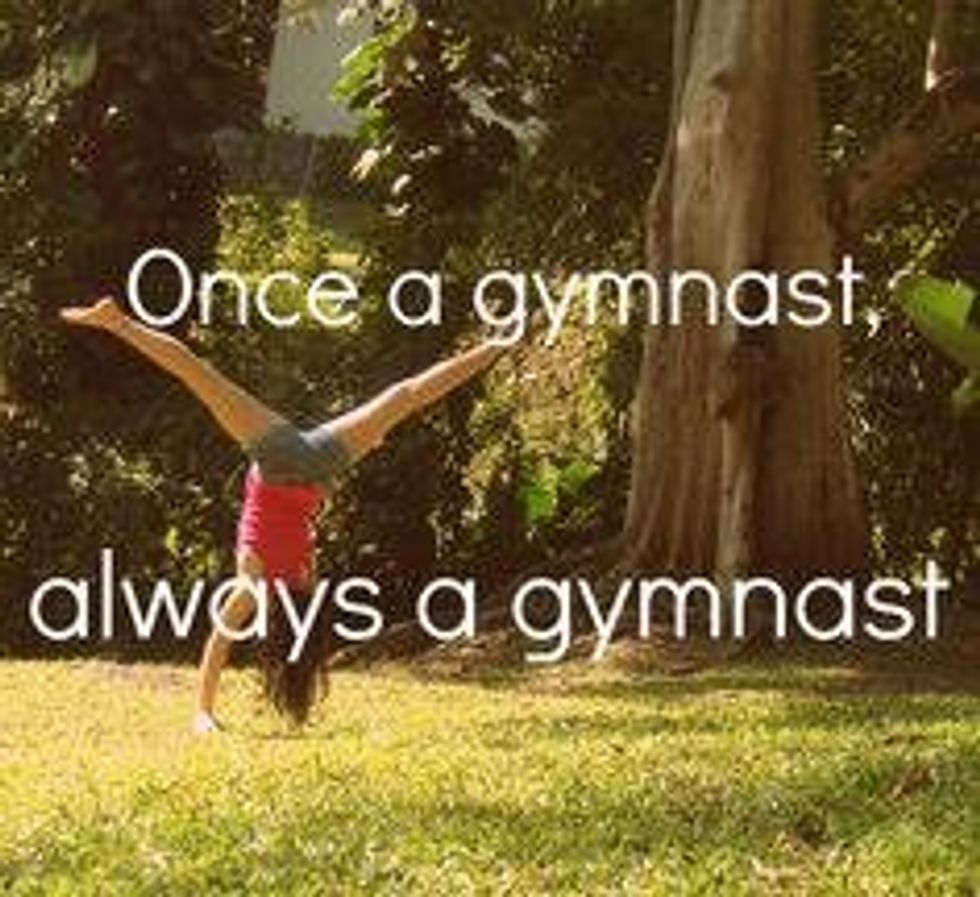
There's nothing that hits you as hard as thinking about a sport that used to shape your entire life. Often it's almost as if the times (no matter how many years) you dedicated to that sport were a blur, and I find myself needing constant reminders that they did indeed happen.
Looking back on my 12 years as a gymnast emotionally hits close to home. Every hour spent in the gym makes up a memorable majority of my childhood. Although, it's saddening that I cannot relive these years or continue adding on to them, I now find myself an "ex-gymnast." This is better than the redundant term of being a "retired" gymnast, as that context implies I'm beyond my early-college age. Having either of these titles, however, I find it impossible to ignore every lesson I was taught from the best sport in the world of all sports (yes, I do have a biased opinion). Here is what I've learned from gymnastics as I also thank the sport that has taught me so much:
Four inches is small. For those of you who don’t know, a balance beam is four inches wide and four feet off the ground. I find myself with feet that each are wider than four inches (or at least it seems so while doing a beam routine). In elementary school we all learned how to use rulers and measure lengths, but “beam-makers” must be using a different form of measurement.
Trust your coach. Whenever I try to think of a specific way that I learned to trust my gymnastics coaches, I am led to an example that occurred frequently in my gym. While trying to get over a fear, or if we were attempting a new skill for the first time, my coach would claim, “If you get hurt doing it, you'll never have to do it again." Sure enough, no matter how badly I wanted to get hurt and have a reason to not do that skill again, my coach was always right, and I found myself trusting her from situations like this.
Be flexible. This is pretty self explanatory, but I do find it deeper than being physically flexible. Yes, I am still able to do the splits and having this flexibility does come in handy at times, but I also learned to be mentally flexible, as not everything goes as planned. For example, if your floor music cuts out in the middle of a routine, you can't just stop with it, you instead work around the issue and continue.
Listen to your body. Taking 14 ibuprofen in order to make it through one day of competition can't be ignored. It’s time to see the doctor. I was taken from the sport due to a career ending surgery and sometimes I find myself thinking what would’ve happened if I had continued to ignore it. But my conclusion to these thoughts is that it would have ended in even worse damage that might not have ever been able to heal.
You can't avoid fear. This lesson is applicable outside of the gym in more situations than one. If you are afraid of something, the right approach is not to avoid these feelings. Instead, you need to face them head on, in order to ensure that they don’t “win” that situation.
Embrace your muscles. Gymnast develop bodies that aren’t your stereotypical "skinny" bikini forms. I remember thinking that if I ran more while avoiding squats and such, the muscles in my quads and calves would shrink. This was my young mindset that was influenced by seeing pictures of lean professional runners next to the muscular gymnast. In turn, I’m sure you can imagine that the running did not change my body figure, and I was taught to love my body in a gymnastics leotard while embracing the muscle definition.
Teammates are your second family. Often athletes spend more time with their teammates and coaches in the gym, than with their family back at home. The people that you train with, endure every hour of sweat, blood and tears that you do, too. It makes it comforting (as in an extreme example) that if the conditioning doesn’t kill them, it most likely won’t kill you either.
Failure happens. Not every skill that you perform is going to be perfect every single time. Mistakes happen and although many gymnasts, including myself, find themselves perfectionists, you have to accept this fact. You will fall, even on your best days, and what really matters is how you move on to pick yourself up, and not give up.
Last piece of advice: No matter what, even if four-fifths of your left butt cheek is showing, you do not pick a wedgie during a floor routine.
Thank you, gymnastics. The sport I fell in love with at such a young age. You will always continue to be a part of me. I am thankful to have grown up in the Grand Traverse Bay Gymnastics environment with the VanDiense family to look up to as my coaches and role models. I can't imagine what I would have done without the support from them, my teammates and my family. Without my years as a gymnast, I would not be near the same person I am today, and for this, I thank you one last time.