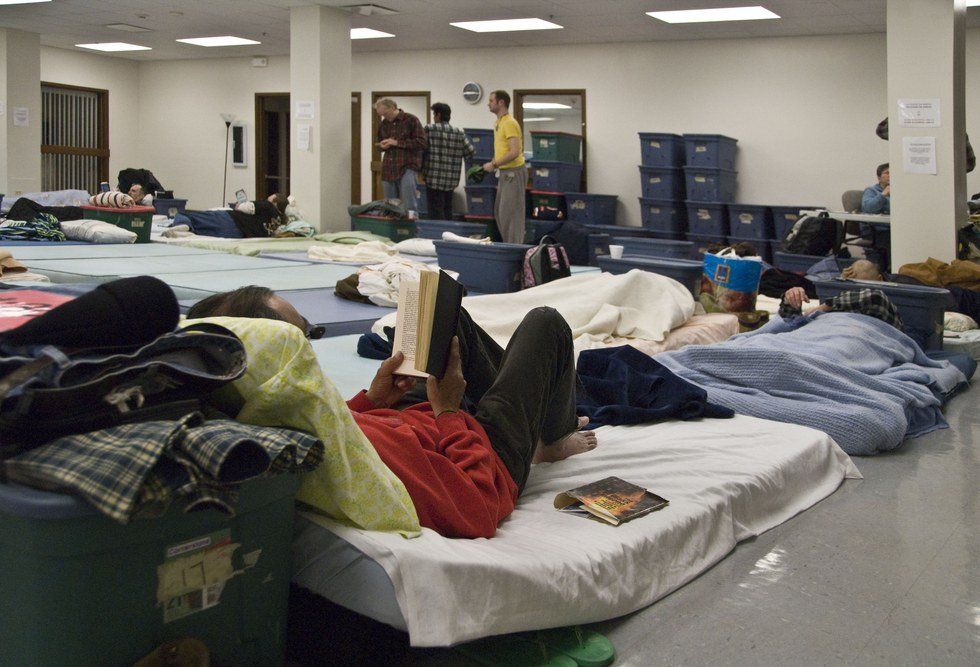
I always felt bad when I saw a homeless man on the street asking for money but didn’t have any to give him because I didn’t have any myself or I had to use my money for other priorities. This makes it sadder. One time I was at the grocery store with my mother and this homeless woman held up a little index card that reads “I have three kids and no money,” so I gave her like 4 or 5 dollars.
“You gotta be careful with those people,” My Mom warned me that day. “She could have been using you to buy crack.”
My Mom had a point. Right after I gave her that money, there were like five packages of red meat in her basket. There was no way she could have got all that meat for just four or five dollars.
For Mental Health Counseling school, I did an internship at a homeless shelter while still working at the library part-time. One of my professors knew a social worker named Rodney Oliver who counseled homeless people there, and he was able to get me the internship. The homeless shelter was run by a couple named Leroy and Hattie Bear. They were social workers as well. Rodney wrote a book called The Therapeutic Outdoors which won the Pulitzer Prize for Nonfiction which is very pleasantly surprising being that it is in the self-help section of many libraries. Rodney Oliver was a major reason why I was excited to do the internship. He was one of my psychological idols next to Carl Rogers and Abraham Maslow. I remember our conversation at the interview:
“Dude, you are like a mental health legend! I loved your book The Therapeutic Outdoors. Even though it is a psychology book, it has it’s own poetic rhythm to it with the descriptions of outside nature. You are like the Wordsworth of psychology!”
“Thank you,” he replied.
“I also loved your book The Philosophy of Charity. You were so right when you mentioned how many poor people have this mentality that because they are poor, they have no purpose in life when in reality they are the ones who stimulate altruism. That’s like what Wordsworth talks about in ‘The Old Cumberland Beggar!’”
“Didn’t realize I was that much of a literary celebrity.”
“I think you are!”
The first client I was set up with was Priscilla, a six year old girl whose house was foreclosed.
“So how long have you been here?”
“A couple of months.”
“How do you feel?”
“It’s different. I feel sad because I miss my friends at my old school.”
“Are you currently attending a new school?” I asked.
“Well, I am supposed to, but I don’t go that often.”
“How come?”
“Because it’s hard to get to school. Like with driving.”
“I’m sorry to hear that.”
“But Leroy and Hattie here are sort of trying to like home-school me. Their son Emmett reads to me sometimes.”
“That’s good, at least. Have you made any new friends here?”
“Not really. There aren’t a lot of kids to talk and play with around here. I also miss my old friends.”
“Do you ever write to them?”
“Yeah, but I want to see them in person.”
“I know, but the sad truth is that sometimes friends move apart and can’t always see each other in person.”
“I hope I get to see my old friends again someday.”
“Maybe when you write them letters, you can ask if they want to visit here.”
“That is true.”
“And you know, there is no harm in trying to make friends with the older people here. And by old people I do not mean like old old, I mean you could talk to them, but even people in their 20’s, 30’s, 40’s, and 50’s.”
“But I don’t have anything in common with them.”
“You’ll be surprised at the connections young people can form with people much older than them. I have friends who are older than me.”
“Really?”
“Yeah. I have a friend named Giselle who is in her 60’s.”
“Wow.”
“See. Also, see who looks lonely. Maybe you can relate to each other. Now, I am not saying not to talk to the other kids. It’s good to be friends with a variety of age groups.”
The next client I was assigned to was an older man named Blake. But he didn’t show up to the appointment.
“Excuse me, do you know where Blake is?” I asked Rodney. “He has not showed up to his appointment.”
“He is probably outside,” said Rodney. “He likes spending time outside a lot.”
“Am I allowed to do therapy sessions with him outside,” I asked, smiling, thinking about his book.
“Yes, as long as he is comfortable with it,” Mr. Bear replied. “Remember confidentiality. If you sessions outside, there is the risk of other people finding out about his personal business. That’s why when I do therapy with clients outside in the park, we typically pause when other people walk by.”
“Right. But I will ask him anyway.”
I went outside and I saw Blake sitting by a tree looking at the birds and squirrels.
“Blake, we are supposed to do our session now.”
Blake walked away.
“Blake?”
“Leave me alone!” he said.
“Blake, I think you feel better if you talked to someone.”
“I don’t need to talk to anyone. I am fine!”
“We can do our session outside.”
“Go away,” he snapped.
“Please don’t talk to me like that.”
I tried seeking help from Rodney, but he was busy with a client, so I sought help from Mr. and Mrs. Bear instead. “If he doesn’t feel he needs to do counseling, then I guess he doesn’t need to,” Mr. Bear said.
“But some people need therapy without consciously realizing it,” I said.
“That’s true, but at the same time, we don’t want to force our people here do therapy.”
“She has a point, Leroy,” said Mrs. Bear. “I mean the guy is old, we want him to have a good last few years of life.”
“Well maybe his version of a good life is to just live a simple life of solitude.”
“Or maybe he is spending time alone to escape from something.”
Mr. and Mrs. Bear continued to argue about what to do with Blake.
“You don’t have to stay, honey, if you don’t want to listen to us fighting. Besides, you already had your time with clients today.”
On campus a few days later, a sorority had a bake sale.
“Come support Relay for Life,” one of the sorority girls yelled. “Donate a dollar.”
The cookies and brownies looked delicious, but I needed to save my money for the bus. I wanted to help the poor, but I was tight on money myself. I felt selfish for setting other financial priorities like food shopping and paying my tuition and student loans. I couldn’t even afford a car.
When I came home that day, I decided to go for a run. When I began my run, I smelled smoke, but I didn’t see any fires. It must be a cigarette smoker, I figured. Or someone’s fireplace. When I returned from my run, I saw that the fire department came. A house was on fire. Luckily it wasn’t my house, but a house down the street. A few EMT’s put a body in an ambulance. A mother and her daughter stood outside of the burned house crying. I should have called the fire department, I thought to myself in tears. Are the mother and daughter now homeless, I wondered? Will they go to the homeless shelter?
The next day I gathered together some old clothes I wasn’t wearing anymore. I walked in Libraria searching for characters in need. I walked through one of the villages in the rain, and I saw a man gently pick up a little girl from a carriage.
“Do you live in Durham?” the man asked the girl.
“Yes, my name is Alice Fell and I have lost both my parents,” she replied.
“I am deeply sorry,” the man replied.
I connected the dots. It was William Wordsworth.
“Excuse me,” I said.
Wordsworth turned his head towards me. “Yes?”
“I have some old clothes that I am giving away, and I was thinking of giving them to Alice Fell here.”
“Sure,” Wordsworth replied. “I was going to buy Alice a cloak, but I was going to bring her to the Porridge Kitchen, the homeless shelter, and provide her with quality care. So maybe you can donate the clothes there.”
“Sounds good.”
So Wordsworth bought little Alice Fell a cloak and we went to the Porridge Kitchen. Inside the cafeteria were many homeless characters. Goldie Lox, The Little Match Girl, Oliver Twist, Dick Hunter, Ruth, Horatio Alger’s tramps, and Beggars from Wordsworth’s poems.
Alice Fell asked where she should sit. Goldie Lox and The Little Match Girl were sitting at a table together, so I suggested she’d sit there.
“I wonder if I can volunteer here?” I asked Wordsworth. “Even if it’s just once a week.”
“Sure. Just as long as you ask Mama and Papa Bear, the runners of this place. They are always looking for new helpers. Their son Little Bear even volunteers here.”
“Where are they now?”
“Probably in their office in the back.”
I went to the back office.
“Hello, my name is Lorelei, and I would like to volunteer once a week here.”
“Oh certainly. Just write down the times you are free.”
I wrote down my hours.
“So how did you hear about this position?” Papa Bear asked.
“William Wordsworth told me about it.”
“Wordsworth is a very altruistic person,” Mama Bear commented. “He helped Simon Lee, the Old Huntsman cut down a tree before he died. Very generous man.”
And then I started business in the kitchen. I helped Mama and Papa Bear cook black bean soup. Afterwards, I helped Little Bear do the laundry.
After that, I went outside. I saw an old beggar sitting by alone by a tree. “Would you like to join the others and eat?” I asked.
“No,” he responded, looking up at the sky.
“Are you sure?” I asked.
“Yes.”
I went back inside to get some of the black bean soup. I handed it to him. “Do you want any?”
“No,” he said.
I went back inside to get blankets. I offered them to him. “Would you like some?” I asked.
“Leave me alone,” he sneered.
I quickly walked back inside. On the Porridge Kitchen Hall of Fame was a painting of Wordsworth with Mama Bear, Papa Bear, and Little Bear at a garden. The gold engravings read “In honor of William Wordsworth for helping us plant a garden to grow food for the homeless.”
“Have you made any friends recently?” I asked Priscilla.
“I made a friend Tallulah,” she said.
“That’s nice. Is she your age?”
“She’s 8 but she’s really nice.”
“That’s good.”
“I tried talking to one old man but he was mean.”
I tilted my head. Was it the same man who blew off our therapy session, I wondered. “How was he mean?” I asked.
“Well, I asked him to play with me, and he said NO GO AWAY REHRRR!!”
Covering my mouth with my knuckles, I giggled because I knew who she was talking about. However, I didn’t want to mention my opinion of him to her because I didn’t know if that would be considered professional or not.
“Why are you laughing?” She asked.
“The voice you made,” I lied. I took a deep breath and exhaled. “Maybe just avoid him and focus on making friends with Tallulah or other people here who seem nice,” I suggested.
After my session with Priscilla, I spoke privately with Rodney. “What are we going to do with Blake?” I asked.
“I think we are going to leave him be for about a week and see how he does,” Rodney said.
“Hattie, Leroy, and I will keep an eye on him,” Rodney explained. “And if he doesn’t seem well, we will notify you.”
“Okay,” I nodded in understanding. I wanted Blake to be mentally and socially healthy, but at the same time I wanted to see him. Not only did I want clinical practice but I also wanted to learn more about him.
“Would you like to play outside?” I asked Alice Fell at the Porridge Kitchen the next day while she was playing a board game.
“Sure,” Alice Fell responded.
“Maybe you can ask your friends if they would like to join,” I suggested.
“Goldie, Match Girl, want to play outside?” Alice asked.
“Sure,” they said.
We went outside. The old beggar was touching the flowers on the bushes.
“Maybe you could play with the old man,” I said.
“But he’s old,” Goldie Lox replied.
“And he’s a man,” The Little Match Girl added.
“You can make friends with people above your age. I think he’s lonely and wants company.”
“Mr. Old Beggar, would you like to play with us?” Alice asked.
“Go away you stupid little girls!” the Old Beggar snapped.
My chest hurt. My eyes teared up, but I held in my tears.
Alice Fell, Goldie Lox, and the Little Match Girl ran away crying.
“That wasn’t nice what he said to you girls,” I said. “But still, next time don’t refer to him as an ‘old beggar.’ A lot of old people don’t like to be reminded that they are old.”
“So it’s our fault?”
“No, you didn’t do anything wrong,” I said hugging the girls and rubbing their backs. “He chose to react that way.” I tried saying the most comforting words as I could to the girls, but the truth was that his words probably stung me more than they stung them. After all, it was my idea to have them play with the old man. I let them continue playing outside, but I told them not to interact with the old beggar. They played hopscotch and jump-rope.
I went back inside. Maybe I’m the one who is really at fault? I reflected. If it wasn’t for me, the old man’s feelings would not be hurt. I went back outside to check on the Old Beggar. He was crying. I walked over to him. I gently touched his shoulders.
“Are you okay?” I asked.
“Just leave me alone!” the Old Beggar retorted. “Can’t you take that for an answer? You make everything worse!”
I bursted into tears and ran back inside. I can’t help this man! I criticized myself. I wish I could, but I can’t. If I can’t help the Old Beggar, I guess I should just stick to cooking, cleaning! I went in the kitchen, quickly put on an apron and gloves and scrubbed the dishes, cups, and bowls. I scrubbed so fast that I broke them. The pieces fell on the floor.
“Don’t rush when washing dishes,” Mama Bear said.
“I’m sorry!” I cried with guilt. I roughly took my apron and gloves off and soared out of the kitchen.
I walked back into the library wiping my tears. I went in the staff room to give myself privacy to cry.
Giselle entered. “What’s wrong?” Giselle asked.
It took about a minute to gather my thoughts. “I’m having trouble with a client at my internship at the nursing home,” I explained.
“What happened?”
“Well, he’s not really my client yet...we were supposed to meet, but he...blew me off.”
“How did he blow you off?”
“Well, he spends a lot of time outside, and when I noticed he didn’t come into my office, I went outside to look for him, and I asked if he wanted to do therapy outside and he said no. I feel like I’m being a bad mental health counselor because I can’t help him.”
“Listen, I don’t know much about therapy, but I’ll tell you this. And this doesn’t just apply to therapy, but here too. I know you want to help. And that is such a great quality about you, but not everyone wants or needs help all the time. Like here, sometimes you put food in the fish tank when the fish were already fed. Sometimes you even waste the fish food bags.”
“I’m sorry.”
“Don’t be sorry. I’m just saying that not everyone you offer to help needs help all the time.”
“Okay.”
“Would you like some water?”
“No thank you,” I said. “I’m going to take a break read for a bit.”
“Okay, take your time,” Giselle said.
I re-read Wordsworth’s poem “Character of the Happy Warrior.” According to Wordsworth, the one “Whom every Man in arms should wish to be” is “the generous Spirit.” That is certainly who I wished to be, except in the form of a counselor. Who is supposed to be the hero in counseling anyway? I wondered. The counselor or the client?
When I got home from work that day, I got a phone call.
“Hello?” I asked
“Hey Lorelei, this is Rodney.”
“Hi Rodney. What’s going on?”
“I wanted to tell you that you will be working with Blake tomorrow.”
“Okay. Inside or outside?”
“Outside.”
“Uh...okay.”
“Are you okay?”
“Yeah, why?”
“Well, you sound nervous.”
“I’m worried he’s not going to listen to me. What do I do?”
“You have to be patient with him.”
“I know but I really want to be able to help him.”
“Lorelei, unfortunately, the harsh reality of counseling that you have to understand is that people can’t change instantaneously at the snap of a finger. It takes time. Sometimes years. And you also cannot control people. Only the client has control over his or her actions.”
“Okay,” I said shaking.
After I hung up, I read some of The Therapeutic Outdoors for comfort and reassurance. Nevertheless, I couldn’t help but fear the possibility of letting down one of my psychological idols.
On the following day, I met Blake at the nearby park. “So you like being outside I can see,” I said to him thinking that would be an easy conversation starter.
“Yes.”
“Did you spend a lot of time outside throughout your entire life?”
“You know, I played outside a lot in my childhood like any little kid and my wife and I-we would take a lot of long walks. Before she died and she was in the nursing home, it was a little difficult to take walks with her like we used to. But one day, the nurses and doctors let me push her in the wheelchair outside.”
“That’s sweet,” I commented, smiling, looking down on the floor.
“What’s the matter?”
“What do you mean what’s the matter?”
“Well, it’s a beautiful day and you...well, you seem a little….low energy.”
It’s sort of ironic him saying that considering he seems like he’s in a tranquil mood when he’s outside, I judged.
“Well, you didn’t want to go to counseling last time, and I was worried you weren’t gonna want to work with me.”
“Hattie, Leroy, and Rodney didn’t stop talking to me about going to counseling so I said whatever I’ll do it. You know, the funny thing is that most people in therapy care what their therapist thinks about them. For you, it seems to be the other way around.”
I paused for a second. It was as if Blake was counseling me and not the other way around.
“I’m sorry, did I hurt your feelings?” asked Blake.
“No.”
“Are you sure?”
“Yeah. I just...I just want to be valued...as a therapist...not like a ‘best friend.’ Obviously because in the real world therapists can’t really be ‘friends’ with their clients.”
“What do you mean valued as a therapist?”
“I want to have clients think of me as a mental health counselor who changed their life for the better. I want to go down in history as one a revolutionary psychotherapist like Carl Rogers.”
“I understand.”
I inhaled and exhaled the fresh air in the park. “What do you get when you go outside?” I asked. “Like what do you feel?”
“I feel...nurtured. Sometimes I don’t like being cooped up inside all day, you know what I’m saying?”
“I completely get that. That’s what I like about doing outside therapy.”
“Have you done it before?”
“Yes,” I hesitantly replied, knowing that Blake wouldn’t believe me if I said I did therapy with the Ugly Duckling. “What are your favorite things to look at outside?”
“It depends. When the seasons, change, I like to look at the leaves on the tree. During the spring and summer, depending on how bright the sun is, I like to look at the clouds.”
I heard a high-pitched piercing chirp from a bird. Blake and I looked at the tree. It was a cardinal.
“Yeah, I’m a bird watcher too,” Blake added. “Cardinals are my favorite birds.”
“Cardinals are my favorite birds too.”
“Really? Or are you just saying that because you want to be a supportive counselor?”
“No, no, I mean it. I love looking at cardinals. I love listening to them too. They have a different chirping sound from other birds, like you can tell when they are around just by their chirp.”
“Sometimes the Blue Jays try to imitate them though. Blue Jays are nice, but Cardinals are still my favorite.”
“When you see a cardinal, do you think of your wife? Because they say that sometimes loved ones who have died come back as cardinals.”
Blake paused. He looked like was about to cry. He took a deep breath.
“I’m sorry,” I said, thinking that I could have been more careful with my choice of words.
“Sometimes,” he stuttered, trying not to let out a sob.
“Listen, it’s okay to cry.”
“But we’re in public.”
We hid further in the trees where not a lot of people were around. We sat on a log, and I let him cry for a couple of minutes.
“Part of what made our relationship so special was that it was so natural...it was one of those unexpected connections when you weren’t looking for a lover or a friend either.”
Natural. Unexpected. I thought about those words. “Let me ask you a question?”
“What?”
“Do you feel more comfortable in relationships and by relationships-I mean any kind, family, friends- that are natural or arranged?”
“What do you mean arranged?”
“Like for example, one of us at the shelter tries to set you up with a friend when we see that you are alone.”
“I don’t mind being alone,” Blake said, rolling his eyes.
“I know you don’t.”
“I don’t want you to pick friends for me. When you, Rodney, Leroy, and Hattie try to do that, it makes me feel stressed and nervous! I don’t know how to act in front of these people! I don’t follow current politics! I don’t know pop culture! I worry that all they’re gonna see me is as this grumpy old man. When this place picks friends for me, it makes me feel like I’m a stupid, socially incompetent child that doesn’t know how to make friends on his own when in fact I do.”
My jaw dropped. “I’m not trying to pick friends for you. Actually, you said exactly what I was going to say. I give you freedom.”
“What do you mean you give me freedom?”
“From being pressured into making friends here. I don’t want to stress you out with that, so you’re free to go. Free to roam around outside. Free to talk to whomever you want. That is, if you want to talk to anyone at all, you don’t.”
“Okay,” Blake replied sounding confused rather than enthusiastic.
“Do you want to continue counseling?”
“Well, yeah, I have to. Rodney, Leroy, and Hattie want me to.”
“I don’t want our sessions to be a burden on you.”
“No, I appreciate you guys pushing me out of my comfort zone.”
I smiled. “Thank you.”
About a month or two later, Priscilla and her family found a new home. The homeless shelter held a party celebrating this new page in her life. My Mom and I baked oatmeal dark chocolate and raisin cookies for them. Leroy and Hattie made a carrot cake. The volunteers and the other homeless people made Priscilla and her family “good luck” cards. They looked like those cute Valentines Day cards kids make for each other in elementary school, but not in a bad way. Blake didn’t show up to the party until later. Before that, he just spent time outside as usual. Unlike the other people at the shelter, Blake gave Priscilla a flower. Something natural.
When I went back to the Porridge Kitchen, I looked to see what the old beggar was up to. Should I apologize to him? I wondered. Or was an apology unnecessary? I saw that Wordsworth was socializing with the old beggar, looking at the sky, trees, and flowers.
“Even if no humans are present, I never feel alone in nature,” said the beggar.
“That’s the whole point of me trying to personify nature in this poem I’m writing called The Prelude,” Wordsworth replied. “Essentially, I’m trying to construct nature as a character.”
“I’d love to read the poem when you’re done.”
“That won’t be for a very long time.”
They smiled at and waved to Alice Fell, Goldie Lox, and the Little Match Girl while they were playing jumprope.
“Good afternoon,” the old beggar said.
“Hello Mr. Cumberland,” Alice Fell and Goldie Lox said back.
I walked over to them. “Hey,” I said.
“Hello,” I said.
“Hello,” said the beggar.
“I am sorry about earlier.”
“Oh, no, it’s fine.”
“I’m glad you and Wordsworth have some stuff in common.”
“Yeah, he was telling me about some of his poems he was writing.”
“Would you like to join us on a walk?” Wordsworth asked.
“Sure.”
When we came back from the walk, we ate some food inside. When we went back outside, the old beggar sat down to take a nap under the shade of a tree. Wordsworth and I sat on a nearby bench and he shared with me some of his poetry. While writing the “Old Cumberland Beggar,” he said,
“Of high-way side, and with the little birds
Share his chance-gathered meal, and, finally,
As in the eye of Nature he has lived,
So in the eye of Nature let him die.”
I smiled and shed a tear. In The History of Libraria, Borges says, “No characters ever die in Library, because even when a character dies, he or she is still a character. They are still on the page. Even when not alive anymore, the names of the dead characters are mentioned on the page.”
One day the librarians were organizing a food drive. I already did a lot of work with photocopying, watering the plants in the garden, and shelving books, DVDs, and CDs.
“Would you like to help us?” Giselle asked.
I hesitated. “I’d love to, but I’m really tired. I’m ready to go home.”
“No problem.”
The librarians won’t view me as any less helpful, I reminded myself as I went home. They know I’m a hard worker.