
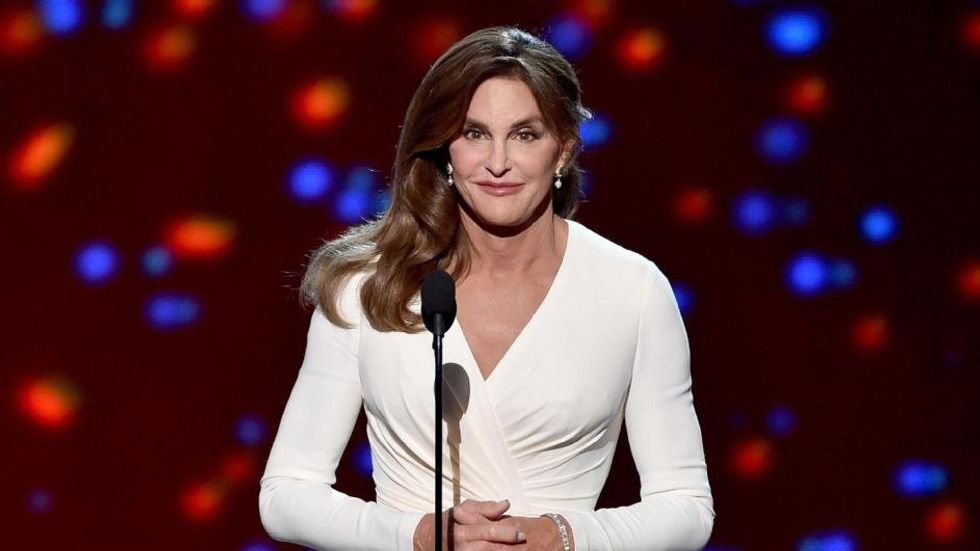
Caitlyn Jenner is a powerful woman. She has proven herself to be of strong will and sound mind on multiple occasions. She proudly flashes her Olympic Gold Medal on the cover of Sport’s Illustrated’s most recent issue. She exudes confidence with her posture and she holds eye contact with the camera.
Sure, Jenner is a controversial public figure. Consider a recent statement she made on behalf of Donald Trump; apparently, he “[...] seems very much for women.” Out of context, of course Trump may be a bit much, yet Jenner seems to excuse his excessive behavior. She stated that Trump allowed her to use whatever lavatory she wished to, in the Trump Tower, of course. As a reminder, she made it a point to let a certain politician know that “by the way [Ted], no one was molested.” She even posted a short video depicting what could be considered one of the hottest issues in mass circulation; Cruz probably did not expect the sass.
Despite her status, she still seems to be vilified in the eye of the public. In the social climate of 2016, it is no exaggeration to think of Jenner as a transgressive figure. On the surface, it may strike some readers odd that she identifies as a Republican. Beyond that matter lies a certain person who experienced the oppressive force of the repression of the self. Self-expression is at the heart of communication. Is it not also odd that Jenner was highly regarded as a prominent socialite before she was able to truly embrace her own womanhood? Regarding her Olympic success, she says “Everyone has their own way of trying to deal with it. The Decathlon was a good place to hide behind the guise of a strong symbol of manhood.”
The above quote is from the video "Jenner, 40 Years After the Gold." She follows up, “I had to prove to myself, maybe that woman who is living inside of me really isn’t living there.” In the video, she comments on her idea of her sense of self before and after transitioning. Perhaps it is worth noting how that during prompted interactions, Jenner seems to choose her words with strong consideration. During candid moments, Jenner can be glowing with laughter and life. Conversely, she jokingly calls herself a stud, referring to a picture of herself at the Olympics in ‘76.
Jenner says her life changed with just that one race. In 1972, she earned a spot on the U.S. team in Eugene, OR. Unexpectedly she achieved this despite being unnamed and unranked, filling the last available spot on the team. Eventually, she met qualifying standards, later attending the Olympic Trials that same year. The tension in the air in Munich during the Summer Olympics had not halted the games, however, Jenner still earned attention when she snatched 10th place. From then onward, she put her body through rigors until she competed in the 1976 Games; upon winning she was received as a national hero. Her subsequent rise as a recipient of the prestigious James E. Sullivan Award.
She is the epitome of a socialite; conversely, the backlash she receives is nearly blinding. The first statement found on RightWingWatch.Org, made by Kevin Swanson, is heavy-handed, to say the least. Not that being pegged as someone who is subject to the "Bondage Of Satan” is something to dismiss as a negative label. Who would not take such a label as a compliment when they live in luxury? Jenner is cautious with her public appearances, but her view of whales in the Pacific sure beats the fire and brimstone of hell, no? Perhaps it goes without being said that Jenner’s impact as an Olympic Gold medalist and as a trans woman is opening doors for the trans community by nature of her very representation in media. She normalizes the idea of trans womanhood. According to Dr. Johanna Olson-Kennedy, adolescent medicine specialist in the care of gender nonconforming children and transgender youth at Children’s Hospital Los Angeles,
“...parents who are scared or nervous about having a child come out as transgender, it suddenly feels like they’re not the only one, because they remember Caitlyn from the Olympics, and this is real. And for the kids, if they know Caitlyn at all, it’s from the Kardashians, but for them, their life is impacted by their parents’ being more open to their journey. It’s a lot easier for them if they have affirming and supportive parents.”
The idea of a trans community is foreign to some, and this is precisely why her representation in media is pertinent. The power that an image has, to dictate the way people organize their own personal thoughts (including the ones about minority groups like the trans community), is nothing to be toyed over in the comment section. The impact of figures like Caitlyn Jenner can be found in Roe v. Wade, which sparked an ongoing national debate. On the surface, Jenner’s media presence does not seem interrelated with issues like the extent of abortion laws, who’s making these decisions, and how morality and religion interrelate within a political sphere. However, in March of this year, when NC Governor Pat McCrory signed into law the Public Facilities Privacy & Security Act, it became difficult to deny that her public appearances may have softened some of the more intolerant attitudes toward the idea of trans acceptance and the acknowledgment of the fundamental human right to privacy.
As a woman known for her zeal and determination, Caitlyn Jenner must receive some sort of approbation for her way with people. That very same wit may give her the resolve to criticize Trump in the same aforementioned statement toward her ideas on his views. When Jenner first came out she may not have been the first person to do so publicly, but considering her impact, what’s left is a window overlooking her strength and courage. Her acquisition of a gold medal earned her glory; her acquisition of a gold medal will be striking the hearts of nonbinary children for many years to come.