In high school, I was the leading sprinter on my track team. It was a sport that I never thought I would love, having originally joined it to strictly stay in shape for soccer. But sprinting made me feel sure of myself and the community of runners I was surrounded by in high school was one of the strongest support systems I had experienced in a while. Some coaches at a school had heavily recruited me to run the 400m in college and eventually won me over with a partial scholarship. They came off as coaches that had my best interest in mind and cared about the athlete as a whole. I thought that I had found another strong support system. With that, I was excited to join their program. Extending my time competing in a sport I had loved for the previous four years was an ambition I was lucky enough to continue. At least that's what I thought at the time.
Team Standards
That summer leading into college, I was given workouts to complete on my own from my coaches. This included a lifting schedule with a card of various exercises I had to complete. I had never lifted before and the card was written in a shorthand that didn't even make sense to the professional trainers at my gym. I was expected to lift and get in shape without knowing what the specific lifts were let alone the proper form to do them safely. That summer I was barely able to complete a single workout because I had ended my high school career on an injury that forced me to rest for a large part of the break.
When I got to campus, the coaches had us go to the weight room to observe our workout, telling each and every one of us that "Now we'll really be able to see who did the summer lifts and who didn't."
It was in that moment that the true team culture become very clear to me. The worst was going to be assumed of you until you could prove people wrong. They coupled this with the idea that we were all lucky to be there. That at any moment, it could all be taken away from us and that there are plenty of other girls willing to step in to replace us. Everyone was constantly competing against and judging one another to see who was "cut out" for the coaches' praise and attention. Having been unable to workout as much because of the pain, I was instantly afraid of the other girls, worried that they would think I was a slacker and "not committed" to the sport and the team. This made it difficult to connect to them so I decided to keep to myself out of fear that I would mess up.
Practice After Practice
When official practices began, I still had severe pain in my legs every time I ran. The sprinting coach decided to keep me out of the team run and gave me stationary bike workouts to do in the NARP rec center. NARP is a term used by student-athletes. It stands for Non-Athletic Regular Person.
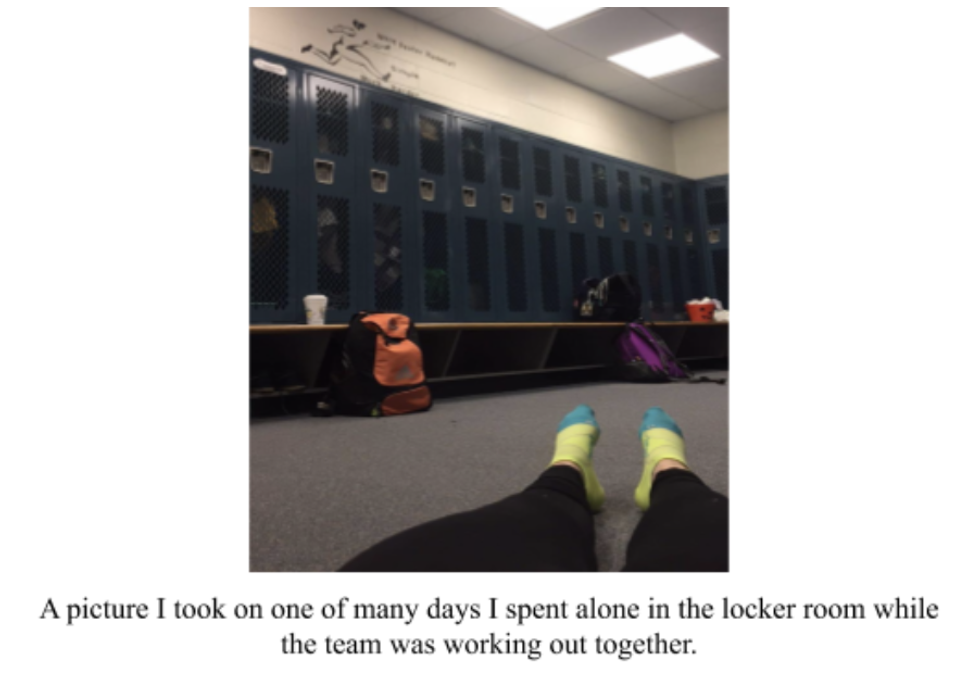
Even my coaches used this term and every time I heard it, it was said with a strong distaste and disgust in their tone. To this team, being a NARP was the worst thing you could be. This seclusion from the team continued each and every day at practice. Even my lift sessions were separate from the rest of the girls. While they traveled to the track down the road to workout, I was left behind to bike on my own and try to work with the trainers to figure out what was going on. I wasn't allowed to workout with them because of my undetermined injury.
"Phantom" Injury
The athletic training staff spent their time with me unable to figure out where my pain was coming from. After my workouts, I would go to them to receive treatment. However, these "treatments" were a string of random exercises they gave me and deep tissue breakdowns with the occasional guessing at what was causing me pain. Each time I came back, I had to break it to them that I was still experiencing the same amount of pain. I could not run without crying. It got to a point where they told me each day that nothing was actually wrong with me and that it was all in my head. My coaches got word of this and decided that I needed to run again. No one believed that something was actually wrong. I cried every day in the locker room out of frustration.
The day I went back to running, I was finally with the team again. We were doing whistle runs which involved running around a field until a whistle was blown. When you heard the whistle, you were to sprint as fast as you could until you heard it go off again to which you were to go back into a slower run. Within the first two minutes of the set, I had to stop because of the pain. I sat on the side of the field silently crying to myself while gripping my legs. I didn't want the other girls to see me being weak. My coach came over and asked what was wrong, clearly annoyed that I wasn't completing the workout. I told him and he sent me inside to the training room. It was then, over halfway through my first semester at school, that the trainers finally came up with the idea to have the doctor look at my legs.
That appointment, they decided on a treatment plan that was sure to fix the pain in my legs. It was called prolotherapy. This is when they take needles and inject sugar water into your legs. Supposedly, the sugar water was to call on the body's natural processes to cause the cells to be renewed. The day I got this done, I was alone. No coach or teammate came to support me or check in on me. After the injections, my legs had swelled up so much that it hurt to walk. I went across campus alone to lay down in my room in pain from the swelling. I did not hear from anyone on the team about how I was doing or how the procedure went. Oh, by the way, it didn't fix shit. I was back to square one.
Complete Decline
When I went home for winter break, I was given workouts to complete. This was my second time around trying to run again - alone and without the guidance of a coach whatsoever. I ran my workouts at my old high school and asked the athletic trainer there if she had heard of the procedure I had done. She hadn't. Over time, I asked various athletic trainers about prolotherapy and not a single one had heard of it let alone thought it would be remotely beneficial. Over the course of break, I attempted to run my workouts during the high school team's practice times. Within the first set, I had to stop running because the pain was too much once again. I hid in the stairwell of my former school crying and having a panic attack. I was afraid to tell the sprints coach that I could not complete yet another workout because I knew he wouldn't believe that something was wrong. The cycle was infuriating and at this point, embarrassing even. I had returned to my old team, a group of people that looked up to me, and I was crumbling before them. I had been reduced to nothing.
At this time, my mental health had declined more than I could have imagined. I had been suffering from depression and anxiety since sophomore year of high school, but within the first few months of college I was losing it even more. Panic attacks happened at least twice a day at practice alone. The stresses of track coupled with the isolation forced upon me had brought me to a point that I became suicidal. I kept this from my family and tried to handle it on my own. My experiences on the team had slowly broken me down to no longer seeing a way out. No one believed my pain, so why should I bother?
The Meeting
I had gotten to a place where I needed to leave the track program.The morning of returning to preseason, I found myself in my kitchen crying uncontrollably to my mom. I was terrified, but with shaking hands, I texted one of the coaches to hold a meeting. When I got to college, we were to instantly go to practice. That day I refused to practice with the team. Instead, I watched workouts and attended lift. The girls didn't even notice that I wasn't taking part in preseason.
After that, I met with the head coach and sprints coach in their office to discuss quitting. This was the first time the head coach had even spoken to me since I signed my NLI. I could tell that she felt blindsided by the words that stumbled out of my mouth. Once they heard what I had to say, they tried to strike a deal with me to stay on the team. They tried anything to stop me from quitting. I then told them of my mental health issues and they attempted to convince me that my mental health would be better if I just remained on the team, in complete denial that they were part of the problem. They truly had not the slightest clue what their team had done to me.
At this point, I couldn't bear the conversation any longer and uttered words I never thought I would say, "I hate running."
I didn't. I knew that they would never understand how I felt, my experiences on their team, and more importantly, I knew they wouldn't try to make it better for me. The conversation ended and they told me that I should go to team dinner to break the news to the rest of the girls. I felt no obligation to anyone there. They barely knew I was there most of the time. But, I went to the dinner and whispered the news. Not a single girl saw it coming, that's how little I was a member of their team.
Aftermath
Once I had quit, I became the one thing that team hated, a NARP. The small school I attended seemed even smaller. The girls on the team would see me around campus and glare at me, they didn't understand my reasons. I could feel their disgust in me, thinking that I just couldn't "handle" being a student-athlete.
Being there, no longer being an athlete had brought up an identity crisis I was not equipped to handle. So that following year, I transferred to UConn. In my first year at a new school, I was diagnosed with a severe case of compartment syndrome. The muscles in my legs could not compensate for the blood pressure increase that happened when I ran. Had I kept running, I could have ended up in an emergency surgery because of my legs essentially exploding from the pressure. In winter break of sophomore year, I got surgery to fix my condition. I spent three weeks unable to walk and was left with six scars all over my lower legs. My injury was very real despite having been in a place prior where every person in a position of power told me I was making it all up.
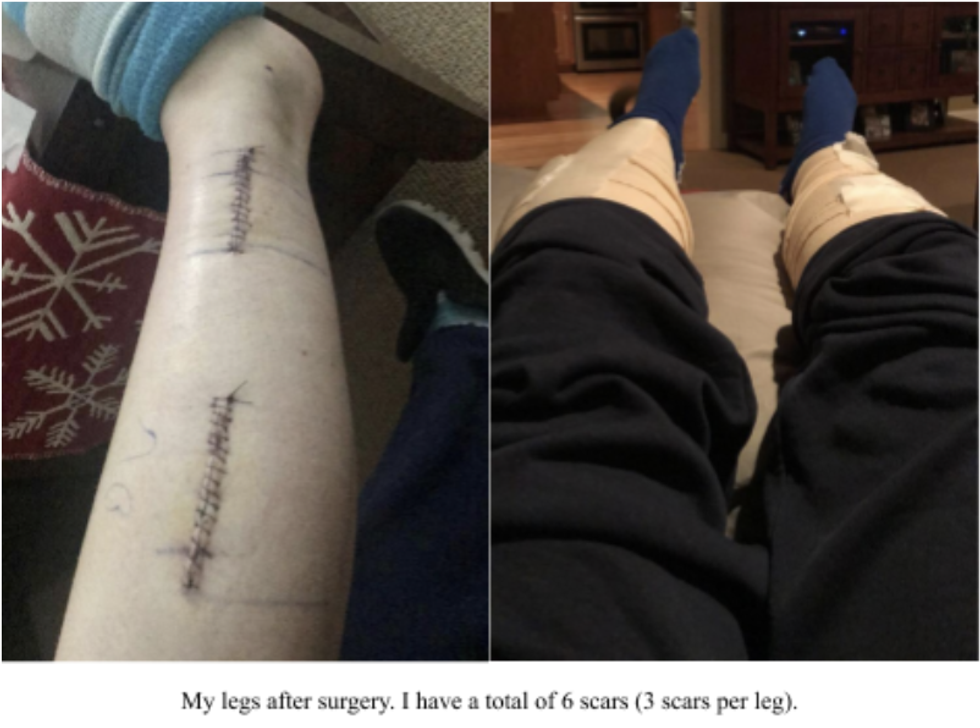
Wanting to be a part of a strong community again, I joined the D1 women's club rugby team on campus. If it hadn't been for my decision to quit, I would have never been able to try a new sport — a sport I now love and have been playing for three years that has brought me to national tournaments and even England. At my old school, I was simply the times I was able to hit when I ran races and when I could no longer be those times, I was cast aside. It was in quitting that I could see my worth again.