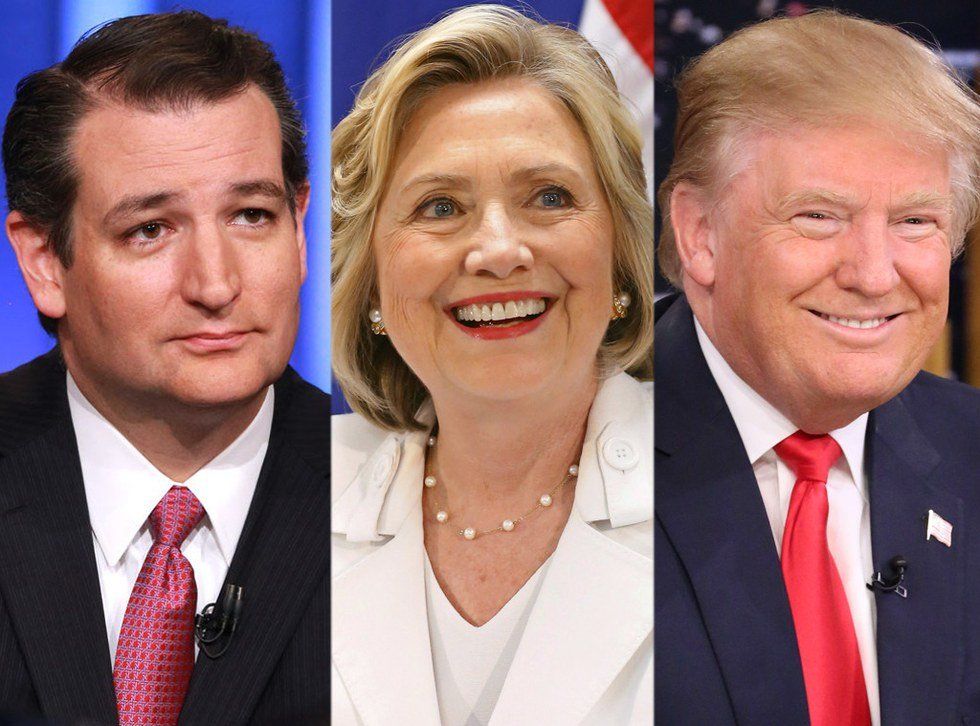
It is now safe to say that Donald Trump is the presumptive Republican presidential nominee. It has not been anything short of a crazy and unexpected election cycle, but one thing I have noticed is that it has been the cycle of unfavorable candidates. In this article I will examine the public’s perception of each candidate and the inverse relationship between unfavorability and success in this year’s election.
Let us begin with the favorable candidates. The most favorable candidate on the Republican side was, before he dropped out, John Kasich, also known as the “adult” on the stage. Kasich is a moderate conservative in this year’s election, otherwise known as a conservative in any other year. He believes in common-sense policies with a dose of pragmatism, in that that he is willing to reach across the aisle and get things done. The other thing Kasich had that the other two candidates did not is favorable ratings amongst the public. The people generally thought Kasich was trustworthy and likable. Nonetheless, he has won just one state, his home state of Ohio.
Next up is the only other candidate with favorable ratings amongst the five most recent candidates running for president: Bernie Sanders. Sanders is the Democratic Socialist running for the presidency under the umbrella of the Democratic party. Sanders believes in the rights of all people and believes we need to restructure our economy as well as our society in order to achieve the America that we want. Sanders is the most favorable candidate, according to the public. Sanders is not expected to win the Democratic primary.
Donald Trump, as mentioned earlier, is all set to be the Republican nominee. Trump is known for his nationalist, racist, and xenophobic policy proposals. Fortunately, he has the highest unfavorable ratings since polls of this sort began. Ted Cruz is known for being a great orator and a strong believer in his religious and constitutional values. For various reasons, some centered around his beliefs and others centered around the demonization on social media, Cruz also has extremely high unfavorable ratings. Ted Cruz recently dropped out.
Lastly, let us examine the Democratic front-runner, Hillary Clinton. Clinton is the moderate Democrat who believes in a strong foreign policy and the status quo. Because of past experiences, as well as demonization on social media, she has the unfavorable ratings roughly equivalent to Cruz’s.
John Kasich is eliminated, barring some unexpected activity at the convention, from the Republican nomination. Bernie Sanders, while not eliminated, faces an uphill battle for the Democratic nomination. Why is it that the unfavorable candidates have done relatively well compared to the favorable candidates in their respective parties?
The first reason is fear and perceptions of “nice” people. Each of the unfavorable candidates have struck fear into the electorate. Whether it is focused on terrorism, immigration, unemployment, the opposing candidates/party, or inexperience, Clinton, Trump, and Cruz have all put fear into their potential constituents. Kasich has been the most positive candidate while Sanders has cited a strong goal of economic and social equality. Republican voters have been scared into voting for anyone but Kasich because they do not believe he will be tough enough on terrorism or opposing countries on trade.
Democratic voters have been scared into thinking that Sanders policy proposals will never be realized, even if we are close to realizing some of them already. Clinton touts her experience in foreign policy, even though her results have not been that great, and Sanders’ inexperience as a reason to vote for her. Voters do not believe that a positive and nice person is what America needs in the Oval Office this year.
The second reason is the belief that a more important quality in the President of the United States is experience and toughness, rather than compassion. A lot of Republican voters would feel “safer” if Trump or Cruz were in the White House, instead of Kasich. The same goes for Clinton rather than Sanders for Democratic voters. In an election where fear is the number one motivating factor, we are likely to see one of the most disliked individuals in the White House come 2017.