
Collectivism (noun): a system with emphasis on the group, rather than individual action or identity
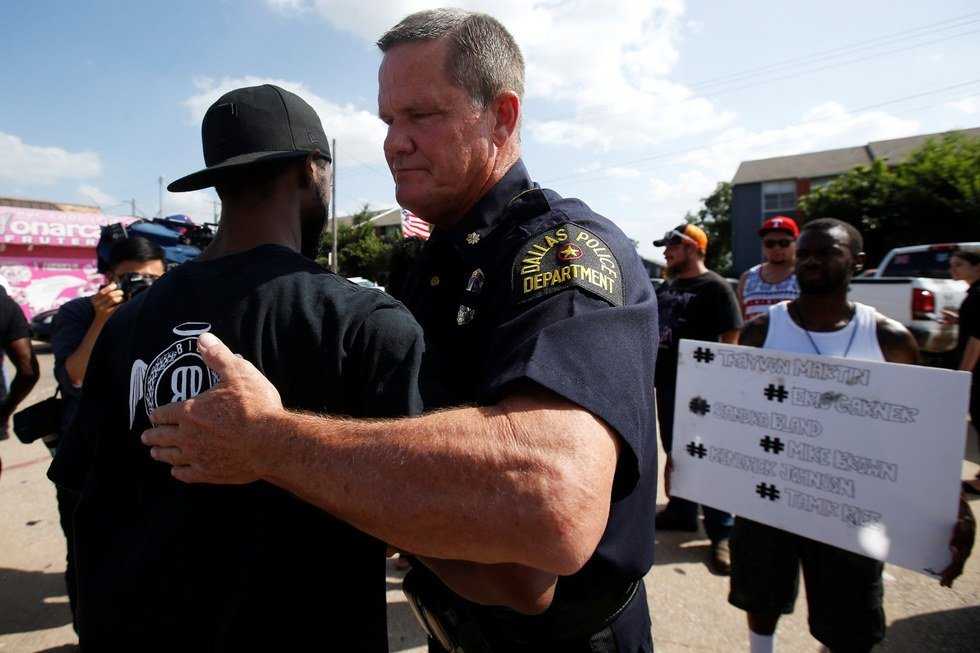
In the face of national tragedy, Americans often put aside differences for the sake of peace and unity. Yet, since the deaths of Philando Castile, Alton Sterling, and five Dallas police officers, last week, I have seen more calls for the heads of police officers everywhere or the activists of Black Lives Matter than calls for peace.
Demagogues, playing identity politics, have divided the nation more than it has been for decades. But this is what happens when people embrace collectivism; Americans view each other not as individuals with inherent value, but instead as cogs in rival factions.
As the dictionary so tells us, collectivism is a system which places the identity and well-being of a group above that of the individual. One lives for the collective whole; he works for the collective whole; and, he will die for it, if need be. And those who do not belong to the collective are outsiders, enemies. It is a primitive system that requires tribalistic devotion and bloodshed to survive. And yet it survives, and will continue to do so, so long as Americans of one identity place the blame at the foot of every American of another identity.
Collectivism is normally discussed in the field of political economy— specifically when describing Marxist Theory— although it extends far beyond economics, as is the case here. According to Marx and his acolytes, the violent overthrow of the bourgeoisie is the prescribed cure to the plight of the proletariat masses; all wealthy citizens are to be stripped down for the benefit of the poor. So what would the collectivist philosophy have us do now? To save the lives of African Americans, should we abolish all police departments, allowing society to descend into lawlessness? Or to save the lives of officers, should we place all blacks in internment camps? Because of course, all police, the pigs they are, deserve to lose their livelihoods; because all blacks— criminals, the lot of them— should be under constant surveillance, deprived of their human rights.
The above suggestions are disgusting, advocated, if at all, only by the most radical and racist among us; and, above all, they are ridiculous to the point of extremity, and should highlight that all police are not murderous pigs and, likewise, that all blacks are not criminals. But collectivism would have it so that all members of a specific subset are viewed as identical, without their own individual worth, and as threats to any opposing— and opposing here does not have to mean rival, but simply different, for collectivism encourages tribalism and hostility towards that which is different— groups.
Collectivism is intended to inspire an “us versus them mentality;” it pits groups against one another with the understanding that violence is sure to follow. And to quote the reverend Martin Luther King, Jr., “hate begets hate; violence begets violence.”
But what are we to do? That is a pressing question that will be addressed and debated on the national stage in the coming days, months, and likely for several years to come. But in the meantime, it is important to stop thinking what we as a nation can do and ask ourselves what I as an individual can do. And the answer, simple as it may be, is for an individual to never judge another by the color of his skin, or the badge he wears to work every morning; not by the clothes he wears, or the neighborhood he lives in; not by the size of his income, or lack of one. A man should be judged only by his character; a man should be judged by only his own actions— but far too often, he is held responsible for the actions of those who occupy similar positions in the societal ladder; he is grouped together with those who fit into the same subsect of society.
Yet society itself is nothing more than a collection of individuals. And in our American tradition— although it is often openly disregarded nowadays— all individuals are entitled to their rights of life, liberty, and the pursuit of happiness (or property, if you prefer, although Jefferson and Locke viewed them much the same). You do not need to believe in a god to believe in Natural Law, that any human holds the right to his own life and all the corollaries thereof. Philando Castile, Alton Sterling, and the Dallas police officers were all stripped of their right to life— but that does not mean we should deprive others of the right to their lives by continuing the cycle of collectivist thought.
There’s enough pain in this world when everyone gets along— society exists simply to ease some of that pain, to benefit from individuals working, living, and loving together. Yet, collectivism deprives the individual of his identity; it breeds the hate that makes life ever more difficult.
Ancient wisdom from the Bible tells us that Jesus advised his followers to turn the other cheek when met with violence, a sentiment echoed by Martin Luther King, Jr.: “We must meet the forces of hate with the power of love.” Certainly, there will always be evil people in this world, but so long as we paint individuals in broad strokes, we, too, court hate and violence, for that is what we do when we embrace collectivism. That is what we do when we name all cops pigs, all blacks criminals, and, in doing so, pit the two against each other.
Collectivism, in this sense just as in the economic one, leads not to an increased quality of life for one group at the expense of another, but to increased misery for all. That’s what we’re observing in Dallas, in Minnesota, in Louisiana. And it’s the fate of our nation should we fail to recognize the collectivist identity politics that plague us today.