
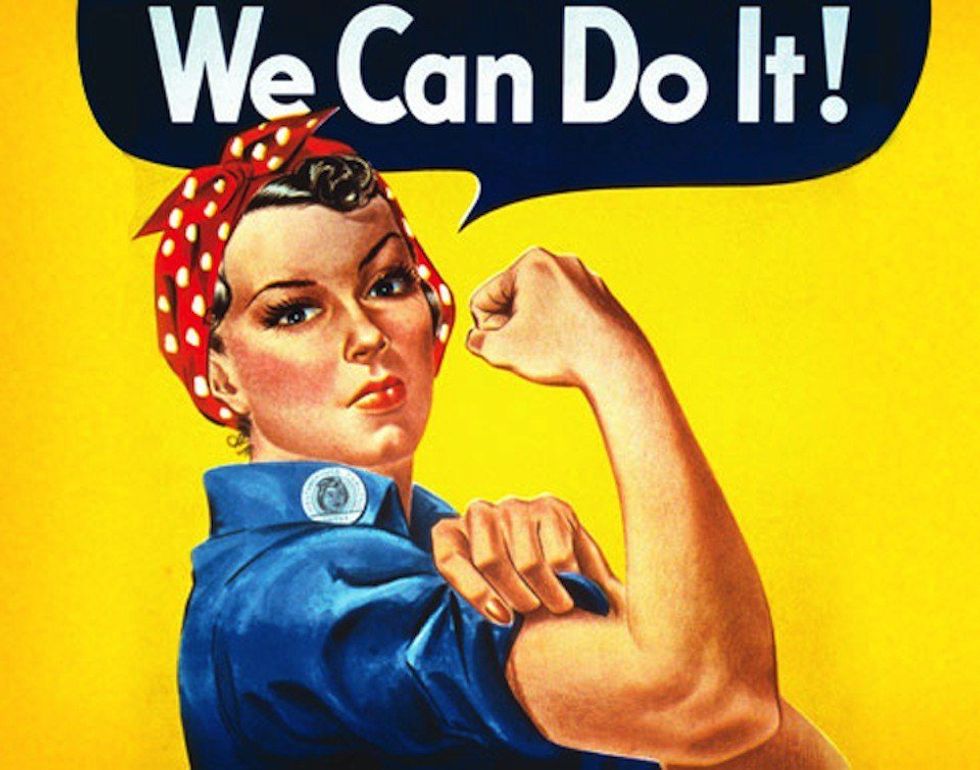
A while ago, I was talking to a friend of mine about double standards in our society and how women are now expected to balance their careers, family, social obligation, their health and also maintain a flawless household. At some point in the conversation, I said, “This is why I am a feminist” and almost instantaneously, he recoiled as if I had just declared to the world that I was a neo-Nazi. I didn’t quite understand why he reacted the way he did, so I asked my friend, “What? Feminism is a woman’s struggle for equal rights amongst men. What’s wrong with that?” His response? “Yeah, that’s what the word means, but that’s not how most of the world sees it. Feminism is the new “F” word because it is commonly associated with a mental image of a crazy lady standing on a soap box preaching about the misogynistic and oppressive crimes all men commit and how females are always the victims in these crimes." As the conversation continued, I began to realize that the definition of feminism at its core and what is commonly understood as feminism are not one and the same, and associating the struggle for equality with radical reverse oppression prevents the goals of feminism from being reached.
According to Merriam-Webster’s online dictionary, feminism is defined as “social, political and economic equality amongst the genders.” However, a popular online dictionary commonly used to define colloquial terms such as “dab,” “swag” and words of the like defines feminism as “a political, social, and cultural movement that aims at equal rights for women. Its beginnings and extreme controversy in a (Western) patriarchal society has created stigma and stereotypes associated with the definition. Some include that feminists are: lesbians, man-haters, and ‘hairy-legged [women].'” This widely accepted colloquial definition is the root of the problem. As long as the majority of society views feminism as a negatively connoted cause, the goal of reaching political, social and economic equality between men and women will remain a mere dream with little chance of becoming a reality.
When associating feminism as a whole with the words “preachy” and “man hating”, the portion of society that does so fails to realize that feminism is not a singular block or entity. There are over 20 different branches of feminism with the three most popular branches because liberal feminism, socialist feminism and radical feminism. According to Dr. Rose Norman, a retired professor at the University of Alabama in Huntsville, liberal feminism is “the variety of feminism that works within the structure of mainstream society to integrate women into that structure. Its roots stretch back to the social contract theory of government instituted by the American Revolution,” Dr. Norman also identifies socialist feminism as “women are oppressed, and attributes the oppression to the capitalist/private property system. Thus they insist that the only way to end the oppression of women is to overthrow the capitalist system.” and radical feminism as “the bulwark of theoretical thought in feminism. Seen by many as the "undesirable" element of feminism…The reason this group gets the "radical" label is that they view the oppression of women as the most fundamental form of oppression, one that cuts across boundaries of race, culture, and economic class. This is a movement intent on social change, change of rather revolutionary proportions,” The branch of feminism that is most commonly associated with the “crazy soap box lady” stereotype is radical feminism as it tends to use a more forceful approach to gain equality than the other branches. The blatant assumption that all feminists are radical feminists is one of the main reasons why the ultimate goal of feminism, to earn social, political and economic equality for all women, is not within reach yet.
What the media portrays as "feminism" isn't actually feminism. Non-violent protests and picket marches don't make good new stories or movies, which is why only extreme displays of feminism are displayed via different media outlets. In her article regarding the portrayal of women and feminism in the media in the National Women’s Studies Association Journal, Debra Baker Beck identifies the representation of feminist values in the media as catfights stating that “besides highlighting the extremists, the media typically depict the diversity of women’s views and philosophical disagreements between feminists as nothing more than trivial catfights,”. Representing all feminists using broad generalizations as those who engage in “catfights” inherently perpetuates the “crazy soapbox lady stereotype” thereby causing the ultimate goal of feminism to become increasingly distant rather than closer as desired.
Critics may argue that what society believes is feminism should be the formally stated definition because the dictionary definition has no value if the common public does not abide by it. This argument can be compared to the definition versus the interpretation of the term “sexism.” If society refuses to accept the definition of sexism as prejudice and discrimination against a particular gender and instead understands it as discrimination against only females or only males, the true definition of sexism would not matter because very few individuals recognize that sexism is applicable to both genders. However, all members of society who are aware of the difference between the dictionary definition of feminism and the commonly accepted definition of feminism must urge their fellow citizens to learn and abide by the true definition of feminism because not doing so would be a great injustice to females.
For hundreds of years, women have fought for their right only to be mocked and discouraged by those who think women are incapable of being equal with men due to physical, mental and emotional differences. However, the struggle for equality has turned into a two-fronted battle with those who believe that men are better than woman on one side and those who assume that all feminists are radical “crazy soap box ladies”. As the former Indian Prime Minister Jawaharlal Nehru once said, “You can tell the condition of a nation by looking at the status of its women;” those who are less than inclined to acknowledge the true meaning of feminism are not only preventing feminists from realizing their dream of social, political and economic equality; they are also preventing their nation from realizing its full potential.