“If I should have a daughter, instead of mom, she’s gonna call me point B. Because that way she knows that no matter what happens, at least she can always find her way to me.”
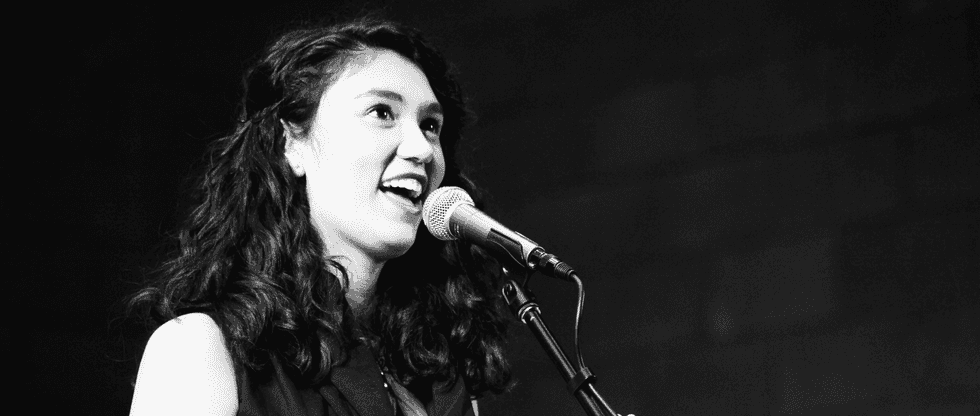
Sarah Kay’s 2011 TED talk opens with these lines as she recites her spoken word poem, B. Until I watched Sarah’s talk, I thought that poetry was: a) only written by old people, b) exclusively comprised of metaphors, and c) always supposed to rhyme.
Turns out, those rules and restrictions only exist in your head, egged on by stereotypes and terrible high school English class curriculums across the country. Poetry is not just a bunch of old white dudes sitting around staring at meadows, waxing eloquent about their perpetual spot in the friend-zone™ and reminiscing about their young, drunken days in long-ago wars. Poetry can be anything: cover any topic, use any words, take any form. Poetry is about giving yourself a voice and taking a stand.
A quick vocabulary distinction here for those of you who don’t know: while your English teacher taught you that poetry goes straight from the page to your eyes, poetry can take many forms. While many poets do simply write their work down to be read on a physical page, some write their poems specifically to be performed. These are commonly referred to as spoken word or slam poems. They are performed by the poet at poetry slams (which, for the record, do not always feature bongo drums and quiet snapping as An Extremely Goofy Movie would like you to believe). I’m covering poetry slams today, but they are not any better or cooler than poetry written exclusively on the page.
The most important thing about poetry is that there is no right or wrong way to be a poet. You can blog about it, write it down on old fashioned paper, make a video performing your piece, go out into the streets and preach the truth bomb you just created to the world. However you want to share (or not share) your poetry: you can do that. Like Shia Labeouf once said: just do it.
If you’re new to the whole slam poetry scene, don’t worry; I’ve watched approximately a billion poets doing their amazing poet thing, and I’m going to show you the highlights reel. But for real, if you find someone you like or a topic you’re passionate about, put your hands to the keyboard and get thee to a search engine. There are tons of slam poets out there who write about the things you care about, and a quick search of the internet will help you find them.
And if you’re feeling really inspired: why not write your own? Is no one talking about that thing that you’re obsessed with and deeply care about? Now someone is, and that someone is you. Whether you prefer the pen or the camera, you can create poetry that speaks truth about something important or relevant to you. Whether or not you share it is up to you, but I dearly hope that you do so that others can bask in the awesomeness that is your poetry.
But, for now, get ready to be inspired and enlightened by some of the most amazing poets writing and slamming today in a little segment I’m calling “Come on and Slam and Welcome to the [Poetry] Jam”.
[Quick note because I am concerned about your well-being, friend: some of these poems have language that some people may find uncomfortable and topics that some may find triggering or hard to listen to. I’ll try to let you know ahead of time, but here’s a heads-up.]
Like Totally Whatever by Melissa Lozada-Oliva: This girl is incredible. Her defense of upspeak and the way teenage girls talk is, like, perfection. [tw for sexual assault]
What Guys Look For In Girls by Savannah Brown: I’m putting this on the list for mainly selfish reasons; it was one of the first slam poems I ever watched, and it inspired me to write my own terrible poetry. Nevertheless, it is an amazing piece, and deserves all of the attention it garnered when it was published back in 2014. [tw for bullying and body negativity]
The Friend Zone by Desireé Dallagiacomo and Justin Lamb: This poem is hilarious. It’s a team piece, which means that the two poets performed it together, and they did a fantastic job as a pair. [tw for language, sex references, and catcalling]
And the News Reporter Says Jesus is White by Crystal Valentine: I saw an incredible quote from this poem floating around the internet in light of recent news, and the whole piece is even stronger. This is the kind of poetry we need more of in our communities. [tw for death]
Phase by Kevin Kantor & Sienna Burnett: It is so easy to ask for advice online and search for answers in other people’s lives, and this poem touches on that and sends out a signal to everyone who is hurting because they do not know if they are whole. It is beautifully delivered and the prose is gorgeous. [tw for suicide]
George Watsky at VidCon 2014: George Watsky is one of my favorite artists. He’s written so many amazing poems, I couldn’t really whittle it down to just one, so here’s a video of him at VidCon, where he performs several poems and talks about why slam poetry is a cool art form and why he does it. [tw language and sex references]
The Type by Sarah Kay: Gosh, I love Sarah Kay. Her poems have this element of softness and gentleness in them that is so comforting.
Meanwhile, In Post-Racist America by Raven McGill: Racism is a problem in America, and it’s not going away. This poem shows how wrong our society is and how our culture must change. [tw for violence]
Dear Straight People by Denice Frohman: I was lucky enough to see Denice perform this poem live during my freshman year, and let me tell you, it was a religious experience. I don’t really have words to describe how great it is, so you’ll just have to watch it. [tw for language]
Now that you're totally in love with slam poetry, go. Go out into the world and tell them what you know, and what you don't. Talk about the people you love and the towns you hate, the parties you went to and the friends you made, tell them about your first kiss and broken bone. Tell them about your life, the one they can't live, because they don't exist inside of you. And listen, and learn how others live, too.