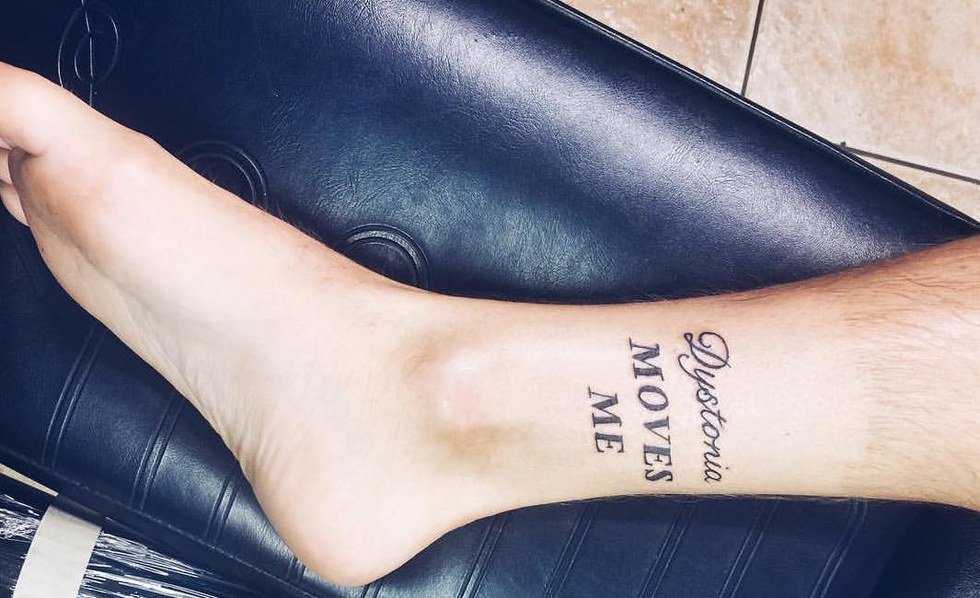
In the last month, I decided to partake in a form of delinquency that the younger, "goody two-shoes" version of me never envisioned for myself. I got a tattoo. It wasn’t a Chinese character, an infinity sign, nor was it the initials of a significant other. Upon the medial portion of my right ankle now reside three words that have come to fuel much of my ambition and character: “Dystonia Moves Me.”
The typical reaction of those that happen to catch a glimpse of my tattoo, frequently covered by socks and pants, are squinted eyes and a stutter as they attempt to say the first word engraved upon my skin. I promptly assure them the pronunciation, and without hesitating, I provide an explanation for the mildly cryptic message.
Dystonia is a neurological condition, which plagues individuals with involuntary muscle contractions, causing usually painful, uncomfortable, and unnatural-looking body postures and movements. While dystonia manifests itself in an assortment of ways, my mother unfortunately suffers from a more rare subtype that inhibits and permeates her life in a devastating number of facets.
Intermittently and unpredictably, my mother’s body decides to turn against her and strips her of the basic control that we take for granted every day: moving. During several days of the week, at any given time, and lasting as long as four hours, my undeserving mother will battle the overactive neurons and chemicals that once allowed her the freedom to navigate her life independently.
While maintaining consciousness, her legs and feet will invert so that they are nearly perpendicular to her knees, her fingers and arms will writhe from side to side, her eyes will become glued shut, and her neck will bend so that her ears are almost touching one of her shoulders. She attempts to speak out and cry, but struggles because her jaw is locked, her vocal chords are taut, and her priority is to not drown in her saliva from a reluctant esophageal sphincter. Her breaths are heavy due to the force of her tightened accessory breathing muscles near her ribs and diaphragm. In the most severe attacks, where the dystonia is completely generalized, her upper or lower body will tremor vigorously, and her body may even begin thrashing her back and forth, similar to the convulsions seen in grand mal seizures.
In the beginning, I used to feel compelled to conceal the terror and hide the anxiety I experience when spending time with her from others. I feared pity, and perhaps I hoped that silence would let me go on with my life as I had originally planned. In my head, I was supposed to be the happy-go-lucky 21-year-old nursing student that worries about completing my homework on time, working out, and hanging out with friends, all without the indefinite worry of an alarmingly and incurably sick mother.
I realized the problem with this unjust attitude in the midst of nursing school. We are taught, as novice nurses, that one of our fundamental responsibilities is to advocate for our patients; my mom is my highest priority and most precious patient. My silence regarding her medically misunderstood, under-researched, and neglected condition perpetuates and exacerbates her voicelessness and helplessness.
I loudly speak up, gladly educate people, and proudly bear a tattoo on my body for my mom and people with dystonia disorders because- well, for the same reason nurses are needed- vulnerable people so commonly cannot help their selves but I know I can help them. I once was moved to tears by the thought of my incredibly compassionate and selfless mother enduring such daily uncontrollable turmoil. But, now, I am moved to action. Every step I take, I choose to do so purposefully, genuinely, and jubilantly as I am acutely aware of this unhindered privilege that I possess.
While dystonia quite literally moves individuals vilely and relentlessly, it propels me to work and live extraordinarily and righteously to the best of my ability. As a nurse, I maintain the honor of being a servant to those less fortunate in a hospital. Because dystonia robs so many of the luxury of self-determination any day of their lives, I am moved to transpose this type of nursing servitude as a duty every day of my life, outside patients’ rooms. Dystonia, it, indeed, moves me, too.