

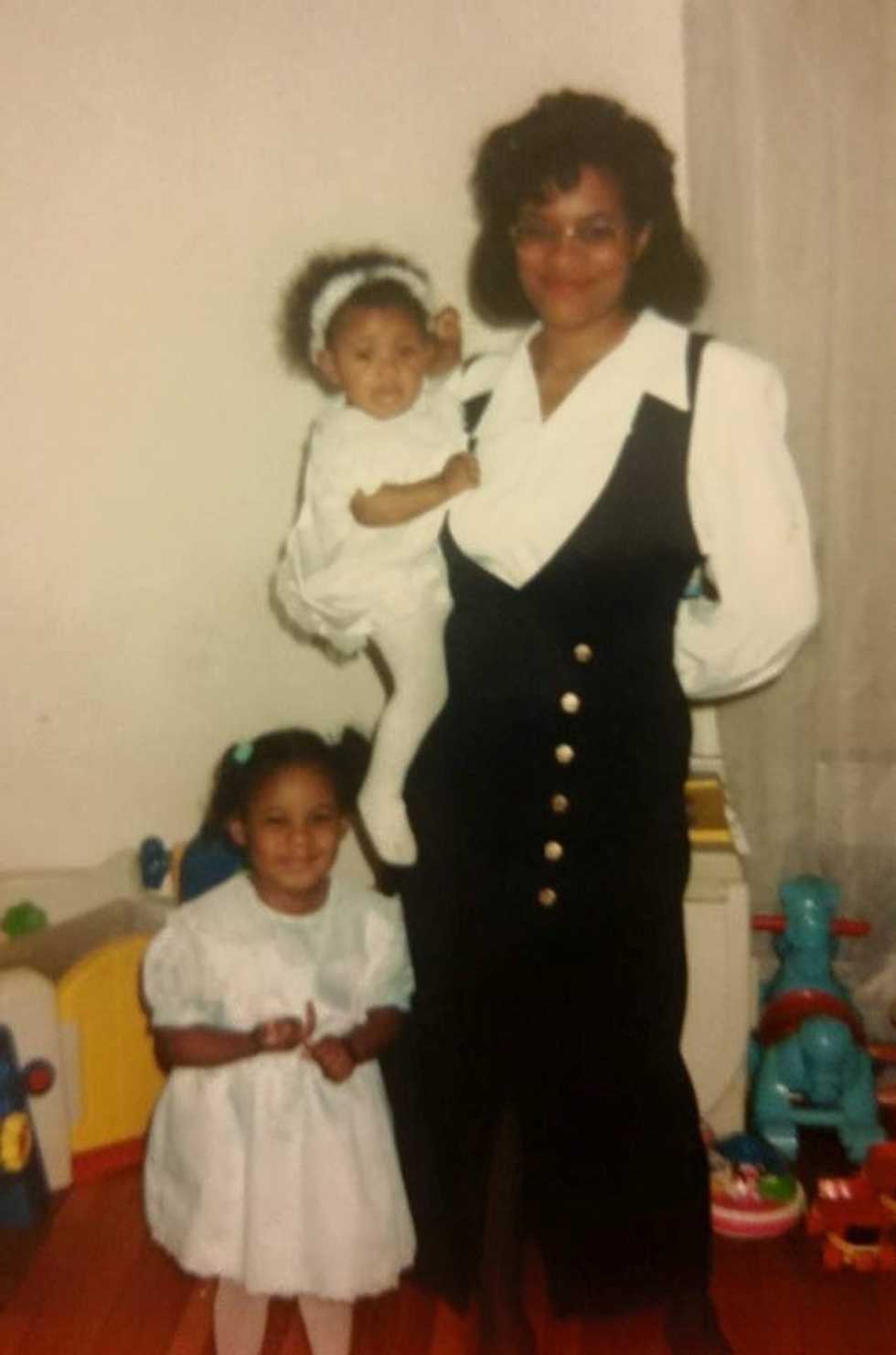
Growing up in an epileptic household has left me vulnerable. To me, they are one in the same. Epilepsy and vulnerability; they are synonymous. According to Merriam-Webster’s dictionary, Epilepsy is, “a disorder of the nervous system that can cause people to suddenly become unconscious and to have violent, uncontrolled movements of the body.” If you look up vulnerable it states, “capable of being physically or emotionally wounded”.
The first time I saw my mom have a seizure, I felt numb. Time stopped, and my eyes welled with tears. My older sister’s voice was faint in the background telling me to check the time. My life became a haze as I looked into my mother’s eyes quickly shifting and rolling. “Dahlia check the time!” My sister’s voice became louder, recognizable and time sped up. Within those two minutes, I witnessed death and rebirth. I heard my mother’s choked cries for help as her nervous system chose, once again, that it was in charge. As my sister slowly asked my mother questions, she came back to normalcy; although slower than before, she once again, gained control.
Her answers were mutters and child-like as her brain recovered from the ungracious play it had endured. “Do you know your name?” she would nod, “Yes” and a moment later say “Lisette Midyette.” My mother, my sister and I sat there in unison as we realized we were helpless. All of the feelings were mutual, mentally and emotionally. My mother on the inside wanted to say she was okay, she wanted to hold her babies and say that everything was perfectly fine. My sister and I wanted to hold her and tell her that we understood. We all sat there in silence afterward, every few seconds my sister or I would ask “Mommy are you okay?” and she would nod, “Yes”. I was 12 when I first truly felt what it meant to be vulnerable.
My mother was diagnosed with epilepsy and so was my entire family. Technically she was the one having the seizures, but we all absorbed her pain, and we suffered from the same vulnerability. I can remember at every cheerleading competition since I was 13, I hoped to see my mom in the stands. I knew deep down she couldn’t be there. She was either too tired, would become too tired, or something would trigger her seizures. Years went by as my house rested under a thick black cloud of vulnerability. Most days the sun would shine through, but we always saw the cloud. Every time we left the house we all stepped over the vulnerability line; it took my mother four years to step over that line with us.
My four siblings had similar experiences to mine, “I have always seen mommy take on five children, work, home, and then some. To see her like that was hard,” expressed my eldest sister. In simpler terms my 16-year-old brother recounted, “I guess I was a little scared and confused.”
I can remember going places and being around people who were ignorant towards epilepsy. It was the prime joke of middle-schoolers and high-schoolers, “____ looks like they’re having a seizure.” Everyone would laugh and even as ashamed as I am to say, I would sometimes absently join in. I thought to myself every time as the laughter silenced, what do these people know about seizures, what do they know? It was in those moments that my adolescent “laugh to fit in” mind would look up and see that my thick black cloud of vulnerability had followed me.
My father wrote to me, his experience of witnessing my mother, his friend, have a seizure for the first time. “It is very difficult for me put into words my experience the first time I witnessed Lisette experiencing a seizure. A seizure can be terrifying to watch, especially if you've never seen one before. As for myself, I have never seen one before so I totally felt helpless when I first saw mommy having a seizure. My superman aura of invincibility was no more. I could not help her and was not sure what I was supposed to do. I let her down. I took pride in being able to always help those that I love and I could not and did not do that in this instance. I felt terrible to see her in this state and not being able to help her. I knew if she were to pull through, I would set out to learn what needs to be done in order to effectively respond the next time such an event would occur. Here is what I learned to do:
- Roll the person over onto their side. This will prevent them from choking on vomit or saliva.
- Cushion the person’s head.
- Loosen the collar so the person can breathe freely.
- Take steps to maintain a clear airway; it may be necessary to grip the jaw gently, and tilt the head back slightly to open the airway more thoroughly.
- Do NOT attempt to restrain the person unless failing to do so could result in obvious bodily harm (e.g. a convulsion that occurs at the top of a stairway, or the edge of a pool).
- Do NOT put anything into the mouth. No medicine. No solid objects. No water. Nothing. Despite what you may have seen on television, it is a myth that an epileptic can swallow their tongue. But they could choke on foreign objects.
- Remove sharp or solid objects that the person might come into contact with.
- Time the seizure. Take note: How long did the seizure last? What were the symptoms? Your observations can help medical personnel later. In some instances, one may have to seek medical assistance if the seizure lasts for longer than 5 minutes.
- Stay by the person’s side throughout the seizure.
- Stay calm. It will probably be over quickly.
- Do NOT shake the person or shout. This will not help.
- Respectfully ask bystanders to stay back. The patient may be tired, groggy, embarrassed, or otherwise disoriented after a seizure. Offer to call someone, or obtain further assistance, if they need it.
No one ever wants to be in a position where they are unable to help the person they love. So I made a commitment to find the best medical professional help who can assist Mommy with effectively managing her seizures as well as educate me as much as I can about seizures and epilepsy. The journey has started and continues to this day.”
Living in an “epileptic household” meant that every creek, every bang, every text, every phone call equated to the possibility of my mom having a seizure. I can remember every time I walked past my mom’s room, peaking my head in, and releasing a comfortable sigh. The times when my two older sisters and I would shield our little brothers from witnessing the uneasiness. Praying my mom wouldn’t have a seizure while my friends were over because they weren’t capable of understanding. My vulnerability spread like a disease, and I know my families did as well.
This isn’t a story meant to victimize those who prevail with epilepsy, or my vulnerability. I’ve seen more strength than weakness and I’ve learned to shed some of these vulnerable feelings. For each seizure I’ve witnessed, I’ve seen more elasticity. My mother is by all means the strongest, most nurturing, forgiving, and empowering woman I’ve met. I will never be okay or comfortable witnessing my mother have seizures. Each time I see it take place, I rewind back into my 12-year-old self and for a second, I freeze. Every time, the minutes slow down, and with each second passing, my worries grow two times faster. There will always be a moment when an unexpected text or phone call from my family makes my nerves jump. Growing up in an epileptic home made my family vulnerable, but it did not make us afraid or incapable.