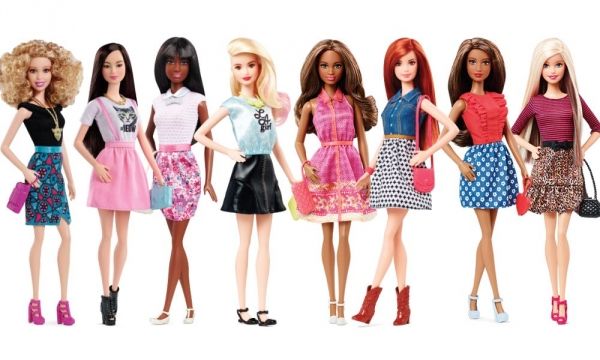
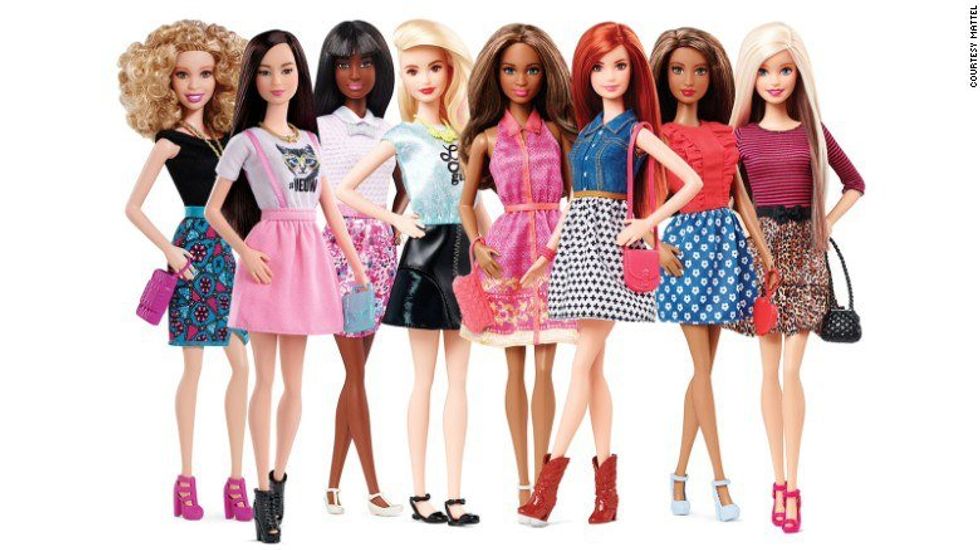
This week, a lot of attention has been brought to Mattel’s new additions to their Barbie enterprise. Mattel has expanded their Barbie line to dolls with four different body types, seven different skin tones, 22 eye colors and 24 different hairstyles. This was announced just a year after Barbie began fashioning removable ankles to wear flats instead of heels.
At this point in time, if you have not seen the photos of Barbie in life-sized proportions along with a doctor-cited explanation of how her 16-inch waist and 32FF breasts wouldn’t be able to sustain life, then you are probably living under a rock. We all know that Barbie’s proportions are unrealistic (she is made of plastic, for goodness sake), but the question has always been whether or not the world’s children knew this. A truthful answer would probably be that they do not.
In a world where the media is constantly promoting the unattainable perfect body, I do think that Mattel’s efforts to change Barbie’s figure (even if it is after over 50 years) have somewhat good intentions. The new Barbie now has three optional body types: short, tall, and curvy. The upcoming generation of doll users now have the chance to choose a Barbie body that they identify most with. But, with these new body options in mind, Mattel has forgotten that these characteristics are all relative. Relative to what, you ask? To original Barbie. Now, not only will a younger generation have to decipher which Barbie looks most like them (and face possible disappointment when they find one that does not), but the fact that they don’t have the same proportions, height or non-existent curves as original Barbie is exaggerated.
While I applaud Mattel for attempting to expand the standard of beauty, I believe that it is important to something into account: Barbie is a doll. She is a character created by Mattel years ago who has now suddenly surrendered her figure, skin tone, and hair color in the name of average-ness. Over her 50-something years of existence, we have encountered Barbie as an astronaut, teacher, doctor, mom, big sister, wife, and dog owner. She was created and expanded to show young girls that they can dream and strive to be anything that they want to be.
We need not pick apart the fact that she is blonde haired, blue eyed, big breasted, and long legged. Barbie is a single character and the fact that Mattel happened to designate these characteristics to her body is not, and should not be, important. Yes, her body is unrealistic, but we need to focus less on her appearance and more on the premise of her original creation: a toy. This character has been given the opportunity to have any job that she could ever dream of, has traveled to every country in the book, and has a larger social circle than most humans (even larger if you take into account all of the play dates that she had with the rest of the action figures and stuffed animals that you kept in your toy bin). By centering all of Barbie’s critiques on her appearance, we are only inflaming the importance of appearance instead of diminishing them.
I understand what Mattel has attempted, but I think that there are more important social issues to criticize than Barbie’s proportions. We need to focus on all that Barbie can teach, instead of what she is doing wrong. If parents are looking at Barbie and immediately looking to highlight all that is off concerning her physical appearance, then that is what they are teaching their kids to worry about. We need to stray away from focusing on Barbie's body, as that is the only aspect of her life that is getting public attention these days. Just like everything else surrounding women in the media, her body has been the main focus of her fame over the past decade and it needs to stop. We need to drift all of her reputation away from her looks and towards a more influential message for future youth: that anything is possible and that the sky is the limit.