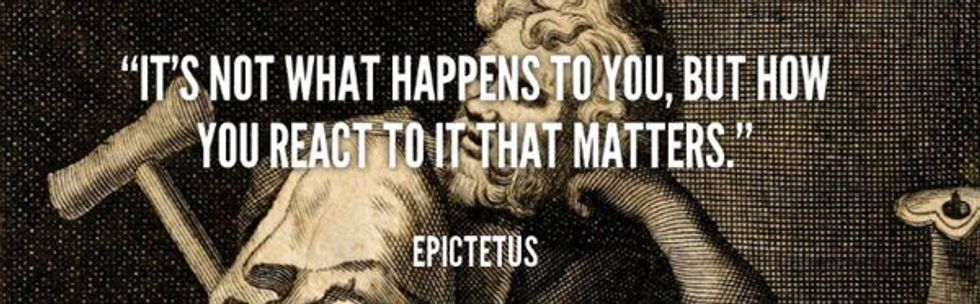
There is an opinion in our generation that everyone has a right to their own opinion without reproach. Well intended safe spaces have turned into places where people will complain and protest over any idea that doesn’t fit within their ideology. Life is hard, and some people would rather complain about how it is unfair instead of working through the hard times to become better. These people could learn a lesson from the ancient stoic philosophers like Marcus Aurelius and Seneca.
“Get rid of the judgement, get rid of the ‘I am hurt’, you are rid of the hurt itself.”
-Marcus Aurelius
We are only hurt by things that we choose to hurt us. Sticks and stones. Life isn’t as much as what happens to you, it is how you chose to react to it. Holding onto a grudge or ill feelings toward someone will only lead to tiring yourself out.
I like the story of the cup of water. A professor asks a student in a class to pick up and hold a cup of water at arm’s length. Then he asks his students how much the cup weighs. They begin to shout out answers before he stops them. He explains to them that it does not matter how much the cup weighs, but for how long you hold it. You can hold the cup for a minute and be fine, you can hold the cup for an hour and be sore. Eventually, no matter how light the cup is, it will be too heavy to hold up anymore and your arm will be damaged in the process. The longer you hold onto something the more damage it can cause.
Stoicism is the philosophy of suffering in silence. It is the endurance of a pain or hardship without the display of feelings and without complaint. It is living simply, keeping your head down and putting in the hard work to get you through any obstacles you face. Recognizing that those obstacles can often serve as the means to further your ambitions. Stoicism is more than a philosophy; it is a way of life.
Doing work in silence can often be more effective than being loud and making a lot of white noise, and also not getting a whole lot done. This energy that could be used toward accomplishing goals is taken away when it is used to fuel complaints about things outside of what you can control.
“Virtue is nothing else than right reason.”
-Seneca
We have lost our connection to our more stoic selves. We were raised with a “good job,” a thumbs up, and a participation trophy. The rise of social media has led to a culture of “likes” “retweets” and self-centeredness. We idolize people online who only post a small idealized portion of their lives. We only see their successes, not their struggles. I love the expression “don’t compare your practice footage to someone else’s highlight reel.”
We don’t grow unless we are challenged, and when people in college are too afraid to have their opinions challenged and debated, there is no mental growth. College is supposed to be hard. It is supposed to challenge our opinions, challenge what we believe in. People protest when someone doesn’t agree with their ideas at an Ivy League school that costs $100,000 of dollars while people all over the world suffer in silence through things like hunger, war, and violence. If the energy we spent complaining about our own petty problems was instead refocused to helping those who actually need it we could get incredible things accomplished.
The guiding tenants of self-control, fortitude, and a deterministic perspective on life have led leaders from Marcus Aurelius to Churchill to many present day leaders. These timeless values can be read in a book that is less than 30 pages and cost one dollar. These ancient philosophers can teach the lesson better than I can, but it is a lesson that we "millennials" should listen to.