
During the steroid era, Major League Baseball was very far behind other professional sports organizations, even the National Collegiate Athletic Association (NCAA). Mark McGwire admittedly took androstenedione during the 1998 season, and said substance was banned in the National Football League (NFL) at the time, as well as in the NCAA. Baseball fans, players and critics alike were beginning to question the legitimacy of MLB’s drug policies. In 2002, as the Players Union and MLB were coming to terms on the next collective bargaining agreement (CBA), the issue of league-wide drug testing was a prominent one.
Harvey Araton, a contributing writer for the New York Times, wrote two pieces in 2002 about the issue of drug testing in the new CBA. Both the Union and Major League Baseball came to a presumed agreement on drug testing, but Araton exposes many of the issues with the agreement in his first article. In his first article on August 11, 2002, it appears that the biggest news of the talks between the two sides was the players’ newfound willingness to be tested. This “landmark agreement” was minuscule in terms of the necessary steps many around baseball felt MLB needed to take. Major League Baseball wanted to test all players on major league rosters. The League believed that if more than five percent of the players league wide tested positive, they had a serious problem on their hands. Araton proposed a scenario where four percent of all players tested positive, which would produce 48 players out of an estimated 1,200.
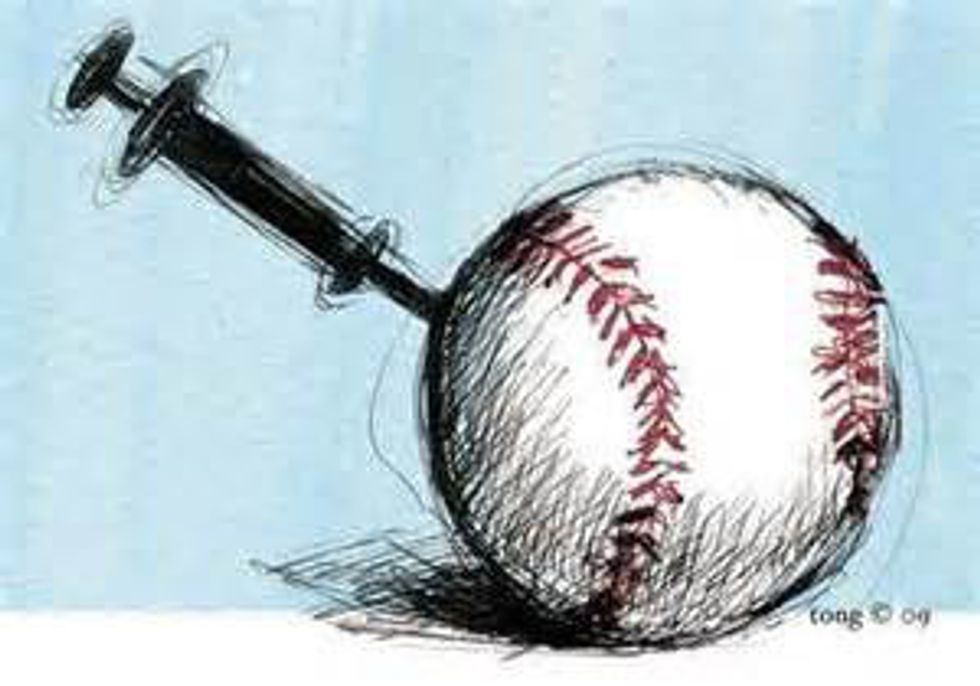
Even though those 48 players were committing a crime, because steroid abuse is very illegal, Major League Baseball would not believe there to be a serious problem. The issue comes further into play when considering the potential impact those 48 players would have on their respective teams due to the statistics they had consistently generated. Major League Baseball was willing to allow roughly 50 players to both cheat in the game of baseball and break the law without taking serious action. The drug testing was set to be pre-planned during spring training, meaning that anyone could have covered up their usage by that point. Essentially, Major League Baseball was willing to allow the game to continue to be played dirty, while the owners and upper level management of the League lined their pockets.
The steroid era can be summed up into one word: greed. Players like Barry Bonds and Alex Rodriguez were great players long before they ever took steroids. They didn’t need them to be successful. However, in our capitalist society, the competition is always tough, and the players were willing to cheat in order to get a leg up. The average MLB player saw a 232 percent increase in his salary between 1995 and 2012.That number, while significant, is dwarfed in comparison to MLB’s revenue growth over the same period. Major League Baseball saw an increase in total revenue of 344 percent.
It cannot be ignored that the players profited from the steroid era, as shown by the data collected. Players like McGwire and Sosa appeared on boxes of Wheaties like so many great athletes before them, and the average professional baseball player’s salary soared upward. The players also absorbed costs that cannot be measured in terms of money. Issues such as kidney, liver, heart, and bone damage are just a few, not to mention potentially shrunken testicles for men. Aside from the negative biological effects, the players that abused these drugs will be haunted for the rest of their lives. In 2003, 70 major leaguers tested positive for performance enhancing drugs, and according to Commissioner Selig and Rob Manfred, MLB’s executive vice president for labor relations and human resources at the time, there were between 70 and 100 positive tests. The number is staggering, considering that Major League Baseball had previously stated it would be unhappy with anything over 5 percent. Manfred still refused to address that Major League Baseball had a serious problem.