


Spoiler alert: This article contains many crucial, key points to the plot of Disney’s latest film “Zootopia.” If you have not watched the film yet and wish to not be spoiled, I would advise you to stop reading. If you simply do not care, carry on. Read at your own risk.
Canadian novelist Margaret Atwood once said, “Every utopia – let’s just stick with the literary ones – faces the same problem: What do you do with the people who don’t fit in?” This is the very question Disney’s 55th animated film, “Zootopia,” tackles. Using a mixture of humor, animation, and anthropomorphic animals, it confronts issues pertaining to reality such as prejudice, the war on drugs, discrimination, bias, stereotypes, and racism.
The film, released as “Zootropolis” in some European countries, is a 2016 American 3-D computer-animated buddy cop comedy, mystery, and adventure film produced by Walt Disney Animation Studios and released by Walt Disney Pictures. It is a feature in the Walt Disney Animated Classics series. “Zootopia” was directed by Byron Howard and Rich Moore, co-directed by Jared Bush, and starred the voices of Ginnifer Goodwin, Jason Bateman, J.K. Simmons, Shakira, Idris Elba, and many more. The film opened to record-breaking box office success in several countries and has earned a worldwide gross of over $1 billion, making it the second highest-grossing film of 2016 and the 25th highest-grossing film of all time.
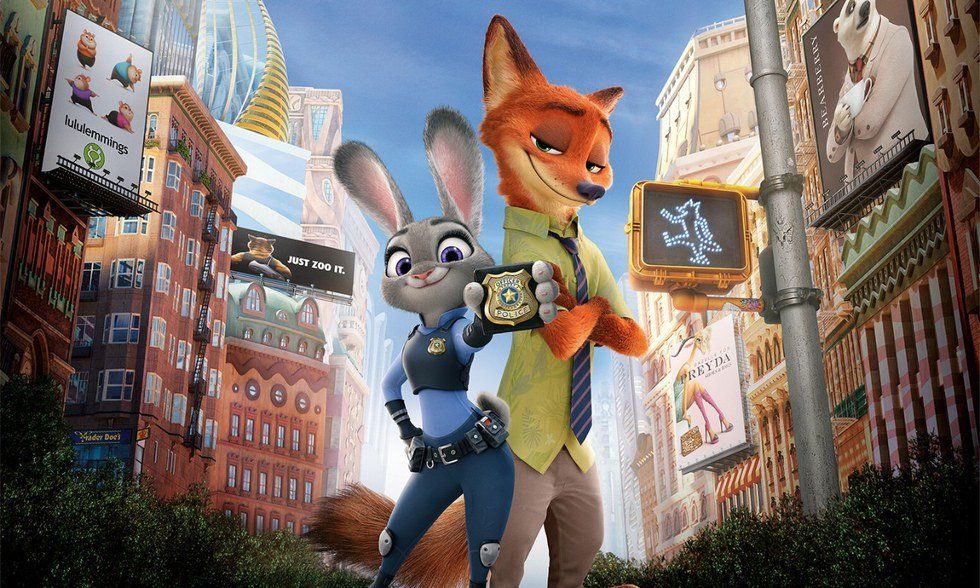
“Zootopia” details the unlikely partnership between a rabbit police officer and a red fox con artist as they uncover a conspiracy that involves the disappearance of predator civilians within a mammalian metropolis. The rabbit, named Judy Hopps (voiced by Ginnifer Goodwin), dreamt of one day achieving her goals to becoming a police officer in the huge, urban city of Zootopia despite her upbringings in rural Bunnyburrow. However, there is a catch to this: there has never been a rabbit on the police force. Despite Zootopia’s pride on it being a diverse community where animals from all walks of life, big and small, predator and prey, can all live together harmoniously, there is still discrimination. Big animals such as bison, elephants, and hippos, along with predators such as lions, cheetahs, and tigers, are in the minority. However, quite a number of them hold good occupations and are generally considered stronger and “cooler.” This parallels the treatment of minorities or people of colour today in our society; while they are often discriminated against, they once held good professions and their culture is often appropriated because it seems “cool.”
In “Zootopia,” terms such as “predator,” “prey,” “black,” “white,” and “Hispanic” are all quite interchangeable when the discussion concerns discrimination. Hopps is discouraged from becoming a police officer; even when she graduated as her class’ valedictorian at the police academy through her sheer unrelenting determination, Police Chief Bogo (voiced by Idris Elba) believed she was just a result of the Mammal Inclusion Initiative, a form of affirmative action for the short and fluffy woodland creatures.
Meanwhile, Mayor Leodore Lionheart (voiced by J.K. Simmons) constantly obsesses about being a predator mayor in a city that is 90 percent prey and the various ways the animals work together but still hold onto aged stereotypes about foxes, sloths, and rabbits. This is becoming an all too real metaphorical analogy of our own civilisation. The film pushes along in a typical Disney manner – a mystery, an unlikely friendship – but then abruptly, in the last act, it makes a turnaround and dives deep into a high-level criticism of white supremacy and the drug trade. No viewer could’ve expected that to happen.
Hopps and her unwitting partner-in-solving-crime, a sly fox named Nick Wilde (voiced by Jason Bateman), discovered there is a drug being put out on the streets that causes predator to “go wild” and revert back to their primitive hunting ways. They become violent, destroy property, and attack other animals. While it is later revealed the drug has the same effect on small, prey animals as well, all of those deeply affected by it are predators such as panthers and otters (all of whom are voiced by black or Hispanic actors). This played into long-existing stereotypes in the prey community that predators are inherently violent and cannot be trusted.
As a result of this new drug epidemic, predators are denied jobs, demoted from positions of influence, and treated as menaces to society. When Hopps and Wilde finally crack the case, they find out the drugs were being pumped into the predator community by the seemingly unsuspecting assistant mayor, Dawn Bellwether (voiced by Jenny Slate), a small, white, fuzzy sheep. The assistant mayor knew if she could feed into the prejudice prey already had against the predator community by playing into existing stereotypes, the majority of animals would be easier to manipulate. Yes, this is the actual plot.
It’s straight out of the realisation that members of the CIA either intentionally or unintentionally aided in the introduction of crack cocaine into minority communities in the 1970s and ‘80s, even though the media and some political leaders denied it for years. The subsequent destruction of mostly black neighbourhoods made it easier for white political leaders and pundits to dismiss African-American communities as filled with “crack babies,” “welfare queens”, and “super-predators”. There can never be enough attention paid to this dark time in American history, even if it comes out of the mouths of furry, animated creatures.
That being said, however, is “Zootopia” perfect? Of course not. Some of its racial messages are muddled. For example, after establishing that being called “cute” in the rabbit community is the equivalent of saying the N-word (something that rabbits can call one another but other animals won’t), Hopps is casually referred to as “cute” by other animals throughout the film, with no further reflection. However, that is a small price to pay considering the film’s beautiful animation, witty dialogue, and insightful plot.
And many others have noticed this as well. Whether you like it or not, “Zootopia” has been generating much socio-political commentary and for good reason too. While many critics have interpreted the film as a thinly veiled attempt to address racism, writer Nico Lang at Consequence of Sound, a Chicago-based online magazine, argued “Zootopia” failed to accomplish its goal adequately. In Zootopia, no one really benefits from racism, and everyone is thus harmed by it equally, which is actually a pretty dangerous idea,” he wrote. At first, I too believed the film was just about racism, but after some reflection brought out by Lang’s criticism, I have come to the epiphany that it’s also about prejudice in general. “Zootopia” can’t adequately address racism and racisms can’t harm its characters equally because the film’s main focus is not on racism; it’s about prejudice, which can and does harm everyone equally, and how prejudice leads to racism. In this sense, “Zootopia” was a stunning success.
Perhaps the most impressive aspect of “Zootopia” is the nuance with which it handles the concept of prejudice. Lang stated the film doesn’t depict any group blessed with privilege and he’s right. This is a world in which even the predators, who would be “privileged” by their natural gifts, are docile and while prey make up the majority, there is still discrimination smaller creatures must face. However, I disagreed with Lang’s assertion that “it doesn’t really work to about a film about the ‘Other’ in which everyone is the ‘Other.’” Instead, with no privileged group, what occurs is that the “other” is relative to context; this shows that in any given situation, any arbitrary person or group can be marginalised.
That being said, it doesn’t mean anyone can be racist toward white people; that’s not possible. Racism is based on a system of oppression; you can’t be racist towards the oppressor. You can be prejudiced, discriminatory, or biased against the privileged group, but to be racist is a completely different matter because the words “racism” and “prejudice” hold two different connotations even if they may share similar denotations. Sadly, this is still a misunderstood, unpopular opinion.
But I digress. This is about how prejudice affects everyone not how racism affects only the minorities. And yes, as I’ve said before, the majority could experience prejudice.
In fact, as I reflected on the character of Judy Hopps, I couldn’t help but to draw parallels to a human character from a different film: Elle Woods from “Legally Blonde”. Both Hopps and Woods are highly enthusiastic, surprisingly intelligent females with major chips on their shoulders, endeavouring to make it in a profession to which their respective societies have told them they do not belong. Their only major difference is that Elle Woods also happens to be the whitest of white sorority chicks, an incredibly privileged individual in America with whom we might not tend to sympathise with unless we belong to the same crowd. However, regardless of Woods’ overall societal status, it’s impossible to deny that she is “othered” at Harvard Law School, where she enters a world that is prejudiced against her from the start based on her looks, accent, and background. “Zootopia” takes Woods’ situation and, in conferring it upon the comparatively unprivileged Hopps, strips away the lens of societal privilege to reveal the reality of the situation: pure, unmitigated prejudice.
Hopps could easily fit into Zooptian society if that was her sole desire. Perhaps she would be seen as the equivalent of a dumb, blonde sorority girl (because that the analogue of “dumb-cute-bunny”) but she’d make her way through with few issues regardless, especially in the subtle dictatorship of the prey that Assistant Mayor Bellwether tries to establish. However, Hopps is held back by the prejudices of the other police officers against the ability of a tiny, dumb, cute rabbit to be a serious member of their ranks. We must consider her an “other” in this context, no matter what her standing in the overall societal structure of Zootopia may be. Besides, if the creators of “Zootopia” really wanted to address racism, they would have made an allegory wherein the cops take down a colony of unarmed foxes and justify it as self-defence.
Speaking of foxes, Nick Wilde also faces prejudice and his response to it is—a self-fulfilling prophecy—is a great depiction of the psychological construct that perpetuates the cycle of poverty and discrimination in American ghettos. In the mostly classless society of “Zootopia,” there is one species that, at least in the city itself, seems to be a legitimate underclass: the foxes, who are seen as sly tricksters. Wilde has been “othered” his entire life, most notably in a very disturbing scene that shows a young Wilde being muzzled by a group of bigoted cub scouts he thought were his friends. That feeling of being “othered” has come to define him. In fact, Hopps has let this existing prejudice get the best of her. After a malicious incident at the hands of a vindictive fox when she was just a young bunny, Hopps has subconsciously held onto the prejudice throughout the years. In her first encounter with Wilde, she tries to dispel this line of thinking and pats herself on the back for doing so. However, things aren’t so black and white as such. Wilde does turn out to be a sly trickster, but it is also revealed he is a much more substantial individual than that. Hopps, then, sees that she, as well as all of us, has much thinking to do.
The lesson for us to take away from this is that prejudice can have the effect of creating an unbridgeable gap between groups.
Having firmly established this film concerns prejudice, we would additionally distinguish between prejudice and racism. Prejudice is a negative attitude about someone held on the basis of cognitive constructs we call stereotypes; racism is these attitudes manifested as oppressive behaviour, and therefore requires a power gradient. Thus, “reverse racism” doesn’t exist, as I’ve said before, it’s discrimination. It’s not good. But, it isn’t racism. Lang correctly argued that because “Zootopia” is a mostly classless society until Hopps’ invocation of literal social Darwinism at a press conference citing predators’ “biological urges.” (See? She’s just as unwitting as the rest of us.) Racism can’t really exist there.
However, the lack of classes in Zootopia belies a very important truth about the film; it’s not a reflection of our own world nor is it an attempt to be a reflection of our world. It is no coincidence that the titular city is named after “utopia.” It’s a depiction of what our society would look like if we somehow beat systemic, institutional racism without addressing its underlying cause. Throughout the film, we see countless examples of how Zootopia is outfitted to meet the needs of every species; for the most part, every animal from the tiniest of gerbils to the largest of elephants is treated with equal respect (at least on the surface) by every other animal. The very concept of predators living in harmony with prey, whites living in harmony with people of colour, is utter fantasy. However, it is a quite “static” utopia: it resists change.
Most importantly, though, as the film proceeds, we see that the façade of peace and mutual respect coats deep-seated prejudices that haven’t been squashed, and when Hopps very publicly tied the predators’ savagery to biology, things immediately start to look dystopian. This is where "Zootopia" more accurately resembles our society. When people feel threatened, the prejudices that they’ve buried deep bubble right back up to the surface. The mentality of in-groups and out-groups is well understood by social psychologists; it goes back to the earliest days of the human species, when the ability to distinguish between friend and foe was vital to the ability to survive and reproduce. That’s why fear is so effective at separating society along lines of prejudice, and that’s exactly what Assistant Mayor Bellwether uses to accumulate more power at the expense of predators. From the moment that Hopps mentioned that the predators might be a threat because of their DNA, what we witness is the process of prejudice activated by fear and becoming racism.
Lang asserted that the moral of “Zootopia” appears to be that “society can reach a racial harmony when bad individuals are ousted from power." In ‘Zootopia,’ the system is not the problem; it’s the individuals who are the problem.” For the most part, I do agree, but the conclusion Lang draws, that the move’s message came across as muddled, is unfair to its true value. Yes, it’s partly muddle, no film is perfect. Nonetheless, what “Zootopia” is really showing is that prejudice, when activated against an arbitrary group by some sort of crisis, turns into racism real fast. That’s how Adolf Hitler and his Nazis transformed the seemingly benign German people against the Jews: the country was mired in an economic crisis and Hitler played upon the latent anti-Semitism of his people to strongman his way into dictatorship (history students my recall how he used an attack at the Reichstag to incite fear and justify ousting his opponents) and then justify the usage of state power against the Jews. Hell, Donald Trump has become a viable presidential candidate by playing on Americans fears of Mexican immigrants and Muslims, who will surely face more overt racism and discrimination if he is elected.
The most important message to take away from “Zootopia” therefore is that prejudice is the underlying cause of racism, and that in order for us to defeat institutional racism in America and the world, we and our children must learn to overcome prejudice; which is only possible through not the mere integration of different groups and the false ideology of “not seeing colour,” but the acceptance and appreciation of others’ differences. Mashing together disparate peoples in one place is a start, but as “Zootopia” shows us, that isn’t enough, because any group can become the target of racism if the context is right and underlying prejudices are allowed to persist. The only real solution is to foster empathy (beautifully portrayed in Hopps and Wilde’s dynamic relationship) and cherish the beautiful tapestry of humanity without using our species’ myriad variations to put people into boxes that can be used to crush them if a reason to do so arises. If we can raise our kids to think in the way that Zootopia wants them to think, we might eventually have unprejudiced leaders who rule a society of unprejudiced people. At that point, institutional racism will be seen for what it is; arbitrary, stupid, and illogical and discarded forever.
Is this a naïve line of thinking? Oh, but of course! However, “Zootopia” is a children’s film and if you never give children hope for a better world, they will never try to work towards it.
Rating: A-















