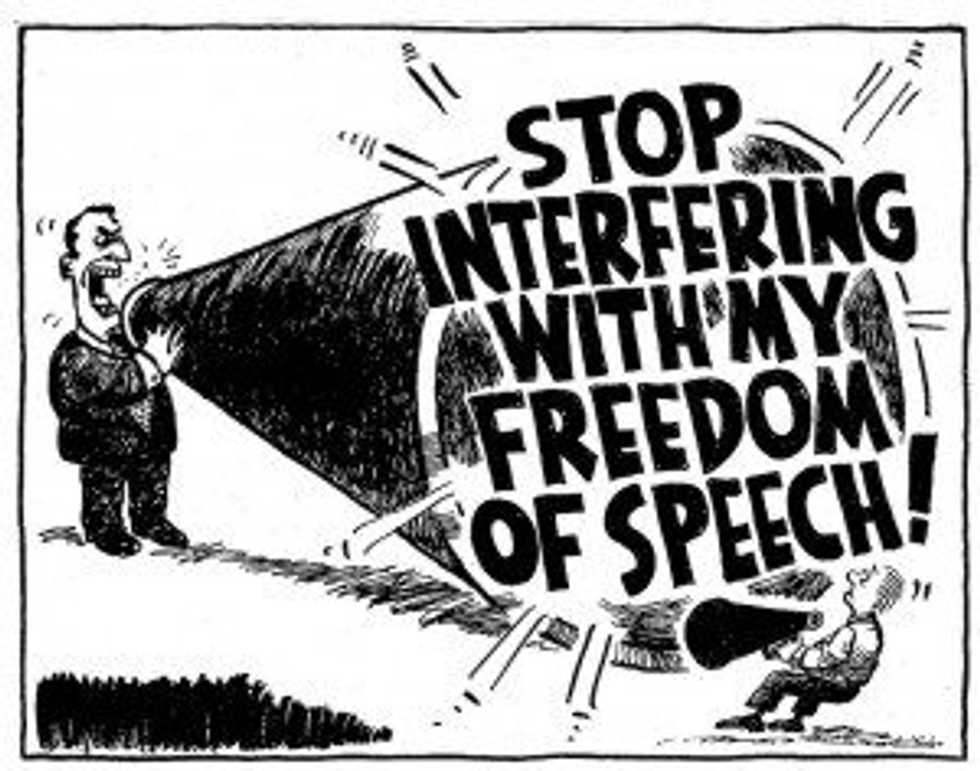
On the road to the White House, Donald Trump has made a lot of outlandish comments that have insulted millions. During his announcement speech he told the crowd, “When Mexico sends its people, they're not sending their best.They're sending people that have lots of problems, and they're bringing those problems with us. They're bringing drugs. They're bringing crime. They're rapists. And some, I assume, are good people.” Suffice it to say, many are not happy with him. Whenever a celebrity repeats an unpopular opinion, whether it be Phil Robertson and his anti-gay sentiments, or Nicole Arbour after her “dear fat people” video, the response against people who want to punish them is, “They’re just exercising their freedom of speech!”

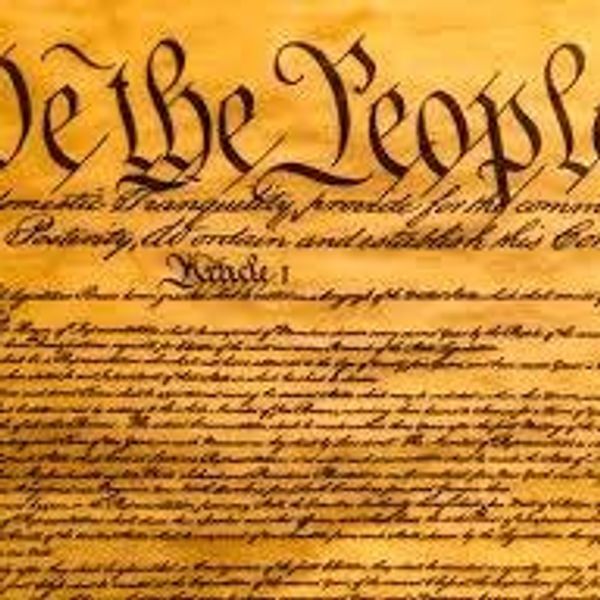
Okay, hold up. So, what is freedom of speech? According to the United State's Constitution, the first amendment states..
"Congress shall make no law respecting an establishment of religion, or prohibiting the free exercise thereof; or abridging the freedom of speech, or of the press; or the right of the people peaceably to assemble, and to petition the government for a redress of grievances."
They key word is, "congress." In most of the cases where "freedom of speech" is brought up to protect the words and statements of an individual, they are cases in which freedom of speech is infringed upon by another individual or a private corporation. Let's take Donald Trump to talk about the second way--where freedom of speech is so-called "infringed" by a private corporation. After controversial remarks in his Presidential speech, Trump in a $500 million lawsuit against Univision alleged that Univision refused to broadcast the Miss USA and Miss universe pageants over his comments: "Univision has no right to terminate its relationship with MUO and refuse to broadcast the upcoming Miss USA pageant,” the suit claims. It said that under the terms of the agreement between the network, Trump and MUO that Univision didn’t have a contractual right to drop the show because “it does not agree with Mr. Trump’s long-standing views or statements, all of which are protected by the First Amendment and have been echoed many times in this country.”
Univision has nothing to do with the United States government, and is instead a private corporation that is not bound to having to respect freedom of speech. With Trump, that is especially the case where speech is offensive. Univision is completely within their right (aside from what other legal concerns regarding contracts there may be) to terminate its relationship with the MUO on the grounds that it found Trump's comments repulsive. The first amendment prohibits the government from infringing on speech, but it does not require that corporations or individuals do the same. The ability to say whatever you want to say is not protected anywhere else. Thus, there are consequences.
The comedian/YouTube personality Nicole Arbour found herself facing the short end of the stick this past week, when backlash to her "Dear Fat People" video surfaced. Immediately people flocked to call out the comedian, including Chrissy Teigen and Shawn Helpin. Arbour's video was eventually taken down, and a project she was supposed to have started ended after the filmmaker watched her video. Nicole Arbour used her "freedom of speech" to publicly shame individuals who could care less about her freedom to say such things. Rather than have a discussion about the consequences, most people arguing for freedom of speech disregard the fact that those people should be held accountable for their words.
Claiming that freedom of speech should be prioritized and valued ignores the true meaning for why our government instituted the First Amendment. It is not an argument that should be made to absolve any offensive comment made, on the basis that they are allowed to speak their mind freely. It is definitely not an argument that should be made after backlash against offensive comments by people like Phil Robertson and Nicole Arbour. Yes, these individuals have the right to say whatever they want to say; but it is mine, and everybody else's right to use our "freedom of speech" to punish these individuals when they are offensive.