
The scoreboard read 1-1 with five seconds left on the clock.
0:05 -- The midfielder passed the ball to a teammate who stood just outside of the 18-yard box.
0:03 -- The player received the ball and set up for a shot.
0:02 -- The player connected with the ball.
0:00.3 -- The ball crossed the line.
Goal.
Game over.
His team rushed the field, dog-piling him.
But his team was not my team.
My team stood there in silence.
We'd lost. And it hurt.
Yet, in the loss, my team reminded me of something that is so easy to forget.
Dec. 25, 1914.
The war had been raging for five months and already thousands had died. The British soldiers sat in their trenches, careful to keep their heads low for fear of any German sharpshooters. Suddenly, however, a sound was heard that seemed foreign to their shell-shocked ears.
Voices. Singing.
"Stille Nacht. Heil'ge Nacht."
Silent Night. Holy Night.
Slowly, one by one the British soldiers began joining in the song. Before long, a few soldiers built up the courage to peer over the trenches. To their surprise, what they saw was not enemy rifles pointing at them, but German soldiers stepping out of their trenches.
Waving their arms.
Unarmed.
The two sides slowly made their way to one another, questioning the true intentions of the other, an understandable reaction given the conflict that had just been taking place, given that they had been taught to demonize their opponent.
When the two sides met, however, no one fought.
Rather, hands were shaken, gifts were exchanged, and the two sides united under a greater bond than pride: humanity.
For the non-athlete, to compare sports and war seems a stretch, and it is obvious that the two are not equal. However, to anyone who has entered a competitive playing field, it is easy to see the metaphorical parallel. Two sides, with conflicting goals, emotions high, and their opponent trying to defeat them -- trying to take what they believe should be theirs.
Our society teaches us to do whatever is necessary to get ahead. Total victory must be achieved at all costs, no matter how many cheap shots we have to throw, no matter how many victims we must trample. The opponent stands in our way, and, therefore, they are not like us, and, therefore, we dehumanize them.
It makes it easier to hate them.
And when we lose?
In these instances, we are taught to hate the opposition even more; to look for the next chance we have to humiliate them. Sports, business, war, you name it. The attitude is always the same.
It's encouraged. It's expected.
On Friday night, however, I saw something different. Something that reminded me of Christmas in 1914.
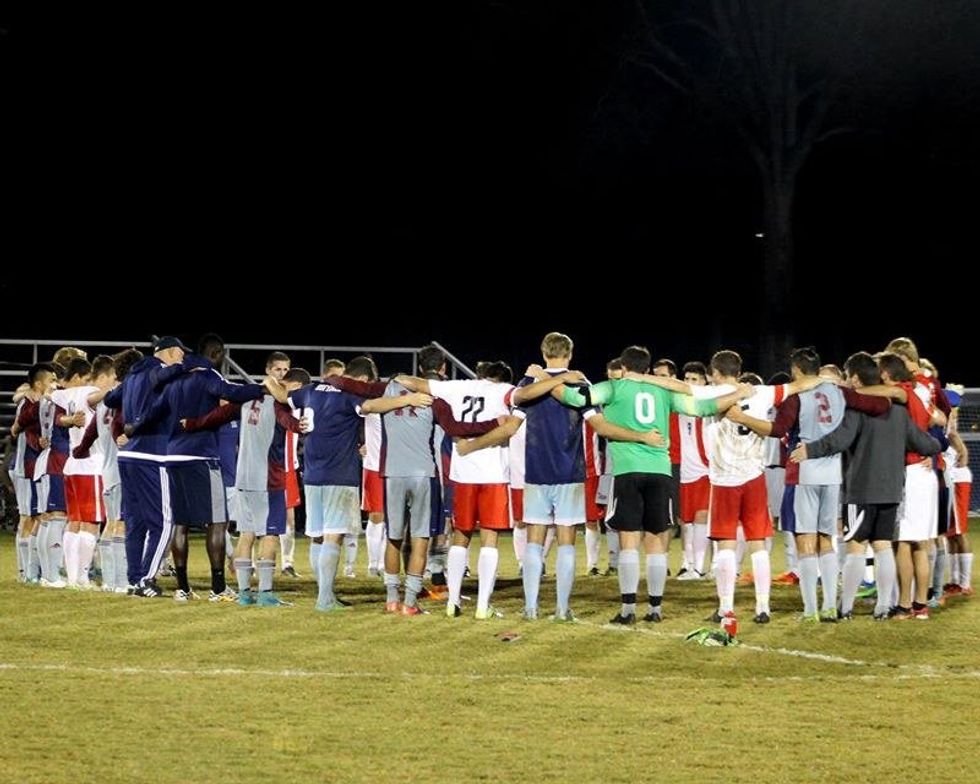
For after the heart-breaking goal, my teammates shook the hands of their opponents. Our captain then, as he does after every game, gathered both teams together and prayed at the center of the field.
The pain of the game had not gone away, but I was given a picture of something greater than a game...
I was given a picture of true humanity: a humanity that unites under something greater than pride; one undivided by uniforms and agendas.
I was reminded that there exists within every human the potential to see the greater picture, and that the decision to do this resides solely in the heart of each individual.
So, today, will you choose to see the greater picture?