I’ve flunked exams, flunked run tests, lost elections, lost keys, broken promises, broken bones and somehow… none of the above compare in the slightest to the feeling of failing to protect a life… an innocent, gentle, beautiful life. A life devoured by the greed that pulses throughout archaic markets and corrupted cortexes, affixing itself like plaque on the stony, bitter walls that construct capitalism today.
I thought I knew the feeling of failure—that your best just wasn’t quite good enough. I woke one morning after barely managing to close my eyes all night. I un-tucked my mosquito net, rolled out of bed, and looked out the dust-covered window of my chalet—hoping to see everyone running around as usual: stirring coffee, pouring cereal, laughing over Buzzfeed quizzes… but nothing. It was then that I knew for sure—knew exactly what failure felt like. The naive and forgotten pit trembling in my stomach these past several weeks oozed and shredded my racing heart with the revoltingly awesome capabilities of injustice.
I couldn’t figure out how exactly to act in order to calm myself down. A part of me wanted to stand up, throw my chair, and scream as loud as I could. Another part of me wanted to run to the nearest Land Rover, crawl in, and cry. But the biggest most passionate part of me wanted justice and wanted it immediately. I quickly learned that there is nothing in this world that will ever calm me down in this line of work. I care too much about this, about them to ever allow the temptations of normalcy to overcome my desire to defend each organisms’ right to live freely and fully.
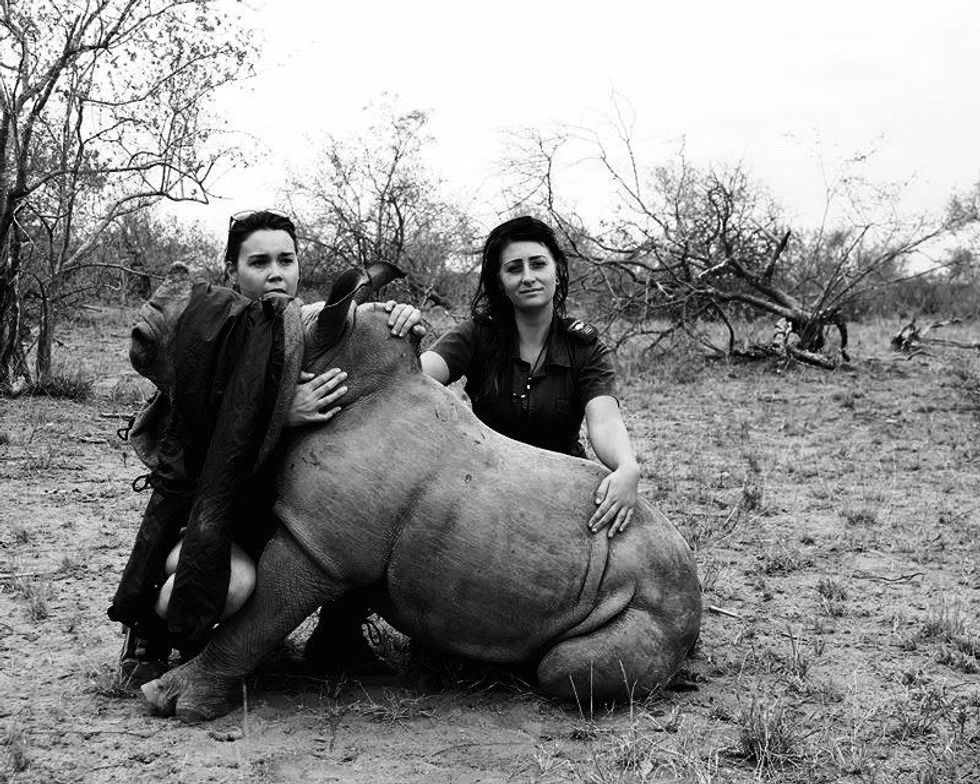
We did not just lose one white rhino today. We lost two. A three-month-old calf was found circling the lifeless body of her hornless mother that morning-- searching for some semblance of safety and certainty. Over the last three years, rhino poaching in South Africa has risen by nearly 7,000%--"fueled by skyrocketing international demand for rhino horn on the black market" (NRDC, 2016). This is an epidemic.
--------------------------------------------------------------------------------------------------------
This past fall, I interned with Transfrontier Africa's Indlovu West Conservation Research LLC: a wildlife NGO based in South Africa that monitors and researches the remaining Black and White rhino populations in Balule of Greater Kruger National Park; South Africa is home to nearly 80% of the world's rhino population. The project is run by head Researcher, Ecological Manager, and Head Warden of the region, Craig Spencer, along with a small team of researchers and game rangers; the entire team operates out of a rustic camp deep in the bush where herds of elephants, lions, buffalo, and others would often visit. Each day, teams of researchers, environmental experts, volunteers, anti-poachers, work in the South African bush—monitoring the remaining Black and White rhino populations utilizing VHF Radio Telemetry. Several years ago, the NGO revolutionized anti-poaching strategies with the implementation of two major programs: an all-female and all South African anti-poaching unit called the Black Mambas and the “Bush Babies” environmental education program--in order to further increase the likelihood of engaging local—specifically marginalized— people to care about these issues in their backyards. So, after hours out in the field, the team returns to camp, cooks dinner over the fire, works on inputting our data from the day (cataloguing the unique ear patterns of each rhino observed both in the field and on photographs collected via camera traps), and share sightings and stories from the day. The days were long and the nights were longer, yet I undoubtedly learned how altruistic and all-consuming wildlife conservation and research truly is; it is difficult and exhausting, but it is truly where I see myself in a few short years. I spent my days riding on the back of Land Rovers, tracking rhinos, marking their locations, making anti-poaching maps, and responding to poaching incidents: my life was insane, and I absolutely craved that insanity.
With all of this excitement though, there is the constant and looming threat of the unknown--the radio message that could change everything at any time. Each morning, Craig would pull out his cell phone and read the locations, species, ages, and sexes of all the reported rhinos that we, and all of Sub-Saharan Africa, had failed to protect and had lost to poaching during the night. It was incredibly demoralizing and yet, an intense fuel that drove you to work harder and longer each and every day. One issue with this concept though is that the world on the ground is not what is going to solve this problem—often, those on the front lines of conservation are rarely those that have the power to change human behavior—change the markets that drive such evils. However, without the people in the trenches, there would little if not no wild rhinos left in Africa—this thread weaves itself into many realms of conservation work. There is little money in saving the world, yet a whole lot of money in taking so much of its beauty away. With so few people in the field of wildlife conservation, capturing those that both accept the impending difficulties of the job and comprehend that the work on the ground is just treating the symptom of the problem, it absolutely vital in achieving some form of quantitative and qualitative success. This entire issue can be categorized as an issue of ideological lock-in. In addition to this specific form of lock-in, there exists an economic form of lock-in here, too. Most small-scale wildlife conservation organizations rely on foreign funding via mainly grants and awards from organizations and concerned citizens. to sustain its practices. Transfrontier Africa utilizes these funds to tag, track, and protect the remaining rhino populations within Balule.
Transfrontier Africa's mission is inherently altruistic and recognizes that “bringing people down to the rhino crisis” is the only way to solve this issue. In order to address the first issue, ideological lock-in, it is important to firstly examine the attitudes and the emotional and/or mental resilience of any wildlife conservation team. In these types of working and living conditions, team dynamics are often tainted with anger, guilt, loneliness, and pain--all emotions that arise during such difficult work. All in all, this is an incredible problem that is often understated by those working to devise successful resource strategies often either understate or do not state at all is the issue of personal resilience. Working to protect the environment is impossible without working with people. “The question is not if you need conservation, but if conservation needs you” was a phrase that Craig did not go a day without saying—and for good reason (Craig Spencer, 2015). While tragedy and happiness have the ability to bring even the most broken of teams together, many team needs more than immense successes and immense failures to create an environment where each member trusts the other to both complete their allocated tasks, and be able to support each other each day. Establishing a “group identity… by [facilitating] group-identity-building activities” helped to establish “a safe and secure social environment and structuring activities so that long-term… objectives were also rewarding over the short term (Generalizing the core design principles for the efficacy of groups, Wilson et al., 2012). This small implementation would revolutionize the dynamics of any team, and help to lessen the effects of intense and often unnecessary group setbacks.
Secondly, the economic lock-in that arises with wildlife conservation funding mechanisms needs to be addressed. Many organizations rely strictly on emergency grants and funding from individuals, organizations, fundraisers, etc.—all of which are rarely dependable and structured so bureaucratically that the transfer of funds almost always occurs after the NGO desperately needs said funds. In order to create a successful and resilient conservation project, addressing the larger fundamental solutions here—seeking dependable financial resources—versus the symptoms of the economic lock-in—seeking immediate, sporadic, and informal financial relief—is absolutely necessary.
Most importantly, wildlife NGOs need to continue, enhance, and spread their anti-poaching and methodologies for educating local people throughout Kruger National Park in order to financially and ideologically incentivize marginalized South Africans to protect rather than to poach. Since the majority of poachers are South Africans hired by foreign—mainly wealthy Asian—merchants and markets to poach rhinos, engaging the surrounding communities with the crisis and giving local people the means to care about these issues is a major focus of the NGO. Transfrontier Africa developed this first all-female, all-South African, non-violent, anti-poaching team that patrols the reserve and assists in protecting the populations at night. Statistically, a young South African man is way more likely to poach rhinos than that of a young South African woman. The Black Mamba Anti-Poaching Unit gives these women a salary, uniforms, food rations, and educational materials to bring home to their communities to show them that their work is more meaningful than the work of a poacher, and that protecting rhinos is a service both to their backyards and their country. In this particular example, the costs of not complying with Transfrontier’s standards locally often include social and economic ostracism, while the greater costs include potentially death, time in prison, etc. In Gibson and Marks’ 1995 case study of a Zambian community-based wildlife management program working to reduce poaching incidents, they found that the benefits of working to protect the rhinos are stated above, yet the financial benefits of poaching often exceed all of the above—and therein lies the true issue:
“Gibson and Marks (1995) conclude that wildlife management schemes have failed because they poorly represent the motives of rural residents and do not sufficiently incentivise against hunt- ing. The extant incentive structure only targets individual hunters through punishment rather than benefits, while non-hunters reap tangible rewards from a successful wildlife management pro- gram—the consequence is that hunters reject the management re- gime. The game-theoretic analysis suggests a bottom-up approach where rural residents are invested with greater authority over wild animals would be most effective” (The conservation game, Colyvan et al., 2010).
No matter what sanctions or proposals the Convention on International Trade in Endangered Species of Wild Flora and Fauna (CITES) puts forth, the market will not stop unless the costs of rhino poaching exceed the benefits: a frightening conclusion. Though a game theoretic lens, it is clear that this scenario fits under the stag hunt game for it relies on the cooperation of two entities—the NGO and local South Africans—to reach one more advantageous n2ash equilibrium; if a South African chooses to poach, then they defect and the Transfrontier Africa’s work is futile. By incentivizing women financially and children ideologically to care about protecting endangered rhinos, Transfrontier Africa defies the above case. However, such success is only as relevant as its ability to spread. Transfrontier Africa needs to be more willing to share its methods, projects, etc. in a formal and understandable way with other wildlife conversation organizations throughout Africa.
More often than not, the above advisements are characteristic of many criticisms of small-scale wildlife conservation: lack of team cohesion, loss of goal-orientated structure, ideological and financial lock-in, and inability to collaborate with related organizations. If the above issues were straightforward and feasible, it is entirely possible that so many of these sometimes catastrophic issues would not exist. However, tackling team dynamics and understanding the scope of one’s work in tackling global conservation issues are but facets in solving the larger problems that are easier than most to implement.
It is slightly idealistic to assume that a steady form of funding and/or revenue of any kind would ever become a part of wildlife conservation and related work. There is little money in protecting our planet the right way, and a lot more money in extracting everything we can for our own personal consumption and profit. Still though, many NGOs apply for grants, spend all of their awards, and then desperately apply for more when researchers can no longer eat sun-bleached tuna and rotten tomatoes. This method of supporting these important organizations is irresponsible for a myriad of reasons. Not only is the wellbeing of the team threatened, the wellbeing of the rhinos, and the entire project is threatened with such behavior. While grants, stipends, and government funding may be most NGO’s only source of economic capital, there must be an emergency reserve of funds set aside for when the organization runs out of money and someone in charge of constantly applying for new funds and/or renewing existing applications or partnerships in order to ensure that there are steady and dependable sources for the NGO to rely on.
All in all, anti-poaching models are not the solution to this issue. Addressing each minute problem on the ground, and devising novel ways to attack that issue are but just pieces of this twisted puzzle. This issue is a global behavioral problem--a problem where the consumer has the right to demand ownership over other creatures' lives. I believe that education is the key to fundamentally solving the anti-poaching crisis--educating African and Asian youth is the only way to get people to care about the effects of their behaviors. This world is so broken and yet we must do everything in our power to put it back to together.
I have never felt more passionate about any kind of work in my entire life. I know that my purpose on this planet is to protect the beautiful and often endangered species on this planet that our very own species works so hard to destroy. But I can't do it alone...