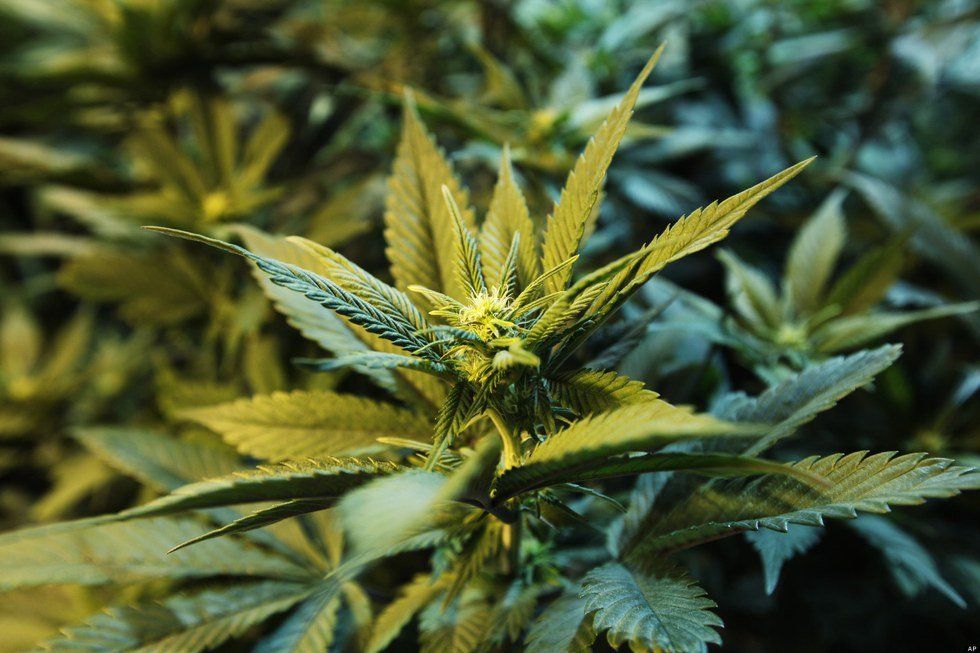
A myriad interesting things have been happening in American news recently. Sarah Palin announcing her support for controversial Presidential candidate Donald Trump has left many scratching their heads in shock or amusement. The forced relocation of numerous families due to the Porter Ranch oil leakage has caused concern to ripple among large families. The continuation of strange crimes has also peaked in everyday American society. What I found most interesting in recent news, however, was the difficult problem of the legalization of marijuana. Should marijuana be legalized in the United States? And, if so, why?
A lot of people nowadays are giving the “thumbs up” to the possibility of legalizing marijuana for recreational use. Those same supporters of the convoluted topic, however, did not seem to have a particular reason for their defense, which I found to be perplexing. What boggled me even further was learning the fact that the state and local governments are more aggressive in pushing for the coinciding goal of legalizing marijuana.
The main motive for the governments in making this socio-political move is financial; specifically, it believes that legalizing marijuana can “bring in as much as $1 billion annually in taxes for state and local governments” [1]. It also thinks that passing this new mandate will be an effective means of “reducing law enforcement costs by tens of millions…” [2]. At first glance, I was impressed by the government’s passionate strategy to increase the struggling budget. Although it is true that people who buy marijuana after the probable legalization of the drug will have to pay additional taxes, one cannot help but respect the governments’ plan to use the tax funds to improve society dramatically by promoting programs that center on “substance use disorder education, prevention, and treatment” [3]. From learning these attributes alone, I was momentarily convinced that legalizing marijuana seems to be a respectable idea in that it will generate a better economy, which America desperately needs in its current, downtrodden state.
However, despite the financial prospects of marijuana legalization, legal use of marijuana should not be passed into law due to its threats of affecting the human population’s health.
For instance, unregulated and consistent use of marijuana has the potential of damaging your mental health. The supposition that marijuana users appear to be more stupid than non-marijuana users actually rings true, since dependence on marijuana leads to the decrease of a person’s IQ and increase the inability to stop, especially if the user were young [4]. In fact, Northern University recently discovered that individuals who regularly partake of marijuana have been reported to have “abnormal brain structure, poor memory…and brain changes resembling schizophrenia” [5]. Learning about these negative possibilities stemming from a supposedly health-increasing drug terrified me and caused me to start thinking why people would want it to be legalized. If marijuana were capable of leading to such damaging circumstances, why are people so keen on promoting it for public use? From a logical standpoint, it seems so stupid, particularly when there is plenty of evidence proving that marijuana is destructive.
From a similar field, lack of restrictions on marijuana application can lead to terrible results on physical health. For example, it turned out that “regular users are hit with devastating lung problems at least 20 years old earlier than smokers” [6]. It seemed that if marijuana users used alternative means of dealing with life stresses rather than smoking marijuana, their health would improve dramatically.
Just looking at these two effects should be enough to convince anyone that legalizing marijuana is not a good law to pass. Rather than debating on the “drug issue,” the government should take the time to consider other socio-political issues of more importance. If the government continues to haggle with the marijuana legalization controversy, it will eventually run out of resources, resources which can be put to more efficient application in other areas. One can only hope that the government is smarter than that.