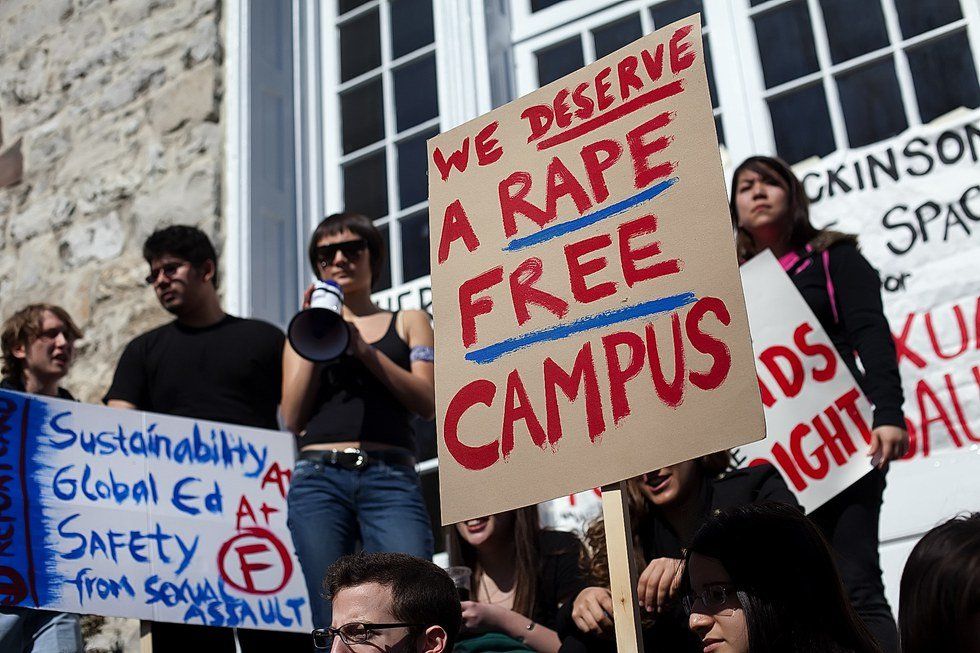
Sexual Assault: “Any type of sexual contact or behavior that occurs without the explicit consent of the recipient. Falling under the definition of sexual assault are sexual activities as forced sexual intercourse, forcible sodomy, child molestation, incest, fondling, and attempted rape,” according to the United States Department of Justice.
It's been estimated that one in five women will be sexually assaulted during their college career, according to the U.S. Department of Justice . That is an extremely large number. Let's put this into perspective: I have 118 contacts in my phone who are females and attend college. If I include myself, that makes 119. If I divide 119 by 5, that means that 23 of my female college friends will be sexually assaulted during their college careers.
Rape and sexual assault are two of the biggest issues that college campuses face today and you know what the scariest part is? The majority of the time, it goes unnoticed and unreported, and the woman who has been sexually assaulted is left to deal with the emotional and physical pain of the assault alone.
Out of my 23 friends who will statistically be assaulted, according to the National Sexual Violence Resource Center, only one out of every ten will report it. So that means that only two or three of my 23 friends will report the incident. Twenty girls will be too afraid, ashamed, or embarrassed to come forward and say what happened. So what becomes of the perpetrator? He gets off with a free pass; nobody ever will know the harm that he has done. Chances are he will do it again.
So what about my three friends who do report the assault? Will the college try and help the victims' cases, or will they push it under the rug to avoid media uproar? In the past few years, large steps have been taken to protect victims and punish perpetrators.
In 2013, President Obama signed the third reauthorization of the Violence Against Women Act. This act has aided in the prevention and better understanding of sexual assault at schools and universities. Along with this, in January 2014, Obama launched the White House Task Force to Protect Students from Sexual Assault.
This task force is helping to generate ideas for how to prevent campus sexual assault and teaching schools how to react effectively when it does happen. A PSA was released by the White House with the message that if the female does not consent, or she cannot consent, then it is a crime. This is one of the biggest issues that comes with assault.
Over 50 percent of sexual assaults are associated with alcohol use. If a woman is intoxicated and not responsive enough to say no, then that right there is an immediate no. Even if she is intoxicated and says yes, that does not mean yes. Plain and simple, if a victim has had too much to drink, that is not an excuse for someone to take advantage of them and pretend that it will go unnoticed. Unless your sober partner says the word “yes,” there is no entitlement to have any physical interaction at all. No means no.
A victim will experience many different emotional and physical aftereffects. Some of the emotional effects are guilt, anxiety, and helplessness. On a deeper level, sometimes one's view on life is completely altered. Creativity and loss of interest drives victims into depression and even thoughts of suicide. Physically, someone may experience inability to sleep, jitteriness, and pain from the incident. Every day, our friends, daughters, and sisters are facing the aftereffects of rape and sexual assault, and we might not even be aware.
So what can we do to fight it? First of all, we need to make sure that if we see something or feel that someone is unsafe, steps are taken immediately. If you see someone intoxicated or someone who is in danger, you may be the only person around who can step up and take action; if you feel that you cannot handle the situation on your own, call someone who can, whether it be the police or another person that can help.
Second of all, it is important that we know how to protect ourselves. Watching our amount of alcohol intake is one of the biggest things. It is important to know how much you can drink until you are not aware of what is happening around you and to know that you are able to say no. But remember that your intoxication doesn't give anyone the right to attack you. Sexual assault and rape are NEVER the fault of the victims, no matter how much a victim has had to drink.
And lastly, we need to let people know that it is OK to speak up. In order for victims to get help, they have to feel comfortable saying that they were assaulted and know that they will have the support and that the right steps will be taken. This alone will let perpetrators know that they cannot just get away with anything. Silence isn’t going to stop anything; it says that what is happening is OK. And sexual assault is not OK.