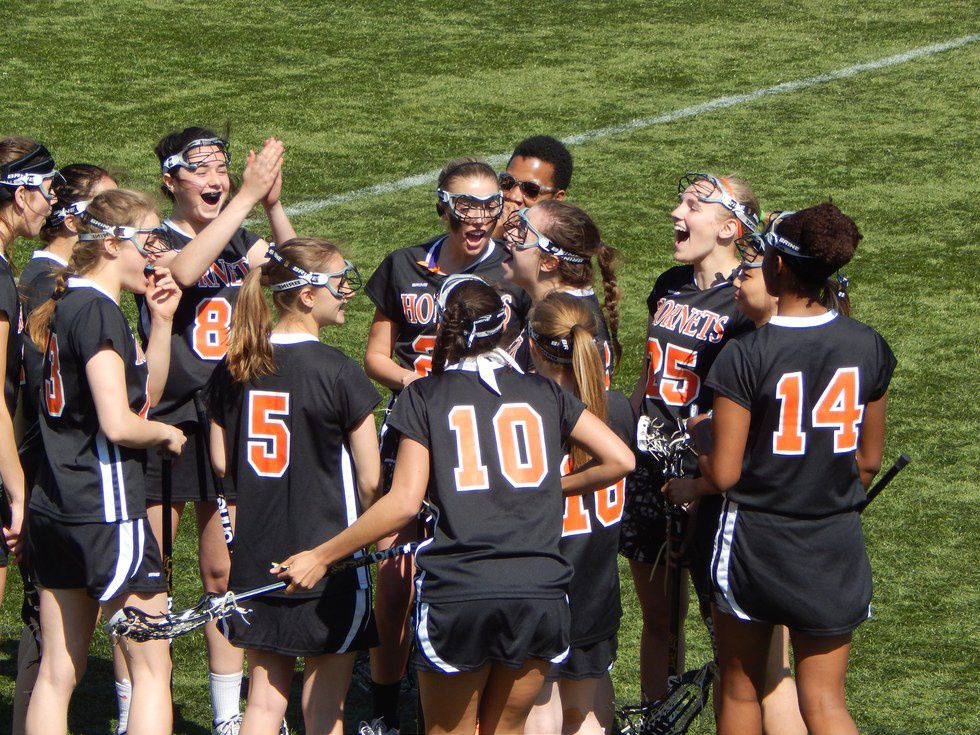

The stereotypical female lacrosse player is usually tall, with a long ponytail and wears Lulu Lemon headbands on a regular basis. Male lacrosse players are typically tall, strong and have a full head of beautiful hair (also referred to as flow). What both men and women lacrosse players typically have in common is that they are usually white. In the lacrosse world, it is not hard to see that the predominant color is white and that there is a lack of blacks within the lacrosse community. Considering the history of the sport, it seems strange that there is still a lack of any people of color for that matter. The sport began as an indigenous sport started by Native American tribes in the early 1400s. Although, even before our time, whites began to take over the sport of lacrosse. In 1840 French settlers in Canada began to adapt the game and come up with rules and regulations for it. I guess this doesn't come as a surprise.
Often, at lacrosse tournaments -- both men and women's -- the athletes seen on the field also come from wealthy families.The sport itself is extremely expensive. I began playing at the age of 14, and I remember having to pay $300 as a participation fee and this did not include the face mask, stick and mouth guard. There is a lot of pressure in the lacrosse world to use the best gear that money can buy and that in itself can turn a person away from the sport. The real question is: is the lack of people of color on the lacrosse field because of the money it costs to play the sport and the gentrification of blacks in the U.S.? Or is the lack of black people caused by the sport being mostly white already and blacks not feeling comfortable participating? As of right now, the diversity of the sport is unchanged. The hope is that as it keeps spreading throughout the country and becoming an official sport at more colleges, the black population within the sport will increase.


As the sport spreads, more and more people of color are beginning to appear on the field. This is increasing as more blacks encourage others to play. Icons like the ever-popular Tari Kandemiri, better known as Official Lax Girl, on Instagram and Twitter, is a black woman that has no fear in exposing herself as being one of the few black women in the game. She is a role model for most young, black women interested in the sport of lacrosse, myself included. Last spring she was interviewed for an article by Lacrosse Magazine in which she explains that before she revealed her identity to her social media followers, people automatically assumed she was white. This particular comment is a perfect example of how slim the presence of blacks within the lacrosse community truly is. However, having role models such as our Official Lax Girl helps to call attention to the sport.

While the sport does require a large amount of money to participate, it is also a hard sport to flourish, in terms of diversity, because of it being unattainable in lower socioeconomic schools. Many public schools and other inner-city schools cannot afford the facilities the sport requires, which is why it is typically found in prep schools. These prep schools, largely white in population, are usually found in suburbs around large cities and have the resources to support lacrosse teams. The gentrification of blacks into poor, inner-city areas causes the black youth to be unable to afford many sports let alone an expensive sport like lacrosse. In order to diversify the sport, there needs to be more influence from the black players that exist in the sport right now. Likewise, the sport needs to become more affordable in order for blacks and inner-city youths in general to come and participate. Programs like the U.S Lacrosse BRIDGE (Building Relationships to Initiate Diversity) program are helping to make lacrosse more affordable and attainable for black, inner- city youth at younger ages in order to continue to diversify lacrosse for both men and women.
While it can be said that black gentrification and the current white dominance of the sport hold blacks back from being able to participate, it also seems that the reason the sport is predominantly white is because the sport doesn't reach out to blacks. As programs like the U.S. Lacrosse BRIDGE program continue to aid in diversifying the sport, we need current blacks in the lacrosse community with a strong passion for the sport to be role models and reach out to the young, black community much like Tari Kandemiri has through her social media pages. As the sport of lacrosse grows, the hope is that the population of black players will continue to grow with it. I can proudly say that I play for a very diverse team at Kalamazoo College; however, I hope to someday be able to go to a lacrosse tournament and see more than just our black faces in attendance. As lacrosse continues to spread across the country, I am hopeful that my black brothers and sisters will triumph in a once white-dominated sport.