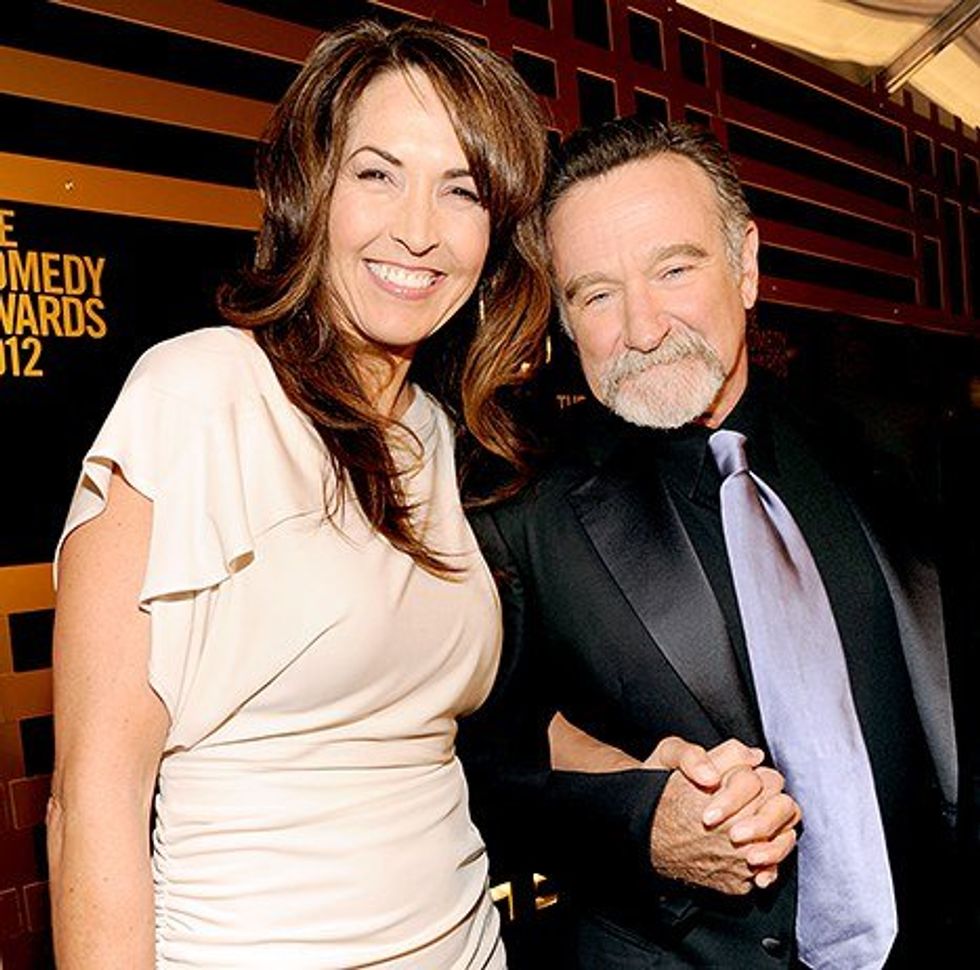
After over a year since the death of beloved comedian Robin Williams, his wife Susan speaks out and says that it was in fact not depression that killed her husband.
On August 11, 2014, the world was shocked by announcement of the 63-year-old comedian's suicide. People believed years of drug and alcohol abuse, along with living a life with Parkinson's Disease and depression, pushed Williams over the edge. After spending the last year processing and understanding the death of her husband, Susan Williams recently spoke out in an emotional interview with ABC news to say that she and her husband "were living a nightmare" before his death. We are now learning that the autopsy showed that her late husband was suffering from Lewy Body dementia, which she says is what ultimately killed him.
Though not well known, Lewy Body dementia, or LBD, is the second most common form of dementia following Alzheimer's disease, with symptoms resembling Parkinson's as well as Alzheimer's. According to the Lewy Body Dementia Association, LBD is a disease that affects nearly 1.4 million people in the U.S. LBD occurs when proteins in the brain begin to form clumps called "Lewy bodies," which makes it difficult for brain signals to occur.
Similar to Alzheimer's, symptoms of the disease mainly stem from cognitive issues which can range from confusion, memory loss, graphic hallucinations, and shortened attention span. Other symptoms, such as motor skills or movement impairments mimic Parkinson's, making it very difficult to diagnose the dementia. LBD also effects mood, which could have been the cause of or could have contributed to Williams' depression. Although there is no cure for LBD, symptoms can be treated through medication, although sometimes these medications can actually worsen depression.
During the interview, Susan says that Robin was in fact losing his mind, "and he was aware of it." Williams was experiencing an "endless parade of symptoms" beginning in late 2013, which later led to a diagnosis of early on-set Parkinson's disease in May of 2014. Susan says his death was caused by "what was going on in his brain" and that his suicide was his way of proving that he still had power. He was living a different life, which is why she says she forgives him after his suicide by hanging. She says that in seeing him after his death, she had the opportunity to tell him of her forgiveness and called him the bravest man she had ever known.
Williams' story is a tragedy that many people face. Difficulty of diagnosis due to low awareness of disease is a sad reality that many people come to know. He is proof that you can't judge a book by its cover. A seemingly happy man lived his life with many struggles. You never know what others may be going through or struggling with. Let their story be one that they tell, not one that is assumed.