Political news these days seem all about Russia. Did Russia hack the election? Is Russia blackmailing the president? Has Russia invaded Ukraine? While the current flurry of news about Russia can give the appearance of a rapid escalation of events, the relationship between Russia and the United States has been molded over the last century. However, the modern context of Russia’s American affairs began this decade.
2011:
Secretary of State Hillary Clinton alleged that Russian President Vladimir Putin’s election that year was rigged. According to Clinton, these allegations, a “personal beef,” were the reason Putin interfered in the American presidential election.
2014:
In March, Russian soldiers wearing unmarked uniforms invaded the Crimea region of Ukraine. Crimeans put the decision to be annexed by Russia up to a vote with a majority voting to join Russia. Rebel groups rose up in Crimea, backed by unmarked armored vehicles from Russia and clashed with the Ukrainian military. Conflicts also grew in other areas in Eastern Ukraine. In July, pro-Russian rebels shot down a passenger jet over Ukraine killing all 298 passengers and crew. A ceasefire is agreed upon in September, but pockets of fighting still break out occasionally.
2015:
Use of a private email server by potential Democratic presidential candidate Hillary Clinton comes to light. The email server was not secured and could have been hacked. A month later, Clinton announces her candidacy for 2016.
Donald Trump announces candidacy for the 2016 presidential election. Nobody has any suspicion (nor any reason to be suspicious) that Trump may have political ties to Russia.
Russia becomes involved in the Syrian Civil War. Russia provides the Syrian government with air support to assist in fighting rebel groups. At the same time, the United States is supporting rebel groups fighting the Syrian government.
2016:
In July, just prior to Hillary Clinton’s official nomination at the Democratic National Convention, an anonymous hacker publishes nearly 20,000 leaked emails from the Democratic National Committee. Included in these emails were strategies to undermine rival candidate Bernie Sanders’s primary campaign as well as emails showing that the DNC favored Clinton. It was announced by the CIA in December that Russia had hacked and leaked the emails through Wikileaks.
In October and November, another anonymous hacker group releases more than 20,000 emails hacked from the chairman of Clinton’s campaign. The emails were released over a period and the releases coincided with negative press coverage of Trump. The emails included strategies and a list of problematic quotes from Clinton’s infamous speeches to corporations. The CIA also concluded this hack originated from the Russians.
On November 8, Trump wins the election.
In early December, the Obama administration sends 300 combat-ready marines to the border of Norway and Russia. The presence of U.S. troops and tanks makes it more difficult for Russia to deny its involvement in any aggression in the area. Former Soviet states like Norway fear that Donald Trump will back out of NATO, an alliance formed during the cold war to stop Soviet aggression in Europe. The U.S. leaving NATO would significantly weaken its ability to repel Russian expansion.
Recent Events:
In response to the CIA’s assertion that Russia meddled in the election, the waning Obama administration puts sanctions on Russia. It is reported a month later in a scathing Washington Post article that newly appointed National Security Adviser, Michael Flynn, communicated with Russian officials on the same day the sanctions were applied. Flynn called the Russians five times in one day giving the appearance that he was instructed to do so. Nine anonymous government officials confirmed the phone calls occurred and that sanctions were discussed.
In late December, Russia tests a controversial intermediate range ballistic missile. Missiles of this type are banned by a nuclear disarmament treaty that was signed in the 1980s. The missile is capable of carrying nuclear warheads. These tests continue well into January.
2017:
In mid-January, the Obama administration sends a 3,000 troop armored brigade to Poland, a move that Russia sees as a threat.
Also in mid-January, the “Trump Dossier” is published by Buzzfeed and reported on by CNN. The dossier is allegedly the basis of a collection of blackmail Russia has against the president. While there has been no confirmation of the contents of the dossier, a few of the conversations it documents have been confirmed.
In late January, Russian-backed separatist rebels in another border region of Ukraine begin to assault a town under the control of the Ukrainian government.
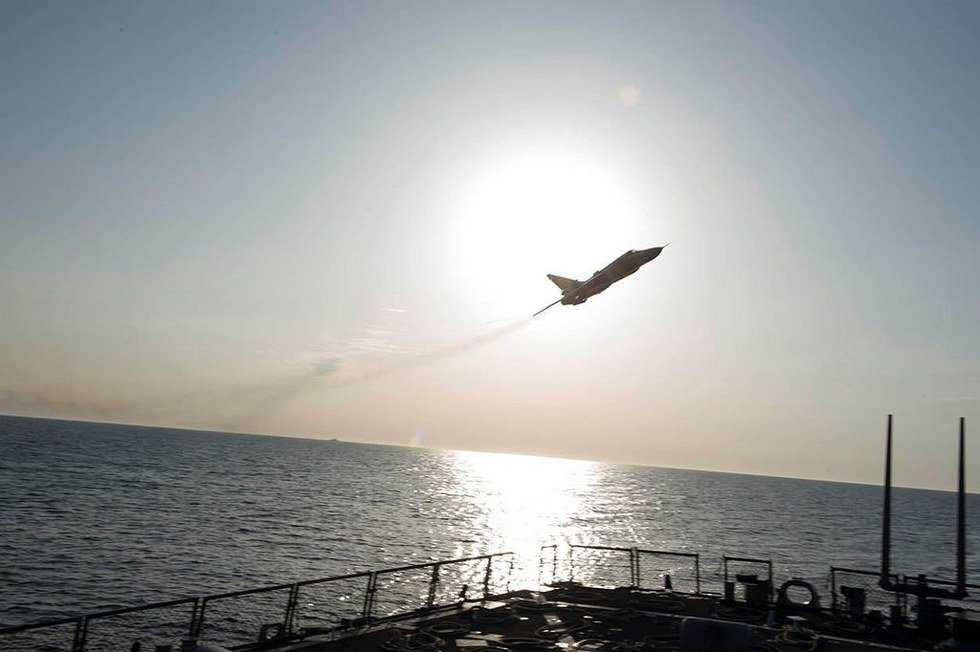
In early February, a U.S. Navy ship in the Black Sea, the USS Porter, was “buzzed” by a group of Russian aircraft. The planes—three of which were unarmed fighter jets—came as close as 600 feet to the ship at speeds nearing 600 mph. The USS Porter was within 600 miles of the Russian mainland.
In mid-February, six weeks after the phone calls to Russia, Flynn resigns at the request of the president. Information comes to light that the White House had known Flynn may have been compromised by Russian intelligence for weeks.
Also in mid-February, a Russian spy ship was seen only 30 miles off the coast of New England loitering near U.S. Navy submarine bases.
As for the future of America’s relationship with Russia, the most recent events show increasingly aggressive actions. It is highly possible that Russia is testing Trump to see how far he may go. It has also been proposed (primarily by progressive Democrats) that Trump may be influenced by Russia’s blackmail against him.
If Russia feels that Trump won’t react aggressively in response to these events, the aggression may grow as Russia makes moves to become more internationally dominant.
Despite all the rhetoric surrounding these incidents, many of the domestic events mentioned above were discovered through thorough journalism. Journalism will likely see an increasingly important role in government oversight in the coming years with more leaks and more scandals. And quite possibly, one of those leaks will complete the puzzle of information surrounding Russia and the United States.