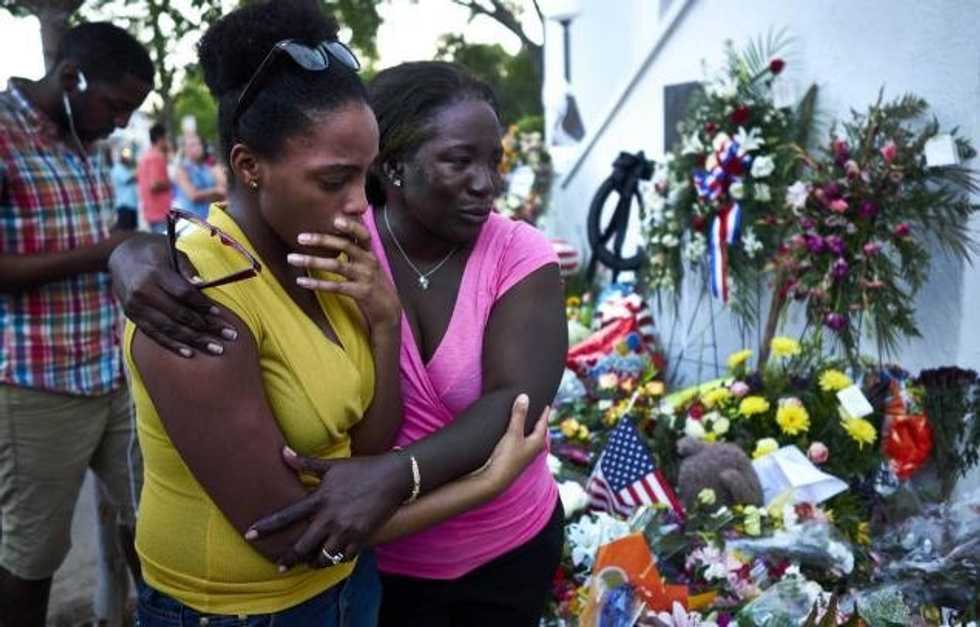
The mass murder of nine people who gathered last Wednesday night for Bible study at the Emanuel African Methodist Episcopal Church in Charleston, South Carolina has shaken the nation. The nine victims' ages ranged from 26 to 87 including Reverend Clementa C. Pinckney, who was the church pastor and a prominent state senator. The man responsible for grief in this community is Dylan Roof, a 21-year-old white man with a history of anti-black views.
The Emanuel African Methodist Episcopal Church is so special because the AME church is one of the oldest black congregations in the south. Its members met in secret during the years when black churches were outlawed, prior to the Civil War. In fact, one of the church founders helped organize a slave revolt in 1822.
It took some time to wrap my mind around this story and even more time to emotionally prepare myself to share my thoughts on this constant war against my people.
From the killing of Trayvon Martin, the black Florida teenager shot to death in 2012 by George Zimmerman, to the mass murder of innocent people engaging in a religious gathering, I found myself disgusted, angry, and feeling hopeless for my community. What I find most disturbing is knowing that there are more people in this world who have the same hatred toward blacks as Dylan does. There are people who still believe that whites are superior to blacks, and as we advance in this nation, they may fear that our unity puts them in danger.
History has shown that when we come together as a unit to make change, we indeed make change. For those who fear us, they would rather get rid of us instead of taking the time to understand our culture. The debate is always centered around if this is a “race thing” and whether people want to admit to it being racial. But there is no denying that this incident took place under circumstances of hatred.
When you can no longer go to church and worship without being fearful, what else can you do? Do you stop going to church? Do you no longer believe?
While watching the responses of family members representing each individual killed at the AME church, I learned something very valuable that ultimately answered my questions. While speaking about Dylan, family members expressed that they forgave Dylan, that they were praying for him, and that they wanted him to take the time out to repent. In that moment, I regained my hope. I felt empowered and proud to be a part of a community that is so strong.
When tragedies occur amongst our people, I always ask myself what’s next. Months from now, will this issue be decreased to a simple hashtag on Twitter or will we decide that enough is enough? Do we continue to wait until blacks are being gunned downed in schools, restaurants, and groceries stores before we as millennials take the same approach for change that our ancestors did before us? Are we supposed to sit around until it’s someone close to us or do we take the responsibility for the entire African American community? I don’t believe we as a nation can make any progress by retaliating with hate but we can make a change by retaliating with consistency, love and unity. This can be done by not killing each other, but encouraging one another, by becoming educated on what is really happening around us as well as educating our brothers and sisters, and being conscious enough to know that we deserve to live in a world where hate does not become our answer for everything. It is time to leave the comfort of our computer screens and get out into our communities and actually make a difference.
There is no way to change the mindset of people overnight, but that does not mean we can't try. I am tired of seeing our black men and black families murdered by hateful people. Our generation has the access to many things that enables us to become more involved, so it is up to us to take advantage of every opportunity we have to make a difference. In the words of Mahatma Gandhi, “be the change that you wish to see in the world.”
As cliché as it sounds, the only hope for our community is to work together, and by being passionate enough about these issues to want more for ourselves and the generations to come.