

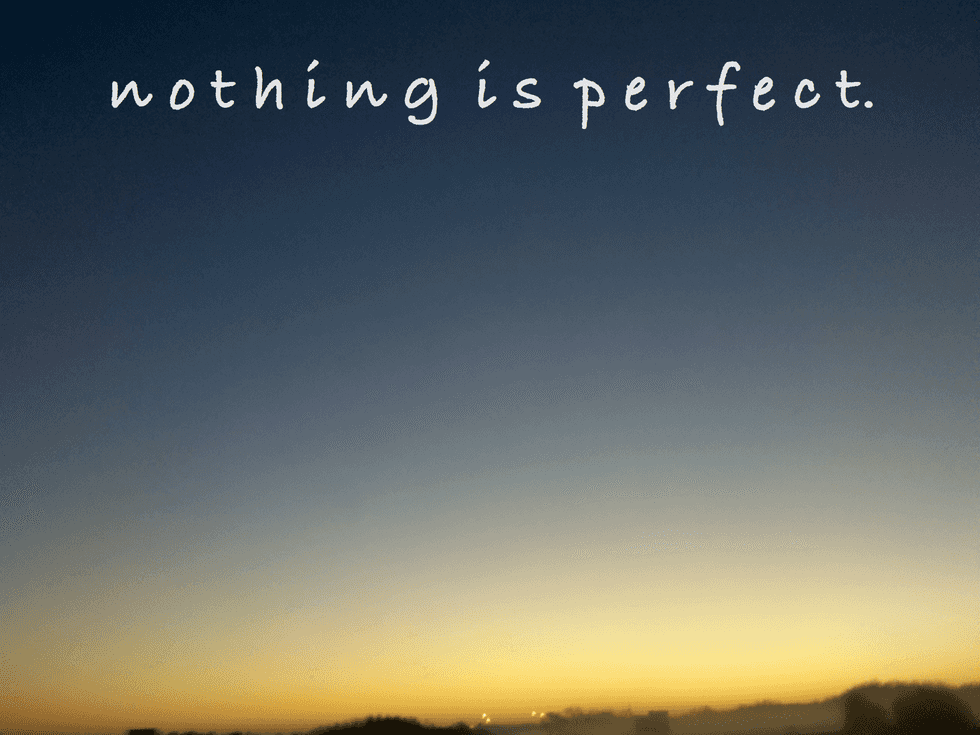
Recently for a class project, my classmates and I were assigned to create an image based on current social and cultural issues. I knew right away I wanted to focus on an internal issue, and the fallacy of perfection came to mind. As I began creating this image, I started to think deeper into the meaning of perfection. My memory raced back to a book I read when I was younger called, "Delirium." It was based on the idea that at the age of 16, you were to undergo a procedure to make you perfect -- inside and out. This was to ensure anything they did in life would be done perfectly -- no flaws, no mistakes. It occurred to me that the desire for perfection isn't just found inside a book, but it's prevalent in the real world as well.
Prior to researching the idea of perfection, I had a preconceived notion about perfectionism; I thought it was unattainable and made people feel insecure about who they are and what they could accomplish. As my research progressed, my opinion never changed, in fact, it strengthened my stance. One article I came across had pictures of stop signs immediately at the top of the page. This was really interesting to me because although I didn’t view perfectionism in a positive light, I never associated it with prevention. The article went on to explain that being a perfectionist will stop you from trying new things or taking appropriate risks in life because you don’t know if the outcome will be perfect or if your actions are good enough. To me, this is something I never thought perfectionists struggled with. They have this stereotype that they never pass up a new opportunity to try to be perfect. It seems as though it is the opposite. Trying to aim for perfectionism will leave you limited with options in life. There is a sense of fear created because you aren’t sure how well you can perform and that stops you from trying.
I read another blog called "Fallacy of Perfection" and the author discussed how it’s a pure illusion because these standards can never be met. The author was asked what he thought of when he heard the word “perfection,” and his response was so relatable. He said, “I think of lies that I tried living up to during childhood that convinced me if I did ‘this’ or ‘that,’ I could achieve something beyond my capabilities.” Once again, my mind travels back to the book, Delirium. The word "perfect" is all part of a fantasy world. You see the perfect life or person on TV or in a book and you think it's achievable, when in reality, it isn’t real at all, it’s an illusion.
Another quote that I admired that he said was “Anything we humans do will always have a flaw.” The idea of striving to be perfect in anything we do can, in the long run, enable us to lose sight in who we really are. In my mind, flaws are a necessity in life -- they make you stand out from the rest. The minute we try and take away a flaw to strive for perfection in ourselves is the minute we lose the authenticity of our being and become superficial. It takes a lot of courage to be who you really are in this world, flaws. To me, that’s superior to perfection.
I understand perfection is just a word, but this one small insignificant word can hold so much power over someone’s way of life and actions. For those who still struggle with the idea of being perfect, I would say don’t let this consume you. Don’t let this stop you from taking risks, trying new things. It’s our job to not live life perfectly but to the best of our ability. Know that flaws are inevitable and make you who you are. Be OK with failure because what’s important isn’t that you were perfect, it’s that you tried.