
As a person with significant foreign perspective, being partially of Colombian descent and living abroad for significant chunks of time, the Olympics are a very interesting event. The Games aim for the non-political peak of human performance while navigating the inherent political complications of awarding medals to individuals as representatives of their countries.
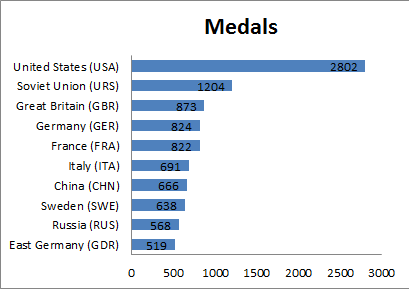
The United States, as the wealthiest country in the world, has typically dominated the Olympic scene since the Games’ revival in the late 1800s. And, indeed, the connection between wealth and success cannot be understated. American athletes do not have advantages singular to the nation, but cumulatively, they benefit more as Americans more than any other nationality. American athletes have exposure to a culture of athleticism and sports performance emphasized from a young age. No other country has such an emphasis on all-around sports performance in both private and public schools, and no other country invests so heavily in it. Some countries are competitive in specific sports—a well-known example: Brazil in men’s soccer—but the United States has a much more diverse array of emphases, from shooting to swimming to volleyball. American athletes also benefit from stability: their country suffers from no violent internal strife and can afford to maintain athletic facilities as it engages in foreign conflicts. These feats set it ahead of many less-developed nations, but the United States’ benefits are also greater than its developed neighbors’.
The Unites States is different from all other developed countries in its raw geographic size and large population. American athletes are simply drawn from a larger potential pool of athletes, giving it a higher number of Olympic competitors. For purposes of comparison, using the most accurate data available for comparison, Russia had a growing population of approximately 23 million 0-15 year-olds, potential future athletes, in 2013. In 2010, the United States had approximately 31 million 0-14 year-olds, giving it an advantage of eight million potential athletes. No wonder the United States is, as of the writing of this article, ahead of Russia by 64 medals.
This is not to discredit the effort and incredible accomplishments of American athletes gathered in Rio in recent weeks, but to recognize their advantages as Americans. Other countries at the top of the medal leaderboard—Britain, China, Germany—can also afford to invest in athletic programs and field large delegations to the Games. It is important to remember that the peak of human performance is not limited to the nationals of the select few countries that consistently rank in the highest of medal counts. The official goal of the Olympism is:
to place sport at the service of the harmonious development of humankind, with a view to promoting a peaceful society concerned with the preservation of human dignity.
Human dignity in the form of physical excellence is not the monopoly of any one state (Maryland!), nation, or hemisphere.
And the Olympic Charter recognizes this in a very important manner:
The Olympic Games are competitions between athletes in individual or team events and not between countries.