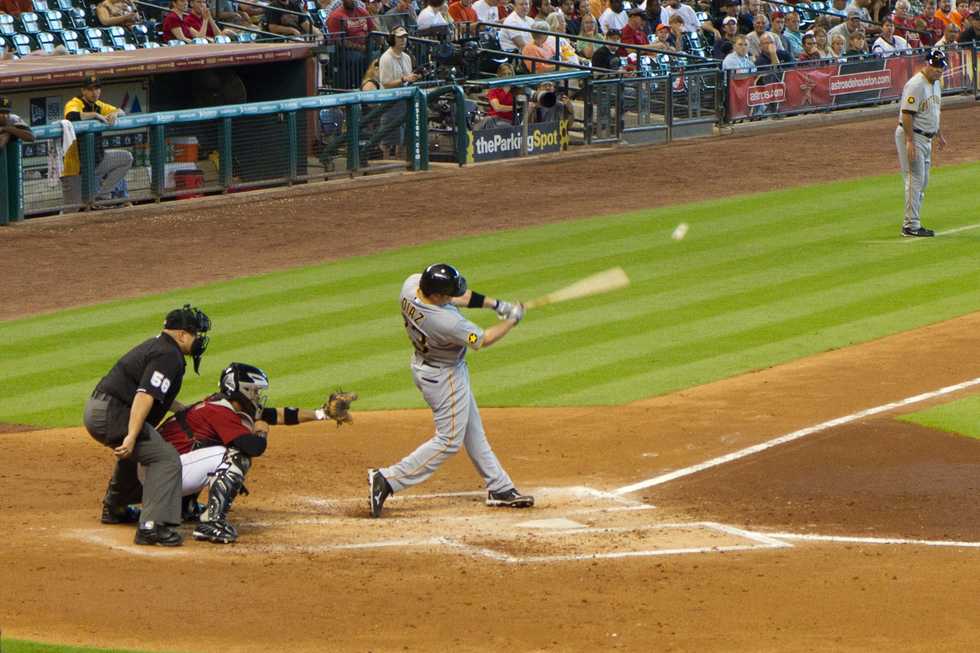
Earlier this month, baseball fans were treated to one of the wilder World Series’ in recent history. The ungodly number of Astros fans crawling out of the woodwork here in DC has me wondering – what exactly drives our love for our favorite sports teams?
One popular idea revolves around group dynamics and belongingness needs. The reasoning goes that, as you become more invested in a team and more aware of the community surrounding it, the experience of watching a game begins to permeate your self-image. Some research even suggests that strongly identifying with a particular team can act as a kind of “buffer” against depression (Wann, 1991).
I can’t help but scoff at that claim – if you Google “suffering sports fans,” your author’s New York Mets are mentioned in eight of the first ten articles that appear.
A similar line of thinking holds that fandom intensity varies by how favorably a team reflects on an individual. A classic study by Arizona State University’s Dr. Robert Cialdini found that fans are more likely to utilize first-person language following a preferred team’s win (e.g. “our offense came alive today”) and third-person language following a loss (e.g. “they couldn’t hit anything today”). That discrepancy seems indicative of a subtle self-serving bias that selectively associates self-concept with your team of choice.
If the social-cognitive side of things doesn’t interest you, consider Dr. Paul Bernhardt’s examination of fans’ hormonal fluctuations during football games. Dr. Bernhardt found that, when their team was winning, fans in the stadium experienced an average baseline testosterone increase of nearly 20% – a spike almost as strong as that which occurred in the players themselves. Eric Simons, a journalist, summed up Bernhardt’s results by saying that “[the players’] victories literally become ours.”
The above research spans decades and disciplines, but it seems to me that there might be a common thread through it all. “Mirror neurons” are the brain cells most closely associated with empathy, theory of mind, and observational learning; they fire when an individual performs a recently observed task, and, to a lesser extent, when an individual witnesses the execution of any relatable action. In doing so, they incorporate those actions into the self and self-image, a phenomenon which we see in different forms in each of the above studies: Wann’s study captures its social aspects; Cialdini’s, the cognitive aspects; and Bernhardt’s, the biological aspects. At the time of Bernhardt’s study (1998), mirror neurons were only beginning to be understood, and at the time of Cialdini’s study (1973), they were not recognized at all.
Might not mirror neurons mediate the social, cognitive, and biological motivators of sports fandom?
Or, maybe we just watch baseball because it’s fun to watch. Here’s to another exciting Series, featuring the Mets in 2018. One can dream.
References
Bernhardt, P. C., Dabbs, J. M., Fielden, J. A., & Lutter, C. D. Testosterone changes during vicarious experiences of winning and losing among fans at sporting events. U.S. National Library of Medicine. Retrieved from: https://www.ncbi.nlm.nih.gov/pubmed/9811365
Cialdini, R. B., Borden, R. J., Thorne, A., Walker, M. R., Freeman, S., & Sloan, L. R. (1976). Basking in reflected glory: Three (football) field studies. Journal of Personality and Social Psychology, 34(3), 366-375. Retrieved from: http://dx.doi.org/10.1037/0022-3514.34.3.366
Wann, D. L., & Polk, J. (Jun 2007). The positive relationship between sport team identification and belief in the trustworthiness of others. North American Journal of Psychology, 251.