

It was an un-merry Christmas for more than 200 American families who were in the process of adopting children from Russian orphanages. In December of 2012, they had just received notice that American adoption was to be banned by the Russian government in January of 2013.
January passed and political relations between Washington and Moscow remained chilly. The ban remained largely undiscussed, save some isolated efforts.
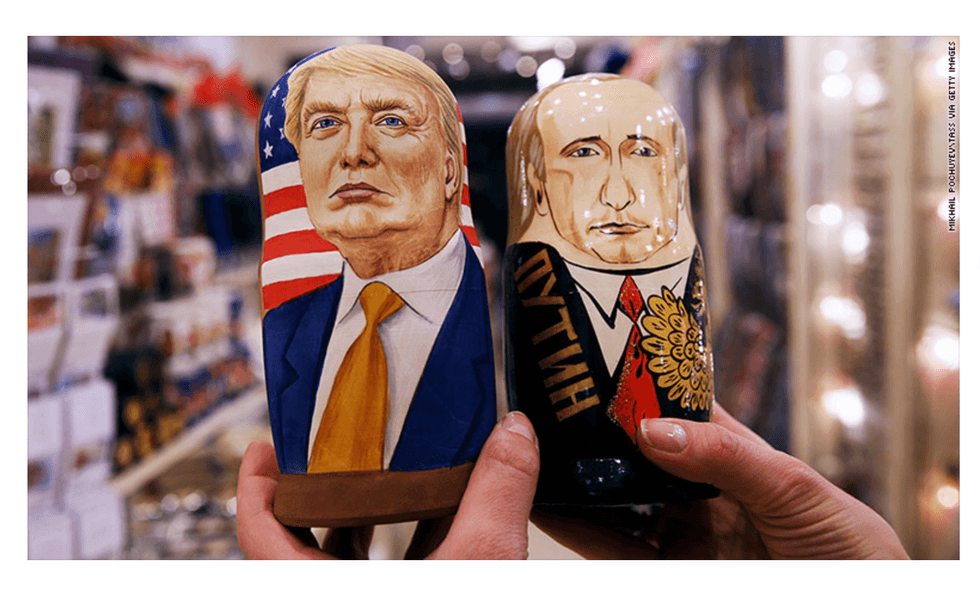
Four years later, the ban has stayed but a legitimate reset of U.S-Russian relations seems possible with Trump's exceptionally anti-NATO, pro-Putin remarks. This reset should not be confused with former Secretary of State Hillary Clinton's gift to Russian Foreign Minister Sergei Lavrov: the red button that said "overload" rather than "reset" in Russian.
Vladimir Putin's recent letter to president-elect Donald Trump is unprecedented. The Obama administration witnessed Putin's 2013 op-ed in the New York Times which decried America's military involvement in Syria. But that was obviously no pledge of cooperation.
In the letter, Putin wrote to Trump "I hope that after you assume the position of President of the United States of America we will be able - by acting in a constructive and pragmatic manner - to take real steps to restore the framework of bilateral cooperation..."
This sounds less like an overloaded plate of unsurmountable issues and more like an appetizing invitation to make smart policies.
Between 2008 and 2016, the rocky relationship between Washington and Moscow was codified by several acts of obstinance. The 2012 bill to ban American parents from adopting Russian orphans was undeniably one of the most appalling displays of anti-Americanism. The ban unanimously passed both chambers of the Russian government and was signed by Putin.
In 1997, Russian neighbor Georgia also proposed a ban on foreign adoptions in the name of state interests. The wife of the former Georgian president campaigned to convince Georgians that "our nation's gene pool is being depleted." Likewise, Romanian officials were concerned about foreign adoption because of adoption agency corruption and the mistreatment of children abroad. Russia is not novel in its prohibition of adoption.
What do these three countries have in common? Unsurprisingly, a distinguished record of human rights abuses (and the deprivation of orphans' heightened chances of survival is no exception). In fact, the 2012 adoption ban was enacted in response to an American critique of Russian human rights policy. The triggering legislation known as the Magnitsky Act blocked known Russian human rights abusers from entering the United States and owning property or other assets in America.
To simplify the political conflict, Russia retaliated against American policy at the expense of orphans and their prospective American parents. It is ironically sinister that Russia should abuse the human rights of its most vulnerable population to protest legislative action that decries human rights abuses.
According to CNN, Putin's administration justified its support of the ban through appeals to emotion and nationalism. Russian legislators pointed to the deaths of 19 Russian orphans since the 1990's to demonstrate the horrors of western parenting. Certainly, these deaths are nothing less than tragic. But for perspective, it is estimated that about 800,000 orphans lived in Russia in 2004, both on the streets and in orphanages. The New York Times reported that 1,000 children were adopted by American parents the year before the ban was enacted. Given these statistics, it is clear that the incidents reported by the Kremlin are extremely rare.
Putin's actual concerns are rooted in nationalism, which is why Putin's positive press time for Donald Trump is so key for Russian orphans.
At the time of the ban, Russian pollster Lev D. Gudkov explained that about 2/3 of Russians lived in smaller towns where their most direct source of information came from Kremlin-sponsored television channels. Consequently, 56% of Russians surveyed supported the ban since their primary source of information warned of the unpreparedness and/or aggression of American parents.
Inadvertently, through maintaining positive relations, America is reestablishing its credibility. If US-Russian cooperation increases, any Russian victories that would be aided by America in any way will become key in Russia's perception of the west and their trust of its parents. Government policy is relayed to the Russian people, so there is potential a trickle-down effect of citizen-to-citizen trust. The Kremlin obviously cannot report any new abuses of adopted children, since there have been none. The government's last argument is that it simply doesn't like the United States.
As Trump's administration strives to cooperate with Russia, this argument becomes harder to make and there is some hope for Russian orphanages through the redemption of Putin's nationalism.