
There’s a fine line between a rock concert and a rock show. Rock concerts are, for the most part, commonplace: artists perform music on the stage, and the audience watches. We all go to them, and we all adore them. Rock shows, on the other hand, are a bit different. Artists masquerade on stage not as themselves, but as characters who therefore give their spectators a theatrical performance.
There’s nothing wrong at all with regular concerts, because they all are capable of providing divine experiences for their attendees, but when it comes down to it, we’re more likely to remember Gene Simmons vomiting blood while hanging twenty feet in the air than Dave Grohl running around stage with a guitar.

With that said, let’s talk about shock rock, perhaps the most classic feature of a rock show. Shock rock combines rock and roll music with the theatrics to bold levels, typically delving in either tasteless or tongue-in-cheek styles. Its history dates back to the days of Screamin’ Jay Hawkins, who would often emerge from coffins and set off smoke bombs.
If you want to know the kick-start of true shock rock in all of its hideous glory, however, you’ll have to go all the way back to September of 1969 at the Toronto Rock and Roll Revival concert. Neophyte rock-star, Alice Cooper, was performing at the festival. Later on into their concert – which thus far had been going normally and not unlike any of the other concerts – a chicken was thrown on stage. Stating that he had never been on a farm in his life and thus thought the fowl could fly, Cooper tossed the bird back towards the crowd, who proceeded to tear the harmless chicken to shreds and toss the remaining limbs back on stage.
Woah.
Next day comes and headlines across the nation are reading how Cooper is an “animal killer” and “evil.” Accidentally or otherwise, shock rock as we know it today was born, and as time went on, it only progressively became more obscene, sadistic, and overall entertaining. The 70s has Cooper, the Sex Pistols, and the Misfits. The 80s had Ozzy Osbourne, W.A.S.P., and Iron Maiden. The 90s had Marilyn Manson, Rammstein, and Nine Inch Nails, and the previous decade had Slipknot, Ghost, and In This Moment. What about in the 10s, though? Who do we have today that can possibly give these rebels a run for their money?
Ladies and gentlemen, I present you: Miley Cyrus.

Now, bear with me for a moment. I know musically, Cyrus isn’t exactly in the same ballpark as these other examples, but neither exactly are W.A.S.P. and Kiss, whose music is about as close to mainstream rock as it can get. For this analysis, I’m focusing on her image alone, and it has been universally acknowledged in the music community and beyond that the Disney Channel sweetheart from "Hannah Montana" has grown up from a kiddy pop star to one of the most important rock stars of this generation.
We should have all seen it coming with Cyrus’s 2008 Vanity Fair photoshoot, yet somehow, it flew over our heads as a “simple mistake.” She also gave the red flag to her maturing as an artist over a dozen times before the release of the “Wrecking Ball” video and the dawn of twerking, yet it still flew over us as nothing more than “teenage rebellion” (despite the fact that Cyrus was well past her adolescence). Since then, she has smoked a joint onstage, ground against Robin Thicke, and has made television appearances almost entirely nude. Even the most hardcore male musicians have never dreamed of taking the latter action. That is bold.
If you want the best representation of Cyrus’s controversy, however, look no further than her Instagram.
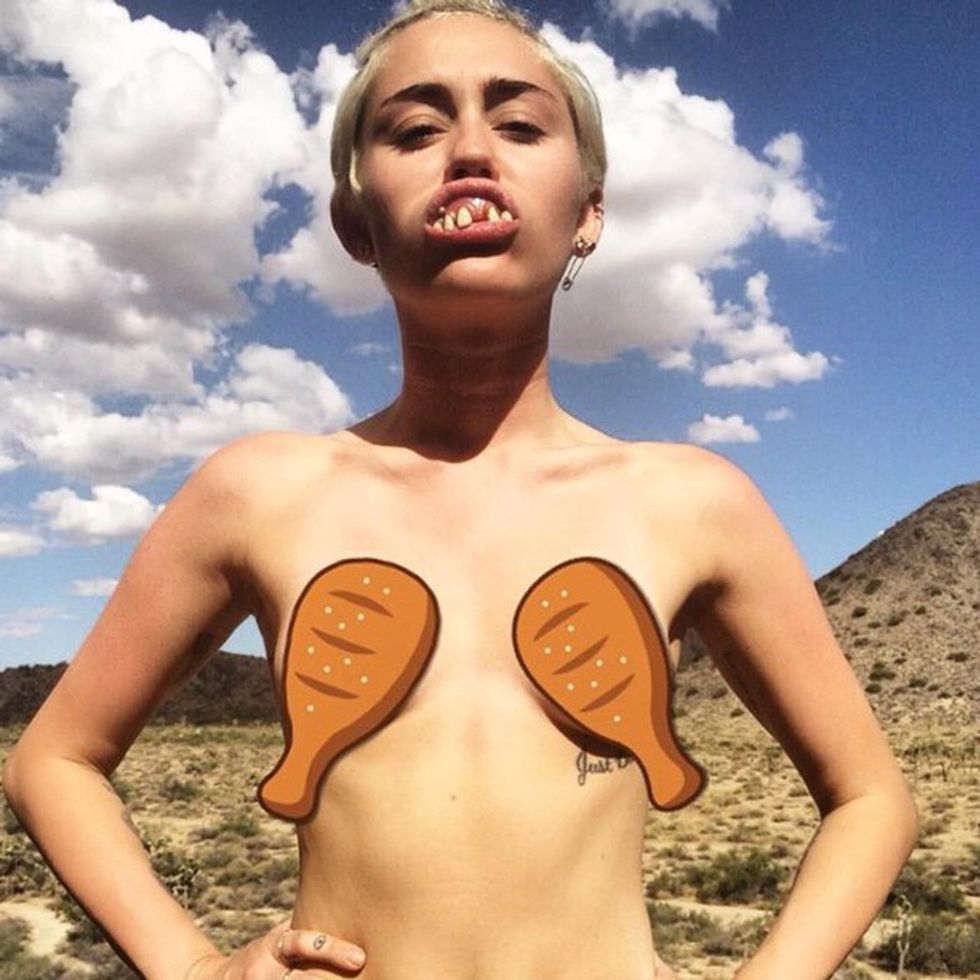
A strong advocate of the #freethenipple movement, it often seems as if the vast majority of Cyrus’s Instagram photos are topless selfies. On top of this, she seems to make no attempt to take pretty pictures of herself – or of anything, really -- a bold move that ultimately pushes against society’s skewed idealization of beauty and proves that nothing is truly 100 percent flawless.
In many ways, this makes Cyrus a much better role model than Katy Perry or Lana Del Rey, who seem to depend more on their beauty than individuality. Considering that it’s 2016, and women are still treated unequally, perhaps we need icons like Cyrus, Lady Gaga, and Pink, who tell women to embrace their sexuality, embrace their gender and, most importantly, embrace their flaws. Perhaps this is why we should pay attention to Cyrus instead of condemn her.