


Then vs. Now
The numbers are swirling in my head. The teacher’s voice continues over the drone in my head, but I can’t seem to listen. My vision blurs, my hands feel clammy. I have to get to the bathroom before long. I try to be discrete when I get up, but you can only be so discrete when others know you have an eating disorder. I puke, clutching paper towels to my mouth over the toilet basin, and pray no one heard. Luckily, my journalism class has a semi-abandoned bathroom, and I feel safer vomiting. My head spins and I taste curdled food on my breath, but I return to class. I go back to calculating what half a turkey sandwich would add up to, trying to factor in the calories I just purged. I scrubbed my hands and mouth, but I feel like there is a warm spotlight behind my head. Everyone knows. My family doesn’t know, but the other kids can sense that I’m crazy. They can see the carbohydrates in my notebook and the weight I’ve lost and why doesn’t anyone help me?

I had my gallbladder removed in 2010. The only way I could feel relief from the intense pain that grabbed my stomach was to vomit or simply not eat. After it was out this pain was cured, but my mind was not. Instead of enjoying my health and living like a normal 15-year-old, I delved into a hole that I would not scratch out of for almost 5 years. I gave my life to bulimia.

There are many studies out there that show that you have a higher risk of an eating disorder if others in your family had it. Several women of my family, some that I was very close to, had dealt with bulimia. My mother had been hospitalized at the age of 15 when dealing with the disease. When she figured it out one day, amidst my denials and hiding it, she simply cried. Once you have an eating disorder, you ever truly break away from its grasp. You can recover and, for years, feel relatively safe. Then, one day, you may have kids, a hormonal imbalance, or simply gain weight. When you relapse, you feel like every single thing you worked for has gone down the metaphorical toilet. It happened to me so bad that, my freshman year of college, I was purging almost every day. I would go to the bathroom in the middle of the night, puke in my trashcan, or walk to a secluded bathroom on campus and purge. It got so intense and interfered with my grades so much that I obtained counseling. I was never hospitalized, but in the process of my being bulimic, I lost my best friend (for a short amount of time), went to several different counselors, and developed several techniques to make myself more invisible.
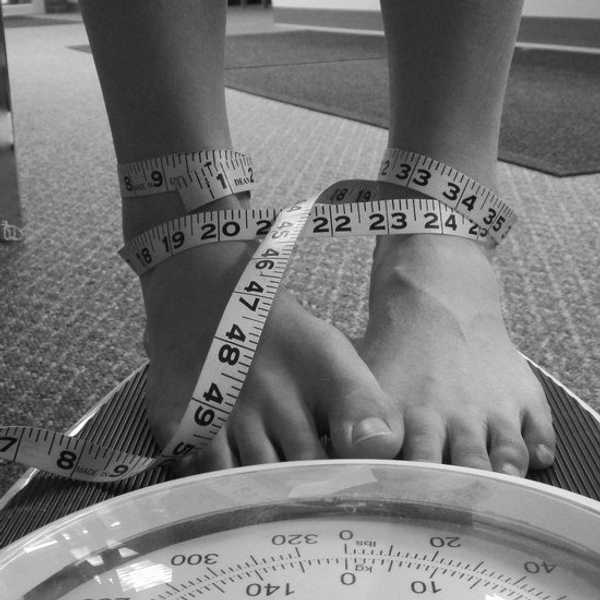
Bulimics are sneaky. I felt like I was lying to everyone. I went from weighing 187 to, in the span of one summer, 133. Everyone commented on how good I looked. Boys started paying more attention to me. I wore things I had never worn before. I had more self-confidence than I had ever had before. But I was also more miserable than I have ever been. I, the girl who never played sports or exercised regularly, began to work out for at least an hour every day. I would get up, work out, starve myself, and count calories of every single thing I consumed. It would be so bad that sometimes, when I was alone, I would only allow myself a sliver of a single piece of gum to chew every hour. I waited until hours I was awake to eat half a banana.
This sounds more anorexic, and maybe it was. Defining eating disorders is a tricky topic. I was neither anorexic nor bulimic. The entire time I had an eating disorder I was aware (unlike many cases) and always said I was bulimic. Once, I ate half of a grape. I would routinely vomit lettuce, apples, and “healthy” cereals. I learned all the tricks to having an eating disorder. I would puke outside, in cups, in the tub, at school. I never needed the classic toothbrush. I took laxatives on a regular basis. Once, when I was a sophomore in high school, I laid out in the sun after starving myself all day. When I came in, I collapsed in front of my sister, who automatically asked if I had eaten. Of course I had. Bulimia caused me to be sneaky in the sense that I lied to my friends and family constantly about my behavior.

But I would also binge. At one point, I had about 6 chicken nuggets, 2 waffles, strawberry milk, peanut butter from the jar dipped in sugar, ice cream, and lots of maple syrup. This was on one New Years when I made a resolution that this would be the last time. I might as well enjoy it, right? But it wasn’t the last time. That New Years was probably about 3 years before I entered “recovery.” I had quit various times, usually because of a boy I liked or was dating, but always seemed to go back to it. It was only when I gained more independence and entered college that I really started feeling less of the urge and less of the counting.

Now, I am a junior in college. I have been on anti-anxiety and anti-depressant medication for about 9 months. I only recently decided to stop taking the pills, and I am feeling the effects more and more. I took a SSRI (selective serotonin reuptake inhibitor) that is not only helpful with depression but is used to treat bulimia as well. I struggle every day to not relapse. I live alone, and the freedom that gives me is simultaneously thrilling and terrifying. If I wanted to purge, I could. If I wanted to binge, no one is going to stop me. It’s the words and the hurt of my loved ones that keep me on the straight track. I still sometimes have days that I want to revert back to my old ways. In fact, about three months ago, I purged. That was the first time in a very long time and I automatically felt dirty and wrong.

In telling my story, I hope that if you are coping with an eating disorder you somehow find the courage to beat it. If you see any weird eating behavior from a family member or friend, don’t call them out on it. Take them aside and talk calmly about how much you care about them and how much they matter to you. Sometimes, a few kind words is all it takes