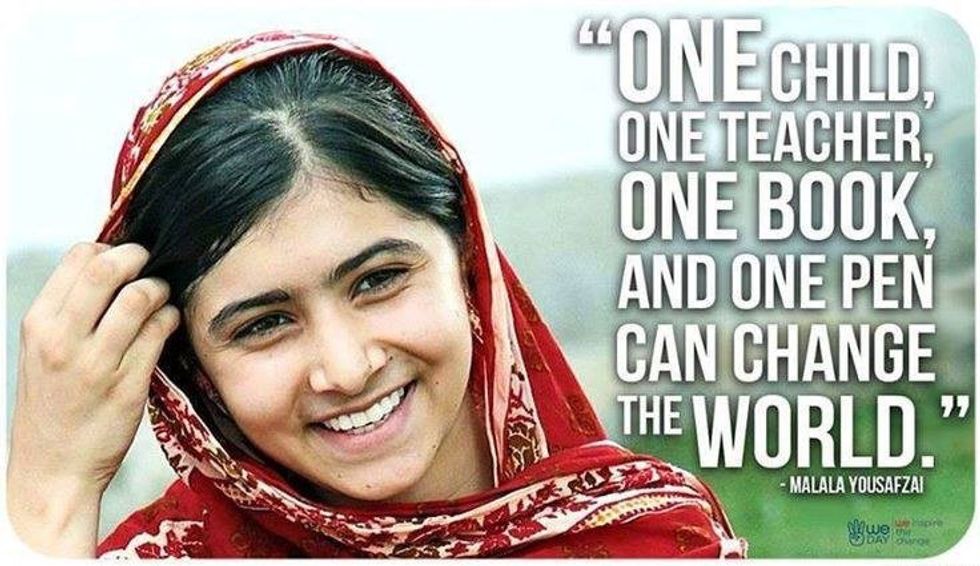
As I was lying in bed on Saturday night studying for classes that haven’t even started yet and wondering what I’m doing with my life, I decided that I was bored. So, like any good college student, I took an hour-long YouTube break. As usual, I started out with seemingly doable (but we all know they’re not) makeup tutorials. A few (hundred) videos later, I came across an interview between Emma Watson and a young woman named Malala.
Malala, an 18-year-old girl from Pakistan, began writing a blog called “Diary of a Pakistani Schoolgirl” for BBC when she was 11. In her posts, she wrote about occasional bans on girls’ education by the Taliban and advocated for change. Her blog soon became an international story — although she wrote under the pseudonym Gul Makai, the name of a heroine from a Pashtun folktale. Sadly, because of the dangers associated with women calling for change and speaking freely, Malala was the only person willing to write the blog. Although she maintained anonymity in her writings, Malala also bravely delivered a speech entitled “How Dare the Taliban Take Away My Basic Right to Education?” As Malala became more recognizable, many feared for her safety.
In December of 2012, the Taliban stormed Malala’s school bus, demanding to know which student was Malala. She was then shot in the left side of her head — the bullet moved under her skin and stopped at her shoulder. Malala was rushed to a hospital where a section of her skull was removed to lessen the swelling. After remaining in critical condition, she was flown to a hospital in England and was even placed in a medically induced coma. She underwent several surgeries to restore her health and gradually recovered. Although the Taliban tried to silence Malala’s voice that day on the bus, they made it grow stronger.
She has actively continued her advocacy for women’s rights and has begun the Malala Fund. Through working with partners around the world, Malala aims to ensure that high-quality education for girls in her country becomes a priority. Because of her unwillingness to abandon her mission, even in the face of danger, Malala became the youngest winner of the Nobel Peace Prize. But what struck me about Malala in this interview was the way that she utilized the attention to passionately deliver her message. She said to Watson that although people think that she has it all because of her newfound fame, they fail to realize that her ultimate goal of education for all children has not been achieved. She went on to say, “This is about the future of all those 66 million girls who cannot go to school right now. It’s about our future ... it’s we who can bring change.”
I think it’s safe to say that this was the most inspirational and important YouTube break I’ve ever had. What we can all learn from Malala is to never take our education for granted because so many do not get the opportunity to learn. Millions of young girls just like Malala are kept from getting educated. They’re even made to be afraid of being educated. We fail to understand that although going to school is the norm here, it is not even possible for many people. Or in many parts of the world. The next time you wish you didn’t have to be in school, reflect on just how lucky you are to be given the chance to learn. We need to join Malala on her mission and advocate for change. If more of us raise our voices, we can hopefully move closer to making her lifelong dream of equal rights a reality.