

While I’ve taken to writing and working as my main extracurriculars in this first portion of my college experience, I used to spend my glory days on the stage performing in my school’s theater productions. I worked behind and on the scenes, painting sets and jazz-squaring for all the world to see. Theater was my outlet, my safehaven, a place where I could be with people and talk about all the shows and actors and actresses that, among my other friend groups, I was alone in enjoying. And when my senior year came and I returned in the fall with my paintbrushes in arms, ready to take on another saturday's set construction, I noticed that after just a few songs from "Pippin" or "Les Mis," an unfamiliar tune entered my ears. It sounded like something out of the early 2000s rap scene, but then I listened further, and much to my surprise it was about Aaron Burr.
I walked over to the girl manning the aux cord and asked, “What the hell is this?”
And with a look of confusion as to why, or how, I was unfamiliar with the music, she responded, “Hamilton.”
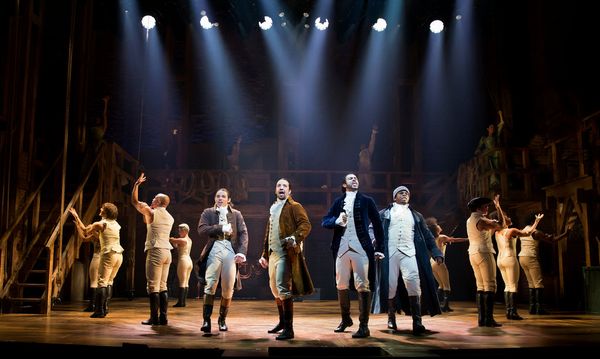
Hamilton: the magnum opus of its writer, director, and star, Lin Manuel Miranda. It is the R&B retelling of the life of Alexander Hamilton, founder of the Federalist party and our nation’s financial system along with a long list of other mass accomplishments. The musical is about 3 hours long, or at least it feels like it, and with a new and unconventional sound and an incredibly unique take on what would often be considered a boring-to-average subject matter, it is massively popular. And not just with one particular group of people, no-- "Hamilton" has become "The Beatles" of musical theater, with Lin Manuel Miranda standing in as their Paul. I usually find myself susceptible to this sort of trending-music fever, or at least my 7th grade self who bowed to the likes of Justin Bieber would probably think so. And while I’ve tried so incredibly hard, ruminating over its soundtrack and researching the history of it time and time again, the little theater bug in my heart refuses to dance along to the pseudo-rap tracklist, and it’s with great chagrin that I must admit:
God, I hate "Hamilton."
It is with a great deal of conviction that I express my dislike for "Hamilton," and while, I know, it’s okay for everyone to have different likes/dislikes, my decision to open up about my opinion towards "Hamilton" puts me at odds against the world, and so I feel the need to defend myself. I am very well aware that "Hamilton" is a globally-renowned, award-winning, history-making (and presenting) show, this however does not take away from the fact that I can’t stand it. It’s not the instantaneous popularity of "Hamilton" which has me writhing at the thought of it, (certainly if I wanted to go against the mainstream I would be writing this article on my hatred for food blogs or nude colored lipstick), no-- it’s the subject matter, it’s the style, and it’s the inspiration.
Alexander Hamilton, who from 8th grade history classes you may remember being a founding father, the sole designer of the United States financial plan, a man who was ambitious and outspoken, and also an elitist asshole. I’m not going to sit here and say that all the founding fathers with the exception of Mr. Hamilton were the best of men, almost all of them owned slaves and carried their own beasts, all of many burdens. However, I will say that to disclude the ideology of the Federalist party and Alexander Hamilton’s favoritism towards the merchant class during his designing of America’s financial system should be marked. The musical does talk of his adultery (with some amount of historical inaccuracy), but this, to be fair to Mr. Miranda, is part of what adds to the interesting tale of Alexander Hamilton. But as I read through the play’s lyrics and through the biography of Alexander Hamilton, I began to wonder, “Why Hamilton? Why not Ben Franklin?” I mean Ben Franklin was nuts, if he wasn’t tinkering with his glass harmonicas or contracting syphilis (I never said he was perfect), Franklin was taking arms in the abolitionist movement or writing pieces of humanitarian insight in one of the numerous editions of Poor Richard’s Almanac.
In contrast, Alexander Hamilton was once quoted having said (in reference to the middle class of Republican party members), “Your people, sir, is nothing but a great beast!” Ah, the refreshing inegalitarian tone of Alexander Hamilton, one which Miranda completely discludes from the entire show. It certainly was not concealed from Alexander Hamilton’s biography, which Miranda boasts to have read “on a whim” if you will, as it is nearly impossible to outline the history of Hamilton without including his opinions towards lower-class involvement in politics. I can accept and understand taking some amount of artistic license, but to promote a skewed version of American history to a mass audience, of which I’d assume half will take away from that musical the most engaging history lesson of their life, it seems unfair to neglect such important aspect of such a multi-faceted man.
In this new twist on American history (I say twist because it presents an image not popularized by the average history textbook), Miranda uses rap as a technique of pulling the whole “not a single arrhythmically spoken word in the whole show, just like Les Mis!” party trick. As a firm believer in the style and execution of direction/lyrics by Stephen Sondheim and Stephen Schwartz, I look to their musicals as a standard to be reached by other hopeful pieces, both lyrically and musically. And while I promised myself that I would take to this article based strictly on researched conclusions that I’ve drawn, I feel it should be mentioned that the lyrics of Miranda’s "Hamilton" pale in comparison to that of previous generations’ “rule-defying” musicals.
To incorporate rap into musicals isn’t particularly revolutionary, it was done before not only in Miranda’s other big-winner "In The Heights," but in other musicals such as "RENT" and "Into the Woods" (yes, even Sondheim knew how to put that spoken-word to use). I believe that the lyrics of this musical take second chair to the conceptual aspect of “Hamilton,” and I think this alone proves that it shouldn’t hold as great a value in the world of theatrics as it does. It most certainly should take away from this ever-growing idea that “Hamilton” is redefining and reestablishing the world of musical theater. Put aside the unique subject matter and the “super cool” rap style, and ultimately you have just another musical, based loosely on the life of a founding father and presented in a slightly more contemporary fashion.

















