
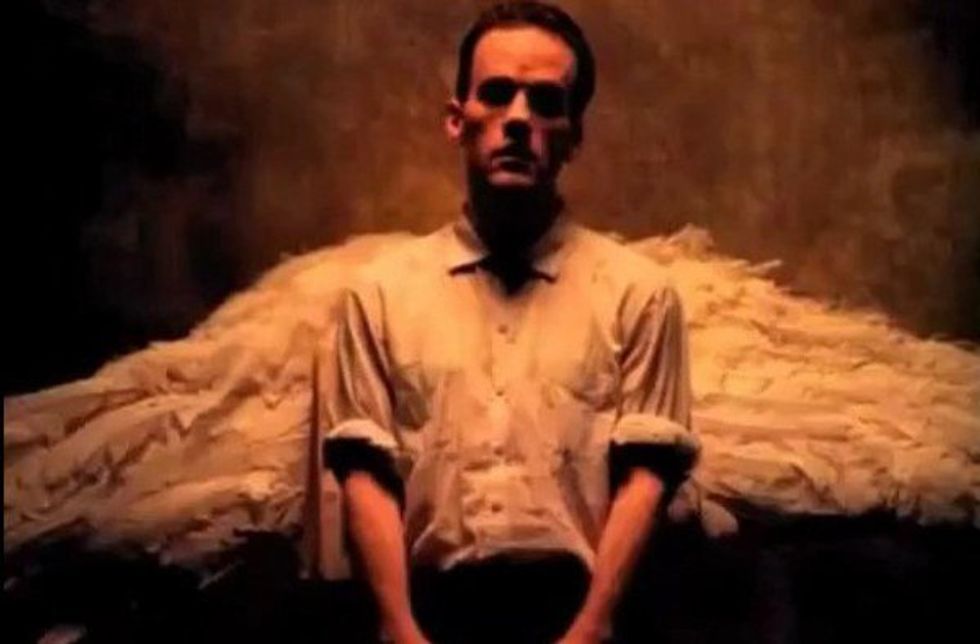
Whenever I look back on my religious journey, REM’s “Losing My Religion” always comes to mind. As Michael Stipe describes in the song, he comes to the end of his rope, or “loses his religion.” In my own experience, I had to come to the end of my rope to both lose and find my religion.
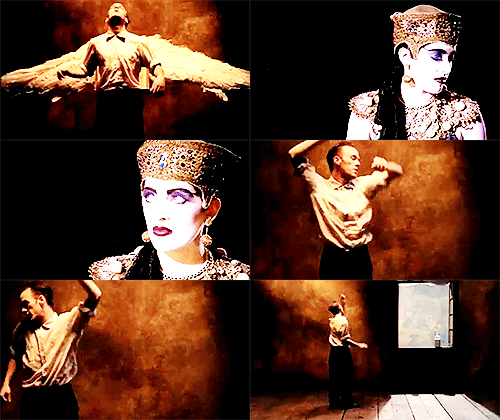
I have often found myself at a spiritual crossroads—to believe or not to believe? For a long time, I chose the latter. “What’s the point?” I agnostically exclaimed in lieu of more sinister feelings of being forsaken and neglected.
I was raised Christian—Presbyterian, to be more specific. I attended church regularly, my mother was a deacon and very active in the church. Memories of vacation bible school and youth group make up most of my childhood. It wasn’t until my confirmation at 13 years old that I began to really question my beliefs. I recall explicitly having a conversation with my mother about the Presbyterian church’s belief in predestination and my issues with the concept. I never really fully accepted the Presbyterian doctrine, but I went through with confirmation, mostly to satisfy my mother. Soon afterward, I stopped attending church, dropped out of youth group programs and started to really ponder the point of religion.
To preface, my first introduction to religion was exposure to the divisiveness of it.
My mother and my father left the Church of Latter Day Saints, avoiding pressures to marry soon after they started dating. So they left, completed college and married four years later, at their own pace. However, my father’s family remained devout Mormons and did not take kindly to this breach of faith. For years, a strong division between my father’s family and ours led us to rarely see each other. To be clear, I have no issues with the LDS Church, in fact, I think their mission is wonderful and they do a lot of good for a lot of people. The truth is, I do not have any issue with any specific religion. Rather, my issue lies within the mental rigidity and sectarianism religion often begets. After my birth, my father’s mother and family became more accepting of our family and many of the prejudices of the past—on both sides—dissolved. Still, I remember feeling like an outsider at family reunions, holidays and even my grandfather’s funeral. I cannot put my finger on an explicit reason. No one ever forced their religion down my throat nor did they criticize my own. But, still I couldn’t help but feel different or lesser.
I love my family dearly, never do I think they’d judge me or make me feel different out of malice. Sometimes, it’s just a by proxy result of religious beliefs. If you believe your faith is the only way to salvation, how could you not want your family and loved ones to subscribe to that religion? Or you’re left feeling sorry for their inability to be ‘saved’ if they don’t.
This is where religion becomes especially tricky for me. The concept of a selective ‘heaven’ that only accepts followers of a specific doctrine bothers me. Jewish? You’re out. Hindu? Out. Non-religious? Out. It is unfathomably difficult for me a.) to subscribe to and b.) want to subscribe to a heaven or salvation of such intolerance.
So, what am I left to believe in? Will I be saved from my transgressions? Do I even want to be saved? From what? For years, I’ve laid awake hours on end pondering these very questions. Still, in an inability to really answer them, I always fell back to the agnostic resolution—Who Cares? Why do I need religion or a higher power? What has he/she/it ever done for me?
Agnosticism worked well for most of my teenage to young adult years until it didn’t. In my previous article, I discussed part of my story. I’ve been through a lot, seen a lot of things I wish I could forget and done even more things I wish I could take back. However, a common theme throughout my life and my addiction has been martyrdom—I am the most forsaken, the most neglected. I’ve become a victim of my own device. Everything I have ever done is your fault, not mine. I am the innocent one.
This mindset fueled and already raging anti-God fire inside of me. If there even was a God, I hated him. How could he let these terrible things happen to me? What sick son-of-a-bitch would make someone live this life? I had intentionally been dealt a bad hand, and God was the dirty dealer.
This continued even into my sobriety. I was up for a rude awakening at my first Alcoholics Anonymous meeting, as mentioned of God filled the rooms and the program required a ‘spiritual awakening.’ “We came to believe in a power greater than ourselves who could restore us to sanity?” Ha, cute.
I attempted my first go-round at the 12 steps without a higher power (I don’t recommend this). Without knowing it, I made myself the higher power.
However, my flaws and imperfections quickly led me back out two weeks later. Finally, out of pure desperation for a one-way ticket out of a little place I call rock bottom, I suddenly realized, or was ‘spiritually awakened,’ and my hypocrisy was exposed. I could no longer hide behind my martyrdom. I am the one to blame, I am the one who has to own what I have done. Additionally, in my own anger and hatred towards G-O-D, I had been perpetuating the very intolerance I found repulsive in the first place. I had been close-minded, judgmental and self-preaching in my mix of hatred and apathy towards religion. In typical Chelsea fashion, this realization that I had been wrong this entire time and a lack of willingness to own what I had done, I became even angrier. The religious double-bind damned if I do believe, damned if I don’t made me retreat even further into my rollercoaster of either complete apathy or extreme hatred.
It wasn’t until my last relapse that I began to realize that there might be a solution in not knowing exactly what the solution is. Religion and sectarianism do not have to be synonymous, many of us just perpetuate such. This time around, I have decided that the only way to truly find my spirituality is to explore every single practice and do so without judgment. I may look like a fool going to Catholic mass and not knowing when to kneel or what to do with my hands, but I still try it.
I may not know any Hebrew save “Shalom!” or understand Jewish Shabbat practice, but I still try. I may not know how to pray Hare Krishna or how to tie a hijab, but I’ve still tried. And, you know what? I love it. My newfound open-mindedness and religious freedom have allowed me to meet some of the most faithful, spiritual, interesting people. Through my religious odyssey, I have gone from finding organized religion repulsive to realizing the beauty in every single one.
To this day, I am still searching. Do I feel a sense of urgency to commit to one practice? Do I feel a spiritual deficit in not yet finding a religious home? No, in fact, I’ve never felt more spiritually fit in my entire life. I have found solace in the adventure, serenity in the unknown.
I pray every day. I’m not always sure what to pray or what God I am specifically praying to, and that’s OK. I pray to a God of my understanding—a constant work in progress. For now, God to me is simply the good I see in people, the good I see in every religious practice, the resiliency of many through hardship, the serenity amongst a chaotic world and the blessings I have received that are allowing me to turn my life around. I believe in a God of tolerance and of love, a God that accepts all persons regardless of religious belief or denomination. Some may call it naive, but I call it brave. I have found a plethora of blessings in places I would never have looked before, in places my closed-mind who never have dared to go. Today, I have a God of my own creative, analytic, flawed, messy understanding, and that is OK. My God is doing for me what I have not been able to do for myself. My new spirituality is allowing me to not only survive, but thrive. And for that, I am grateful.
Remember, “Not all who wander are lost” –JRR Tolkien