


The Diagnostic and Statistical Manual of Mental Disorders is one of the go-to assessment tools that clinicians use to decide whether or not someone has a mental illness. Within the hundreds of pages dedicated to various conditions that one can experience within their lifetime, depression is something that is described as occurring within an episode or a long-lasting disorder with various symptoms.
These two conditions of the mind differ in time; a depressive episode is something that can be a part of Major Depressive Disorder and Major Depressive Disorder is categorized with symptoms being present for more than two weeks. These symptoms include, a depressed or irritable mood that deviates from the baseline, decreased interest in daily life activities, impaired function and negative views of oneself (pessimism, unworthiness or ideas of self-harm) all of which paint the portrait of someone experiencing Major Depressive Disorder or a depressive episode.
However, I’d like to believe that there is a space between having depression consistently impact you and total alleviation of depressive symptoms that isn’t discussed in the scientific or social realms of society. Because, as one recovers from any sort of illness, there are moments where the characteristics of that illness are more present or powerful than others. For this specific example, I’d like to describe it as “functional depression.”
Functional depression: not something that most of the world would find plausible, but it seems to be the only explanation for the situations that I have found myself in throughout my short experience as an adult.
Looking at me, I'm probably not pegged for someone who experiences the dark clouds of self-doubt and hopelessness; I am an honors student at a private university, I am following my passions, I am striving toward success and building a promising future for myself. I have very close friends and a stentorian family network that surrounds me. I have role models, inspirations, talent and promise for the world that I have not yet began to harness. I have potential, the potential for greatness, right before my eyes...
...There’s always a screeching “but” to follow a barreling clause like that.
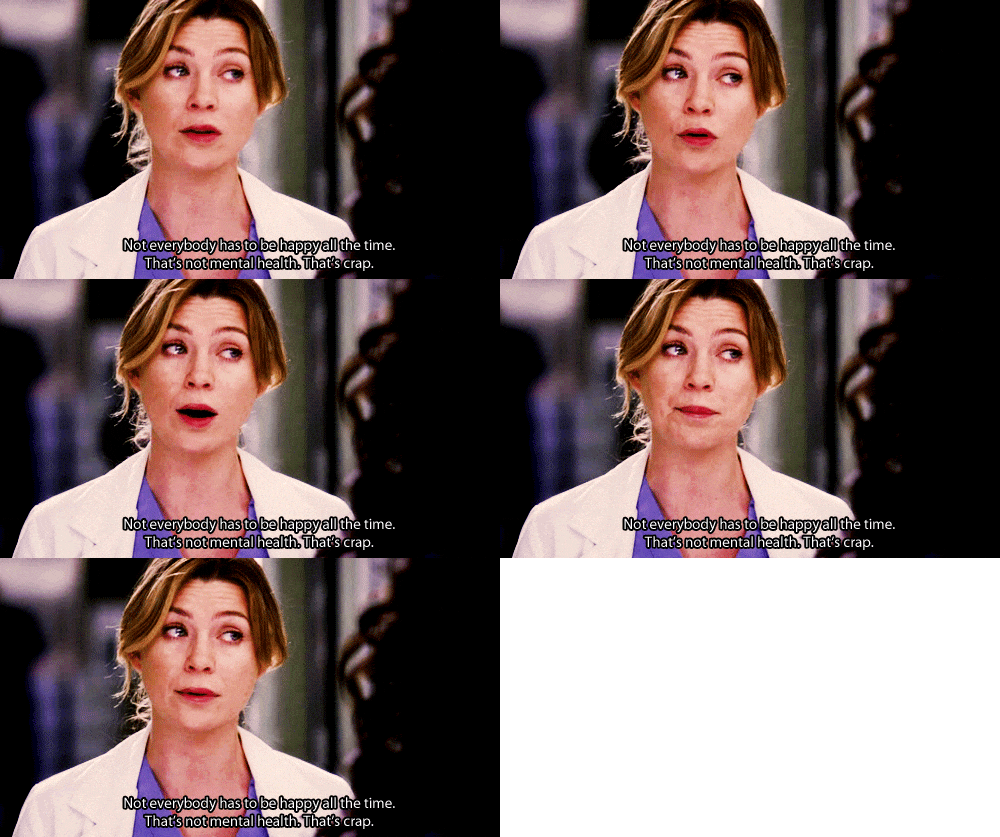
There are times where I don’t feel so (to take some phrases from "Grey’s Anatomy") “bright and shiny.” Generally, I am able to take on the world with clean perspective, a smile and a sense of purpose. On the other hand, there are also times in which I’m folded into my emotions, shadowboxing my own conscience and I feel very “dark and twisty.” Most of the time, I’m able to brush it off and muddle through the metaphorical fog that makes life hard to see.
There are more days that I don’t want to get out of bed and then there are days that I look forward to waking up. There are more times where I want to shy away from social interaction for fear that my poker face isn’t up to snuff. There are more moments that I don’t feel present in, and I resemble an emptier shell of the person who I do want to be. Those are the hard days, the days where things don’t quite match up to my emotional pace.
I was talking to one of my best friends the other night about the more recent trysts I’ve had with myself. She assured me, as she always does, that I have something to offer to the world around me, and that people who don’t stick around to see it are merely missing out on the person I will become. To her, I said this:
“I think it’s sad that the first thought that came to my mind was ‘maybe I’m something worth missing out on.’ That’s my low self-esteem and depression talking, and I know it’s not true. But, d--n, sometimes, that tiny voice isn’t so tiny.”
Quite abruptly, I was met with an epiphany that I hope to carry on my shoulders for the rest of my life. I finally learned to reason with myself, but I also learned to accept the emotions that weighed the heaviest on my heart – coping with my mental illness and my proclivity toward being depressed will always be a lifelong journey, but I had made the first few steps toward understanding what head-space I was in. I had to commit to that new perspective on my life, and I continue to apply it as I lift myself out of my own self-doubt. I want to be spunky, like a child who is riding their bike for the first time without training wheels – I wish I felt that delight all the time, but, I also know that I can’t always make it so. Without the complement to happiness, we wouldn’t know it.
American poet Susan Polis Schutz had this to say about recovering from having depression:
“Getting better from depression demands a lifelong commitment. I've made that commitment for my life's sake and for the sake of those who love me."
As I embrace the fact that I am a flawed, perfectly unwell human being, I continue to march forward hoping that the days where I feel heaviest will soon be outweighed by the days in which I feel limitless. I assert to myself that I am loved, I am worthy of being loved and I tell myself that I should love myself with as much fervor as the good people that have blessed my life.
To those out there with this same struggle, I’m here to tell you that while the world around you might not change, you can still change within that world. We are not the sole product of our environment. We are not to be known by our mental illness(es). We are much more than that.
You are much more than that.
Sincerely yours,
The light within the dark that will permeate and persist.