Imagine this scenario, adapted from the book "Stumbling On Happiness" by Harvard University psychologist Daniel Gilbert. You’re going through old boxes, and you find a bundle of savings bonds that your grandma purchased for you when you were a child. You think about cashing them in and investing in Company A, but you’re busy and never get around to it. Two years later, you learn that if you had invested in company A, you’d be one thousand dollars richer.
Here is a second scenario. You find more unforgotten savings from your grandma tucked away in a box. You decide to cash them in and invest the money into Company B. Two years later, if you had just left them alone to collect dust and interest, you’d be one thousand dollars richer.
In both scenarios, there were mistakes, but which mistake causes greater regret in the long run? Well, according to research by Daniel Kahneman and Amos Tversky, research concluded that nine out of ten participants felt more regret in the second scenario, when investments were invested badly. Fair enough, no one wants to look or feel inadequate or like a fool. Most would rather be teased for doing something embarrassing.
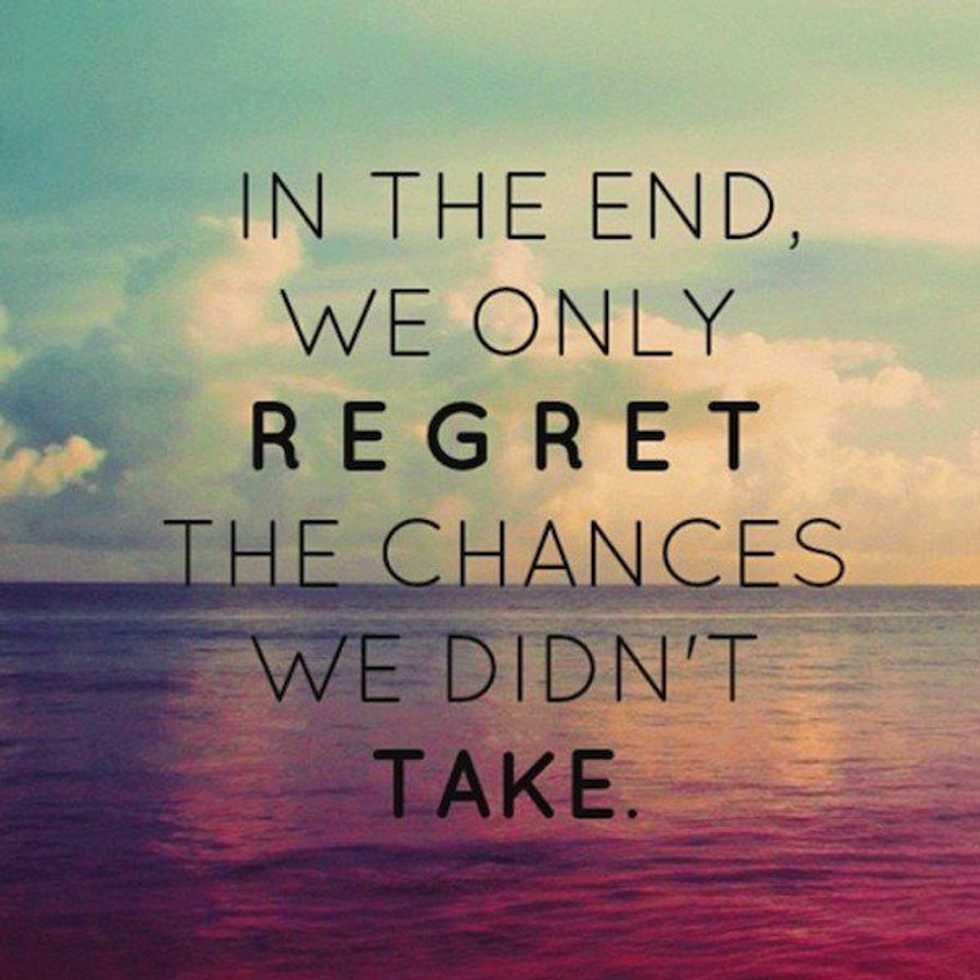
Surprisingly, most of us would be wrong, at lest in the long term. Research studies continue to to prove that we can have short-term regrets for dumb things that we do as humans, but those regrets fade quickly, usually within two weeks. But the regrets for things we didn’t do, the missed opportunities? Those have the potential to last years.
We think we’ll regret what we do, but for most, the bigger regrets are a result of the things we didn’t do, when we didn’t invest our time, money or energy. We regret not acting when we had the chance, or we regret waiting too long to act. Sometimes, we regret not reaching out to a family member, pursing a master’s degree, or not standing up to a bully. What we don’t have much regret about is the things we chose to do. Our actions usually become things that were meant to be, and even our poor choices teach us something.
But why? Why don’t people have strong regrets from their actions? Particularly, ones that induce pain and discomfort. According to a group of researchers at Cornell University, whenever we act, particularly when it’s a big decision such as going to college or quitting a job, we work the results of that decision into our life story and out understanding of who we are. It’s how we develop meaning in our lives. We create the perspective that our choices help us become who we are.
I’m not usually a person who regrets things, but for a while, in college, I had a lot of regrets that I couldn’t let go of. Ever since I remember, I dreamed about swimming in college. From the age of eight I began swimming year round, only taking minimal time off out of the year. However, I didn’t mind or think twice about what I was foregoing because at the time, swimming was what make me feel like an individual. I was mesmerized by the utter silence below the surface of the water. I loved feeling the power of my body as I raced ahead to the first flip turn of a race. I lived to shed time, even just a millisecond. The pool defined my successes in my life and made me feel balanced. When I applied to schools, I began to apply to a lot of scholarships and selling myself as a reliable, fast athlete hoping one coach would even take notice of me. Somewhere in the process, this made me lose some that spark that made me love swimming in the first place. I was no longer swimming for myself, but I continued to push through. Eventually, a coach from a small liberal arts school signed me. This brought a little spark back, but I still had a void that I just couldn’t fill. This went on for years. I tried so hard to find interest. I even started setting my phone screensavers to pictures of my favorite swimmers, hoping that there was something left.
Between my thirteen years of swimming I quit once for a long period of time, but this time was different. What was I supposed to do? I had a dream and fulfilled my goal. As a child, I was programed to be resilient and to plow through when times got tough. We live in such a society where quitting has such a negative connotation and even the thought of the word makes me shudder. I was worried about what my parents would think since they were the ones who drove me to the big swim meets and carried my swim gear to all my races. How would I tell my team that I didn’t want to swim because I honestly just didn’t want to swim anymore? All of these question swarmed my head.
Eventually, I quit. It was kind of weird at first, and honestly it’s been two years and I still feel weird about it. To me, I’m still ‘Tori the Swimmer.' I earned that title like every other swimmer that had to miss out on social events to practice for two plus hours on a Saturday or to spend their mornings doing sprints at 5:45 practice.
By quitting, it has given me more opportunities to explore other aspects of my character. I was able to join a sorority and really find a true, close group of girls that I love unconditionally. I was offered the opportunity to mentor students with Autism at my school, and it helped me find perspective on my career as a hopeful speech pathologist.
I recently have taken up swimming again, working through my first group of triathlon trainings. I appreciate the lack of competitive pressure since it has allowed me to find other outlets to get to where I want to be, and make me think of long-term goals.
If we feel beset about the actions we take, does that mean you should say yes to every opportunity? Of course not, but it’s worth paying attention to the biggest goals and shoot for them. If there is something you’ve always wanted to do, pay attention to it. The mind can generate a dozen possible regrets, but in the end ignoring that open door might be the biggest regret you make.