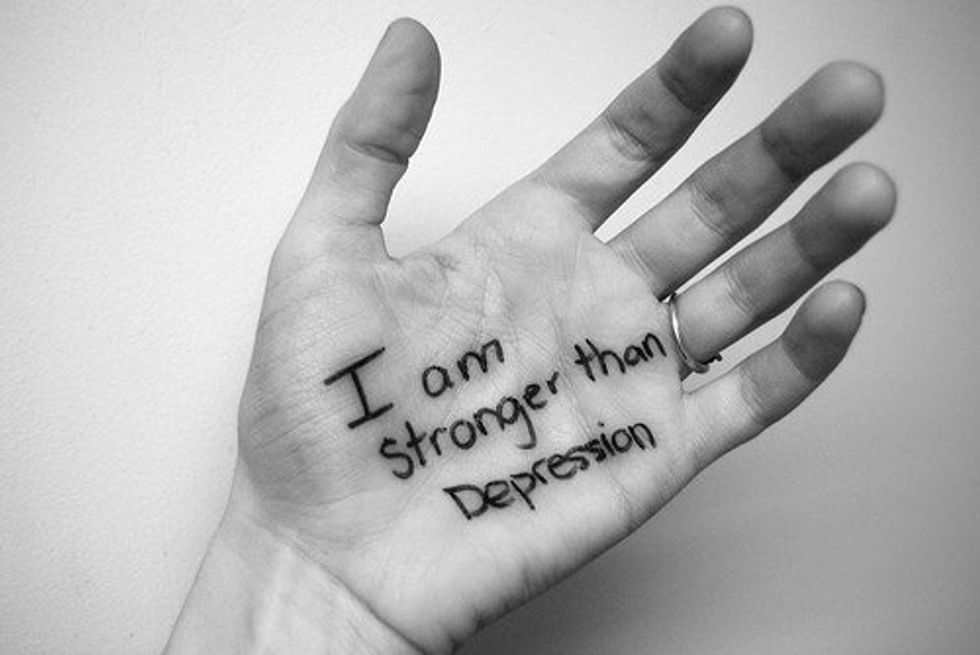
Being diagnosed with depression was for me a traumatizing and freeing thing. When the doctor looked at me and said, "What you're suffering from is severe clinical depression," I looked at my feet and thought, "Well what the hell do I do now?" I had been fighting myself for so long, and now I was being told that there was a fight to be fought, but it was against a real enemy now. I wasn't the problem. Depression was the problem. That day I started a medication that could help me, and I began to battle against the lies that depression continues to tell me sometimes, over a year and a half later.
"You're not depressed."
Before my diagnosis, I always let my depression (even though I refused to call it that at the time) tell me this lie. "I can't be depressed. I smile a lot. I have fun. I play video games. I'm funny." It took me a long time to admit that what I was feeling was depression, and by a long time, I mean years. I spent years telling myself I was okay. Calling my occasional (and getting more and more frequent) breakdowns stress-related, and crying myself to sleep when my roommate wasn't around. Even as things piled up, I told myself it didn't matter, because it wasn't about me. My friend's brother got in a car accident, and I told myself, 'It isn't about me, why am I crying so much?' Even when I found out I was having spinal surgery, and I sat on the porch comforting my crying mom, I told myself, 'Just stop. It isn't about you. Be strong and worry about yourself later.' I thought that if I made everything in my life about everyone else, I would be fine. It couldn't be depression. I didn't have time for depression. Everyone in my life needed me to hold it together. So I did that. I spent years pretending that depression just wasn't in the cards for me. I would take online quizzes at night wondering if I should ask for help, but during the day I tried to pretend I was fine and the sadness would go away, but it doesn't just go away. You have to acknowledge it and face it.
"Everybody feels this way. Sometimes. For a long time."
This is a dangerous lie to tell yourself. The longer you're depressed without treating it, the more dangerous it gets. when I was trying to tell myself that I didn't have depression, I moved closer and closer to the edge of a very dangerous cliff. Everyone feels sad sometimes, that's true, but when that sadness becomes the dominating factor in your life, something is very wrong. When this sadness interferes with parts of your life, like being able to be happy, to eat, to sleep, or even do the things you used to enjoy, it's about then that people realize it's something more than sadness. To cry once is to be sad. To do it regularly every single day? That's when it might be depression. In reality, everybody doesn't feel that way. Everyone isn't hiding from you the fact that they sit around and cry all the time. It's out of the ordinary, and thats when you should get help.
"Your friends won't care if you're not around."
When depression told me this lie, I started thinking that my friends didn't want me anymore. I started canceling plans. I started avoiding making plans. I went from being one of the most social people I knew to being someone who spent Friday nights lying in my bed while my friends ran up and down the halls in my dorm. I stopped eating meals with my friends, and settled on not eating at all. When they called and asked what I was doing, I lied and said I was too busy. I justified this by pretending they didn't want me around. When you turn down enough invitations, the invitations stop coming, and it becomes easier to tell yourself no one wanted you around anyways.
"Being alone is better anyway."
When the invitations stopped coming, I told myself, who cares? Being alone is the best thing for me when I'm feeling super down anyways. I don't have to be around people. I don't have to answer their questions. I can just sit and cry and no one will be bothered. This is how it's supposed to be, because my depression told me...
"You are a burden."
I believed this lie. I internalized it. I allowed it to become fundamental to who I was. When I was avoiding my friends, I told myself it was because they didn't need me and I was too much for them. Every time they asked me how I was feeling, I thought they were doing it because common courtesy says we should ask. So instead of saying, "Today is a battle in my mind and I don't know if I'm winning," I would say, "Hey, I'm good, how are you?" But believing you're a burden is so dangerous. It's dangerous to you, and your mental health, and your struggle to get better. You're not a burden. You're a person, and people are not burdens. I avoided family, and friends, and even therapists because no one realized they needed to tell me I mattered. But I did need to hear it, because I do matter. So do you, and everyone else who's fighting some dark quiet fight. We are not burdens. We are important.
"This isn't worth it."
On my best days, I can't hear this. On my worst days, this is all I hear. I hear this screamed at me from every angle of my mind, but this isn't true. It is worth it. All of it is worth it. My life is worth it. My friends are worth it. All the time I've put into this life and will put into this life is worth it. Some days I'm curled up on my bed with a pillow over my head trying to avoid this voice, because this life is worth it. Sometimes it helps to remember what you're holding on to. For me, I hold onto this poem. This poem was the wake-up call that I needed in my darkest days. You sometimes have to think about the things that are worth it. For me it was my friends. I imagined this poem was written from them to me, and that helps me. Everyone isn't going to be the same, but sometimes you need to find what's worth it to you. Maybe you don't want your dog to miss you. Maybe your major needs something only you can contribute to it. Whatever it is, in your darkest days, you can cling to it, because that thing, whatever that thing is, is worth it. This fight is worth it. You are worth it.
"You can do it all alone."
No. You can't. Depression's best asset is it's ability to get you alone and beat you down. You push away your friends and your family to spare them the pain, but it doesn't help. It makes things worse. You can't do this alone, and you shouldn't try. It's not that you aren't strong enough. It's that you don't have to be. You should keep your friends close. They're the most helpful thing you have in your arsenal against depression. Every friend isn't going to be able to understand your depression, but they don't all have to be good at it. You just need to have a couple good friends. I call my friends my God given solace, because they hold me down when I feel like I'm floating away. They throw me a life saver when I feel like I'm drowning. Fighting depression takes an army sometimes, and you have to find yours, whether it consists of one good general or a hundred well trained foot soldiers. You must find your army.
"There's nothing you can do about depression. Nothing."
When my doctor explained to me how depression worked, he said it wasn't my fault. I didn't make it myself. I didn't earn this. Depression is created by a couple different things, from the situations in your life to the chemistry in your brain being off enough to mess you up. To me, that sounded like something I can't change. I didn't make my life this way. I didn't throw my brain out of whack. And if I didn't do that to myself, then there is nothing I can do to fix it, but that isn't true. There are ways to control depression. Lifestyle changes are useful. No alcohol, because depressants don't help depression. Sleeping more, because a well-rested brain does better. Working out because it gives you endorphins, which make you happier. Avoiding unnecessary stressors, because excessive stress is counter productive. Therapy helps a lot of people, because sometimes talking can help fix a lot of things. Then there's medication to set your brain chemistry right again. Some people only need one of these things. Some people utilize all three. There is so much you can do about depression, and you shouldn't let it convince you otherwise. You are not helpless, even when depression says...
"You don't deserve to get better anyways."
Depression makes you feel worthless. I spent so long convinced, even once I was diagnosed, that there was no reason for me to improve. This was life's payback for not seeing my best friend when I was ten years old for two months before he died. This was karma for the time that I had disappointed my manager at work by being disrespectful during a work meeting. This was what I had earned because I had still been in love with my first significant other when we broke up the first time, and when we broke up the second time, so the world was giving me a fraction of the pain I'd been giving out. But that's just some crap that the depression fed me so it could hold me tighter. I don't deserve this. You don't deserve this. No one deserves depression. It's just something that you have, and you have to remind yourself that you did not earn it, no matter what you've done.
"They have it worse, so you have no right to be in pain."
This lie is so easy to believe, because people tell you it all the time. "I mean, maybe you're depressed, but there are kids in Africa who can't eat." "I understand you're sad, but there was a shooting in a school. You could have been one of those kids but you're alive." "The chances of any of us even being made is so miraculous, you should just be thankful." If you are depressed, stop listening to these things. They will not comfort you. If you are not depressed, stop saying these things. They will not comfort me. Walk up to the next person you see with a broken leg and say, "Well my friend broke both his legs, so you shouldn't really complain about the pain." Or maybe go up to someone who had a heart attack, "Well at least you haven't had two heart attacks like lots of other people have." Stop this. It is not useful. It's not helpful. It is not a good thing to do.
"The depressed version of you is the real you."
My biggest problem with depression was the person it made me become. I've always been a good person. Confrontational when I needed to be, believed in the good in those around me, couldn't hold a grudge and was rarely ever angry. Depression changed so many things about me. It made me angry, withdrawn, irritable, and indifferent all at once. When things didn't go well, I didn't give a damn. When people told me they cared, I called them liars. There was so much about my personality that just changed when I was depressed. I became convinced that that was just the real me. That is not me. That is not who I am. It is not who you are. You are not created or remade or unmade by your depression. It is not the biggest thing about you, and it is not the real you. Do not think that the sad, hurt, angry person you might become when you're down is who you've always been. That is not true, and that will never be true. You're still there. You're still exactly who you've been.
"There is no hope."
This is what I more than anything want you to quit thinking about. This is what I want to quit thinking about. There is always hope. For something. There's hope that tomorrow the sun won't just rise, but it will shine through the clouds. There's hope that tomorrow your friend will smile at you and you'll remember that time you laughed for ten minutes over the stupidest joke you've ever heard. There's hope that tomorrow you'll get asked out by the cute girl or boy in class and instead of saying great or cool you'll say, "Grool." As long as you are here, there is hope. Hope that things will improve. That you will improve. That tomorrow you'll learn the perfect coping strategy. That tomorrow is the day the doctor finds the perfect mix of medication that allows you to stay on solid ground instead of sinking through the quicksand. There is hope for me. There is hope for you. As long as you're alive, tomorrow holds nothing but hope.
Don't give up.
This isn't a lie my depression told me. This is a mantra that I've given myself. I say it to myself. I say it to my residents. I say it to my students when they don't want to do an assignment. This article is for me, but it's also for you. You're not alone. You're never alone. Don't give up. If you're ever in need of help, the number to the National Suicide Prevention Hotline is 1-800-273-8255. It's manned 24/7, and you just need to remember. Don't give up.